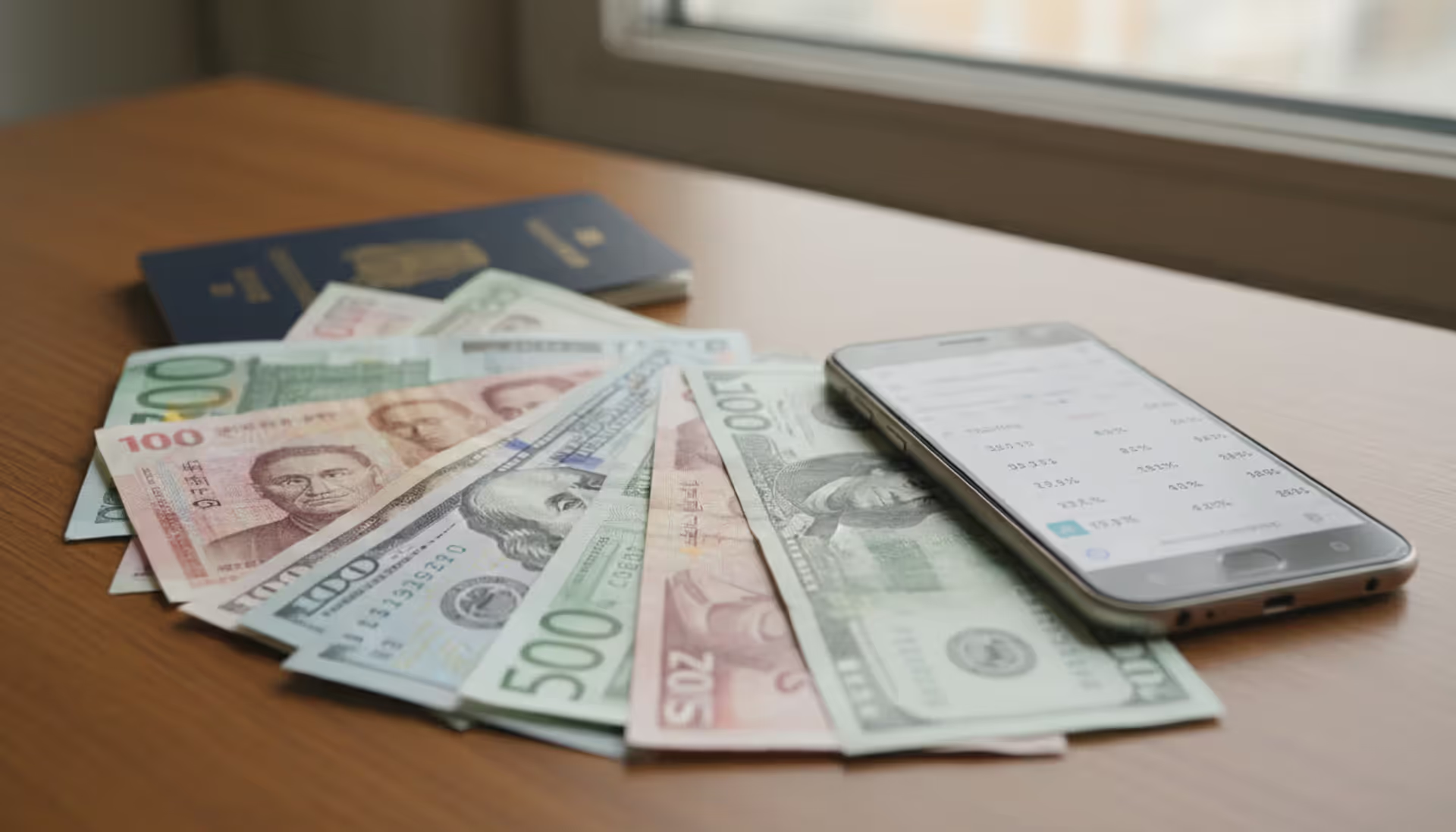
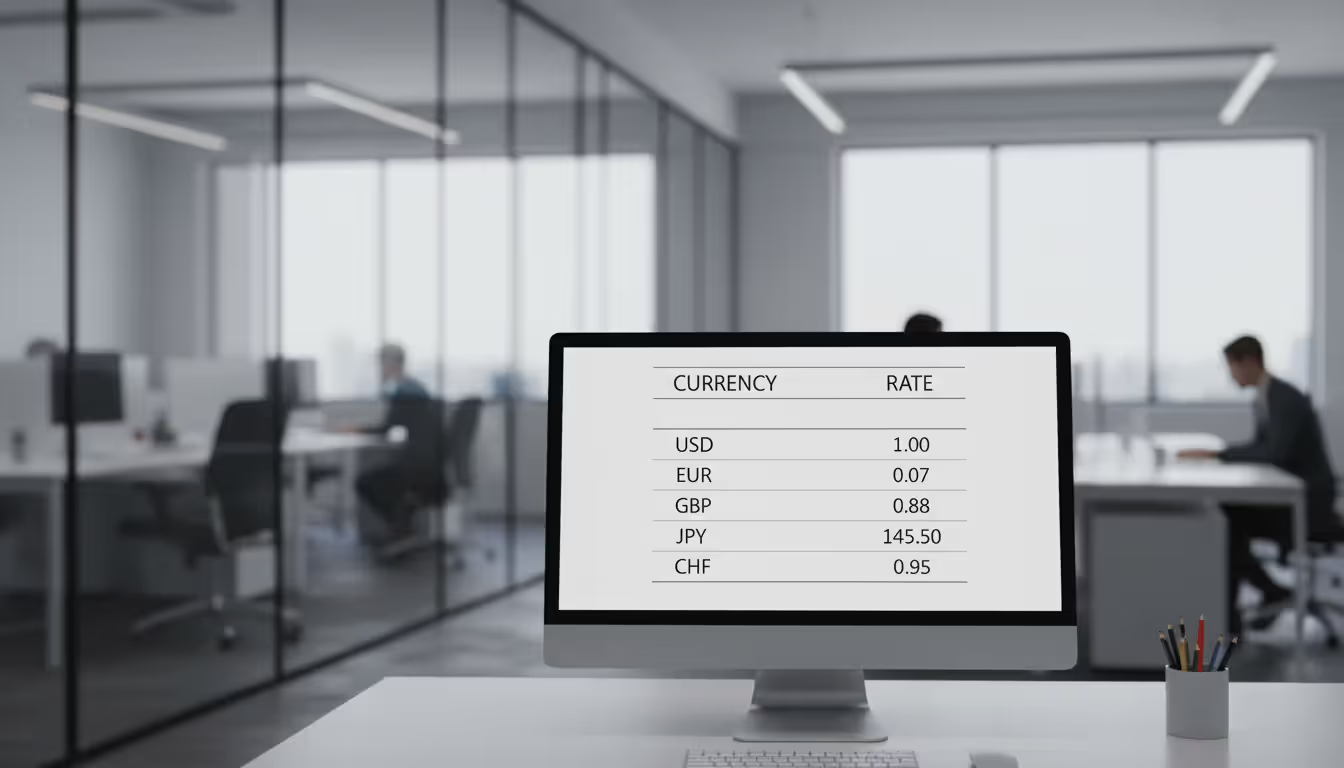
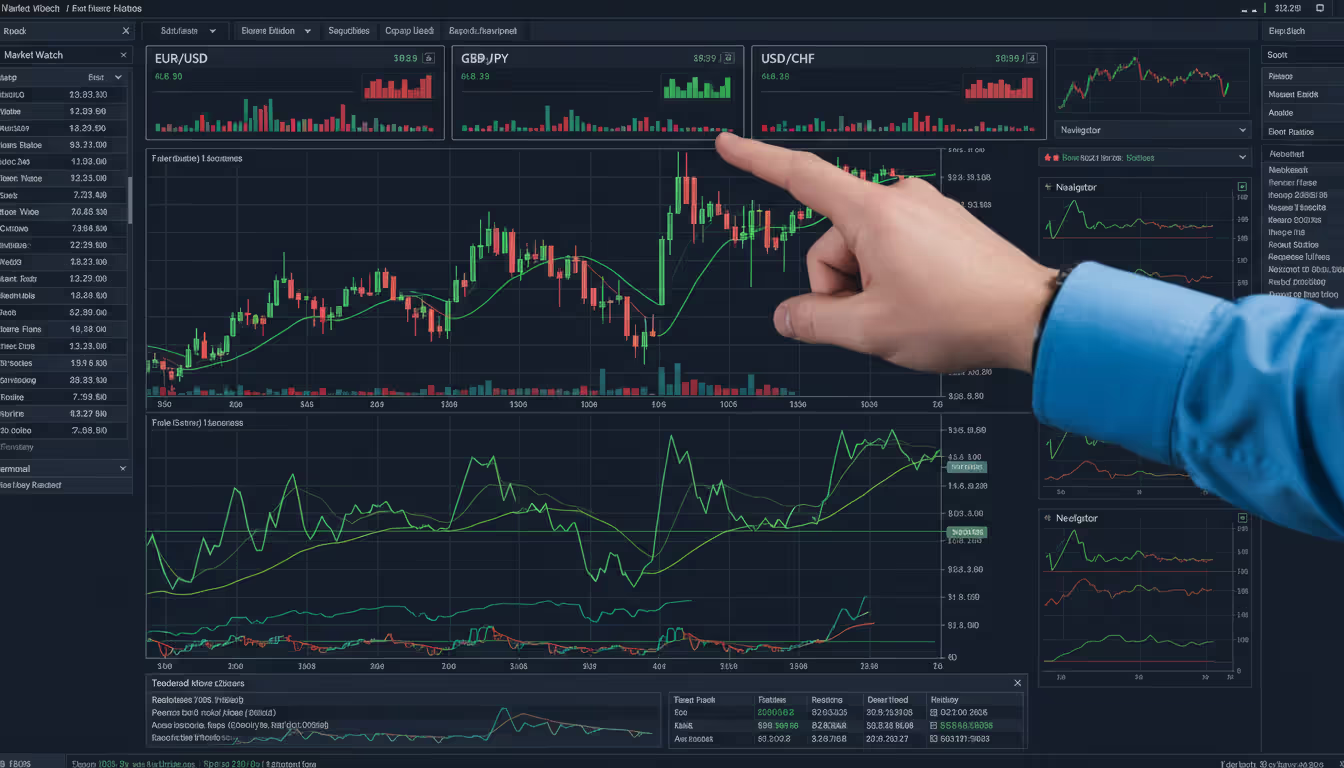
You're at an airport kiosk, staring at an exchange rate board covered in symbols and three-letter abbreviations. Or maybe you're reviewing an invoice from an overseas supplier, trying to figure out whether that price is in Singapore dollars, US dollars, or Hong Kong dollars. These moments happen more often than you'd think—and knowing how to decode currency notation saves you from costly misunderstandings.
Money markers have a surprisingly complex history. They started as merchants' shorthand in ledger books, evolved through centuries of international trade, and eventually got standardized by global financial institutions. What we use today is part ancient tradition, part modern bureaucracy—a hybrid system that works remarkably well once you understand its logic.
What Currency Symbols Represent
Think of currency symbols as the emoji of finance—compact visual markers that communicate meaning faster than words. Instead of writing out "forty-five British pounds sterling," you see £45 and instantly grasp both the amount and the currency. This compression becomes crucial on price stickers, mobile screens, receipts, and anywhere else space comes at a premium.
But where did these little glyphs originate? The stories vary wildly. Some evolved from stylized letters—the pound sign (£) descends from an ornate capital L representing "libra," a Roman unit of weight. Others emerged from merchant abbreviations scrawled so often they became standardized. The yen symbol (¥) started as a Latin letter Y with extra strokes added, representing the currency's name when romanized.
Here's something most people don't realize about what currency symbols mean: they're cultural artifacts as much as practical tools. When India unveiled ₹ in 2010, it wasn't just about convenience—the new rupee symbol represented economic ambition, a visual declaration of India's growing financial clout. Similarly, Russia's adoption of ₽ in 2014 signaled a desire for international recognition beyond Cyrillic script.
Author: Olivia Kensington;
Source: martinskikulis.com
The contrast between symbols and codes runs deeper than you might guess. Symbols favor speed and recognition—you spot € in a shop window and know immediately you're dealing with euros. But that same brevity creates ambiguity. The dollar sign represents currencies from more than twenty countries. Is that $ referring to Jamaican, Canadian, or US dollars? The symbol alone won't tell you.
Before printing technology standardized these marks, financial clerks improvised. You'd find dozens of variations for the same currency depending on which merchant house or bank issued the document. The printing press changed everything—suddenly, typesetters needed consistent characters that could be reproduced identically across thousands of copies. This technological constraint drove the formalization of currency symbols into the shapes we recognize today.
Most Common Currency Signs You'll Encounter
The Dollar Sign ($) appears in more contexts than any other currency marker. Americans automatically associate it with their own money, but Australians, Canadians, Mexicans, and New Zealanders claim it too. In American style, you'd write $250—symbol first. Quebec's French speakers often reverse this to 250$. When a document discusses multiple dollar currencies simultaneously, prefixes become essential: MX$250 versus US$250. Without that clarification, you're guessing.
The Euro (€) grew from committee design in the 1990s, crafted to look recognizable across all European languages. Twenty countries share this currency today, but they can't agree on symbol placement. Germans write 50 €, the Irish prefer €50, and both are correct within their regions. This quirk reflects the compromise at the euro's heart—unified money, preserved local customs.
The British Pound (£) traces back to Roman times through its name "libra." That fancy L-with-a-crossbar appeared in English financial documents by the medieval period. Britain always puts it before the number: £180, never 180 £. Brexit hasn't diminished the pound's presence in global finance—London remains a major forex trading hub, so you'll encounter this symbol constantly in international markets.
The Japanese Yen (¥) uses a character that looks deceptively simple—two horizontal strokes through a Y. Japanese practice puts it before amounts: ¥5000. Here's where confusion creeps in: China's yuan shares this exact symbol. In casual contexts where the currency is obvious, no problem. In an international commodity contract? You'd better use JPY versus CNY codes to avoid a very expensive misunderstanding.
The Indian Rupee (₹) got its modern symbol just over a decade ago, mixing Devanagari script with Latin letters. Before 2010, Indians wrote "Rs" or "Re," neither of which worked well in global commerce. The new symbol's adoption took time—fonts needed updating, keyboards required new mappings, businesses had to modify their signage. It's a reminder that changing currency notation involves far more than just picking a pretty design.
The Russian Ruble (₽) joined the symbol club in 2014 after a public competition and government approval. The design combines the Cyrillic P with a horizontal bar. Despite official recognition, "руб" and "RUB" still dominate actual usage, especially outside Russia. Creating a symbol is the easy part; getting the world to adopt it takes decades.
Beyond these major players, you'll run into Swiss francs (sometimes shown as CHF, sometimes as Fr.), Brazilian reals (R$), Korean won (₩), and Turkish lira (₺). Each carries positioning rules that matter to locals—put the symbol in the wrong place and you'll signal yourself as an outsider.
Positioning isn't random, despite how it might seem. Languages influence these patterns. Romance language speakers say "fifty euros," so they write 50 €—the spoken order matches the written one. English treats currency symbols as adjectives that modify numbers, placing them first: £50, $50. Neither approach is superior; they're just different linguistic traditions frozen into financial notation.
How ISO 4217 Currency Codes Work
In 1978, financial institutions faced a serious problem: international wire transfers kept getting botched because symbols created confusion. The solution came from ISO, which established a three-letter coding system that eliminated ambiguity. Every currency got a unique code—no exceptions, no overlap.
The three-letter structure follows predictable logic most of the time. Grab the two-letter country code, add a letter from the currency name, and you've got it. US + D = USD. GB + P = GBP (the P stands for pound). JP + Y = JPY. This pattern makes codes somewhat intuitive even when you're encountering one for the first time.
Author: Olivia Kensington;
Source: martinskikulis.com
Exceptions exist, naturally. EUR doesn't refer to a single country because euros circulate across twenty nations. CHF looks weird until you learn it stands for "Confoederatio Helvetica Franc"—Switzerland's Latin name. XAU represents gold (not a country at all), XAG means silver, and XXX indicates "no currency" in database systems.
The system includes more than just letters. Each code gets a numeric equivalent: USD is 840, EUR is 978, JPY is 392. These numbers work better in systems that can't handle text efficiently. The standard also specifies decimal places—how finely each currency subdivides. Most currencies use two decimal places (cents, pence). Japanese yen uses zero (you don't split yen into smaller units in practice). Kuwaiti dinars divide into 1000 fils, requiring three decimal places for accurate accounting.
What is ISO 4217 beyond technical specification? It's the infrastructure enabling trillions in daily cross-border transactions. When someone in Brazil pays a supplier in Thailand, correspondent banks route that payment through multiple intermediaries. Every institution in that chain needs to know exactly which currencies are involved. Codes make that certainty possible.
Difference Between Currency Symbols and ISO Codes
Symbols win for customer-facing interfaces. Your e-commerce site shows "$49.99" because that's what shoppers recognize instantly. Nobody wants to see "USD 49.99" on a product page—it feels clinical, overly formal for a retail context.
Codes dominate backend systems and professional communications. Banks never process transfers using symbols. Imagine the chaos: a payment marked with "$" could mean twenty different currencies. The receiving bank wouldn't know whether to credit US dollars, Canadian dollars, or Australian dollars. GBP, CAD, AUD—codes eliminate that guesswork entirely.
Accounting platforms illustrate this split perfectly. QuickBooks displays dollar signs in reports you'll show clients. Behind the scenes, it stores every transaction with proper currency codes, enabling accurate multi-currency consolidation. That separation lets businesses present information appropriately for each context—friendly for humans, precise for machines.
Reading Currency Pair Notation
Currency pairs show up constantly in forex markets, bank rate sheets, and financial news. The format looks like EUR/USD or GBP/JPY—two codes separated by a slash. The meaning: how much of the second currency does one unit of the first currency buy?
Take EUR/USD at 1.08. This tells you one euro purchases 1.08 US dollars. Got €500 to convert? Multiply: 500 × 1.08 = $540. The first currency (EUR) is your base—the reference point you're measuring from. The second (USD) is the quote—what you receive in exchange.
Order matters enormously. EUR/USD and USD/EUR are mathematical inverses. If EUR/USD sits at 1.08, then USD/EUR equals roughly 0.926 (calculated as 1 ÷ 1.08). Flip the pair and you flip the calculation. Misreading the direction in a business deal can turn a profit into a loss instantly.
Author: Olivia Kensington;
Source: martinskikulis.com
Major pairs always include USD: EUR/USD, USD/JPY, GBP/USD. These represent the highest trading volumes because the US dollar dominates international finance. Cross pairs skip the dollar entirely—EUR/GBP, GBP/JPY—useful for businesses operating between two non-dollar economies, though typically harder to trade due to lower liquidity.
Complete List of Currency Symbols by Region
Below you'll find marks and codes for currencies accounting for the vast majority of global forex activity and trade settlements:
Symbol
ISO Code
Currency Name
Country/Region
$
USD
United States Dollar
United States
€
EUR
Euro
20 EU member states
£
GBP
British Pound Sterling
United Kingdom
¥
JPY
Japanese Yen
Japan
¥
CNY
Chinese Yuan Renminbi
China
₹
INR
Indian Rupee
India
$
CAD
Canadian Dollar
Canada
$
AUD
Australian Dollar
Australia
Fr.
CHF
Swiss Franc
Switzerland, Liechtenstein
₽
RUB
Russian Ruble
Russia
R$
BRL
Brazilian Real
Brazil
₩
KRW
South Korean Won
South Korea
$
MXN
Mexican Peso
Mexico
kr
SEK
Swedish Krona
Sweden
kr
NOK
Norwegian Krone
Norway
kr
DKK
Danish Krone
Denmark
zł
PLN
Polish Zloty
Poland
$
NZD
New Zealand Dollar
New Zealand
$
SGD
Singapore Dollar
Singapore
$
HKD
Hong Kong Dollar
Hong Kong
₺
TRY
Turkish Lira
Turkey
R
ZAR
South African Rand
South Africa
₪
ILS
Israeli New Shekel
Israel
฿
THB
Thai Baht
Thailand
Rp
IDR
Indonesian Rupiah
Indonesia
RM
MYR
Malaysian Ringgit
Malaysia
₱
PHP
Philippine Peso
Philippines
د.إ
AED
UAE Dirham
United Arab Emirates
﷼
SAR
Saudi Riyal
Saudi Arabia
KD
KWD
Kuwaiti Dinar
Kuwait
$
ARS
Argentine Peso
Argentina
$
CLP
Chilean Peso
Chile
$
COP
Colombian Peso
Colombia
Kč
CZK
Czech Koruna
Czech Republic
Ft
HUF
Hungarian Forint
Hungary
lei
RON
Romanian Leu
Romania
₴
UAH
Ukrainian Hryvnia
Ukraine
₦
NGN
Nigerian Naira
Nigeria
EGP
EGP
Egyptian Pound
Egypt
Dh
MAD
Moroccan Dirham
Morocco
These currencies combined represent the overwhelming bulk of forex market turnover. Smaller regional currencies not listed here often peg to one of these major ones or operate mainly within domestic borders.
Where Currency Abbreviations Are Used
SWIFT networks—the arteries of international banking—won't touch currency symbols. Every cross-border wire transfer specifies three-letter codes exclusively. Your bank sending €1,000 to Germany? The SWIFT message contains EUR, never €. This uniformity prevents misrouting across the hundreds of banks involved in correspondent banking networks worldwide.
Forex platforms show screens packed with currency pairs: USD/JPY, EUR/GBP, AUD/CAD. Traders monitoring dozens of pairs simultaneously need instant clarity—symbols would create visual ambiguity, especially for currencies lacking distinctive marks. Price feeds, algorithmic systems, and historical databases all standardize on codes because consistency matters more than brevity in these contexts.
E-commerce sites walk a tightrope between user-friendly displays and technical accuracy. Product pages show €29.99 or $49.95 because customers recognize symbols quickly. Checkout systems and payment processors switch to codes—EUR and USD—to ensure payment gateways route transactions correctly. Behind every symbol you see on screen sits a code in the database.
Accounting platforms like Xero, FreshBooks, or SAP handle this elegantly. Store everything with currency codes internally. Display symbols in user interfaces based on regional settings. A French user sees 100 €, an American sees $100, both pulling from the same USD-tagged record. This architecture lets one system serve global users without sacrificing precision.
Travel contexts blend both conventions liberally. Airport exchange desks post rates using codes (USD/THB: 35.2), but their service fees appear with symbols (€5 commission). Your credit card statement lists foreign transactions with three-letter codes so you can track which currency each charge occurred in—crucial for understanding foreign transaction fees that might get added later.
Financial journalism defaults to codes almost universally. A Wall Street Journal article discussing exchange rate movements writes "GBP gained against USD" rather than attempting symbol-based prose. This convention avoids confusion in stories distributed globally, where readers might misinterpret symbols based on local associations.
Common Mistakes When Using Currency Signs
Placement fumbles trip up even experienced professionals. An American writing for German clients might default to €50 (symbol-first) when German convention demands 50 €. Neither is technically wrong in international commerce, but it immediately marks you as unfamiliar with local norms. Similarly, writing 100$ in US contexts flags you as inexperienced—Americans always put symbols before amounts.
Symbol confusion causes genuine financial errors. Contracts specifying "$5,000" without clarification could mean US, Canadian, Australian, Hong Kong, or Singapore dollars—currencies with vastly different values. That ambiguity in an international contract can lead to litigation. Always clarify: US$5,000 or AUD$5,000. Those two extra letters prevent expensive disputes.
Mismatched symbols and currencies appear surprisingly often in rushed writing. "Japan's economy strengthened, boosting the $" makes zero sense—Japan uses yen. This typically happens when writers conflate different Asian economies or copy-paste from multiple sources without careful editing. It destroys credibility instantly.
Author: Olivia Kensington;
Source: martinskikulis.com
Inconsistent formatting throughout documents looks sloppy. Pick a system—symbols or codes—and stick with it. Don't write "USD 100" in one paragraph and "$100" in the next unless you've got a specific reason for the shift. Financial documents demand consistency because readers assume variation signals intentional distinction between different amounts or currencies.
Decimal notation differences create serious ambiguity internationally. Americans write $1,234.56 (period for decimals, commas for thousands). Much of Europe flips this: $1.234,56. In international documents, that difference transforms $1,500.00 into $1.50 or vice versa depending on how readers interpret the punctuation. For critical figures in global contracts, spell out amounts in words as backup, or use unambiguous notation like 1500.00 USD.
Assuming universal symbols leads to awkward improvisations. Many currencies—particularly from smaller economies—lack widely recognized symbols. The Botswanan pula, Mauritian rupee, and dozens of others use letter abbreviations (BWP, MUR) rather than unique glyphs. Attempting to invent symbols or using unclear shorthand just confuses readers. Stick with ISO codes when a proper symbol doesn't exist.
Spacing irregularities matter in professional typesetting. Some style guides demand non-breaking spaces between symbols and amounts (€ 50) to prevent line breaks splitting them across rows. Others omit spaces entirely (€50). Both approaches work—but pick one and apply it consistently. Mixed spacing looks amateurish and suggests inattention to detail.
Standardized currency notation forms the backbone of confidence in cross-border finance. Consider a Singapore bank processing payments between Brazilian suppliers and Japanese manufacturers—ISO 4217 codes guarantee those instructions execute precisely as intended, with zero room for misinterpretation. That reliability underpins the trillions flowing across borders daily, making modern international trade possible at unprecedented scale
— Michael Torres
Frequently Asked Questions About Currency Symbols
How do currency symbols differ from currency codes?
Symbols are visual shortcuts—€, £, $—designed for quick recognition on price tags, receipts, and storefronts. They're usually one character, sometimes two, optimized for everyday commerce where context makes the specific currency obvious. Codes are three-letter standardized designations like EUR, GBP, USD created by ISO 4217 for banking systems, international contracts, and situations where precision trumps brevity. The key difference: symbols favor speed and familiarity, codes favor accuracy and global consistency. Use symbols when your audience knows which currency you mean, codes when ambiguity could cause problems.
Why would multiple countries use identical currency symbols?
History explains most sharing. The dollar sign spread across former Spanish colonies and British Commonwealth nations—each developed their own dollar currency but inherited the same symbol from colonial trade. Creating new symbols requires global coordination, Unicode adoption, font support, and years of cultural acceptance. Easier to share an existing mark and add prefixes (NZ$, CA$, SG$) when clarification becomes necessary. The yen/yuan symbol sharing reflects linguistic connections—both names romanize to words starting with Y, so they adopted the same Latin-derived mark. Different currencies, shared notation—context usually clarifies which one applies.
What's the origin story of the dollar sign?
Most historians point to the Spanish peso, abbreviated "Ps" in colonial American commerce during the 1700s. Handwritten repeatedly, the P and S merged—the S's vertical line passing through the P, eventually simplifying into $. Alternative theories exist: some claim connection to the Pillars of Hercules depicted on Spanish coins, others to "US" abbreviations becoming stylized. The peso theory has stronger documentary evidence in American ledgers from the period. Regardless of precise origin, the symbol predates the US dollar itself—it was already common in American accounting when the dollar became official US currency in 1792.
How should I interpret currency pair notation like EUR/USD?
The pattern XXX/YYY answers "how many YYY units equal one XXX unit?" EUR/USD at 1.08 means one euro buys 1.08 US dollars. The first code (EUR) is your base—the starting point. The second (USD) is the quote—what you're measuring against. Converting €200 at that rate: multiply 200 × 1.08 = $216. The order matters crucially. Flip it to USD/EUR and you're asking how many euros one dollar buys—approximately 0.926 if you calculate 1 ÷ 1.08. Misreading the direction in financial calculations can swing you from profit to loss instantly, so always check which currency comes first.
Do all currencies have symbols?
Not at all. Plenty of currencies—especially from smaller economies—rely entirely on ISO codes and lack distinctive symbols. The Mauritian rupee, Botswanan pula, Azerbaijani manat, and many others use letter abbreviations like MUR, BWP, AZN instead of unique glyphs. Creating symbols requires design work, international standardization through Unicode, font maker adoption, and cultural acceptance—expensive and time-consuming for currencies with limited global reach. When ISO codes handle all necessary functions in international finance, developing a symbol becomes optional rather than essential. Only currencies with significant international presence tend to get widely recognized symbols.
Why does ISO use three letters for currency codes?
Two letters create only 676 possible combinations—insufficient for 180+ active currencies plus historical ones and special codes. Four letters would be unnecessarily long for systems processing millions of daily transactions. Three letters provide 17,576 combinations—plenty of room for every currency, past and present, plus codes like XXX (no currency), XAU (gold), and XAG (silver). The structure (typically country code plus currency initial) makes codes reasonably intuitive. You can often guess a code even when encountering it fresh: NZ + D = NZD, BR + L = BRL. This balance between brevity and capacity explains why three letters became the standard back in 1978 when ISO 4217 launched.
Currency notation operates as a dual system—symbols for speed, codes for precision. Each serves purposes the other can't match. The € you see on a Paris menu provides instant recognition. The EUR in a SWIFT message ensures your bank transfer lands in the right account without human interpretation creating errors.
Both matter whether you're booking international travel, processing cross-border payments, building multi-currency e-commerce platforms, or simply trying to understand a foreign tax receipt. The placement rules, formatting conventions, and usage contexts aren't arbitrary trivia—they reflect centuries of commercial evolution now formalized through international standards.
The practical approach: use symbols when context is clear and your audience local, use codes when precision matters or multiple currencies might get confused, maintain consistency throughout any single document. Follow these guidelines and you'll avoid the majority of currency notation mistakes that plague international business communications.
The purchasing power of the US dollar has declined roughly 98% since 1913. While gradual erosion differs from collapse, understanding which assets retain value during currency crises provides practical preparation for scenarios that have played out repeatedly throughout monetary history
Volatility determines profit potential and risk in forex trading. Some currency pairs swing hundreds of pips daily while others barely move. This guide examines which pairs exhibit the highest price fluctuations, why certain currencies are more volatile, and how to trade them effectively with proper risk management
The forex market processes $7.5+ trillion daily, yet a handful of pairs dominate volume. Learn which currency pairs traders prefer, why EUR/USD captures 24% of global transactions, and how liquidity, spreads, and volatility shape pair selection for different trading strategies
Major currencies represent the backbone of global foreign exchange markets. These monetary units from economically stable nations account for over 90% of daily forex turnover. Understanding which currencies dominate trading, how they're classified, and why they matter helps traders and investors navigate international markets
The content on this website is provided for general informational and educational purposes only. It is intended to explain concepts related to Forex (FX) trading, currency markets, leverage, hedging, and risk management.
All information on this website, including articles, guides, and examples, is presented for general educational purposes. Forex trading carries significant risk, and outcomes may vary depending on market conditions, leverage, and individual decisions.
This website does not provide financial, investment, or trading advice, and the information presented should not be used as a substitute for consultation with qualified financial professionals.
The website and its authors are not responsible for any errors or omissions, or for any outcomes resulting from decisions made based on the information provided on this website.