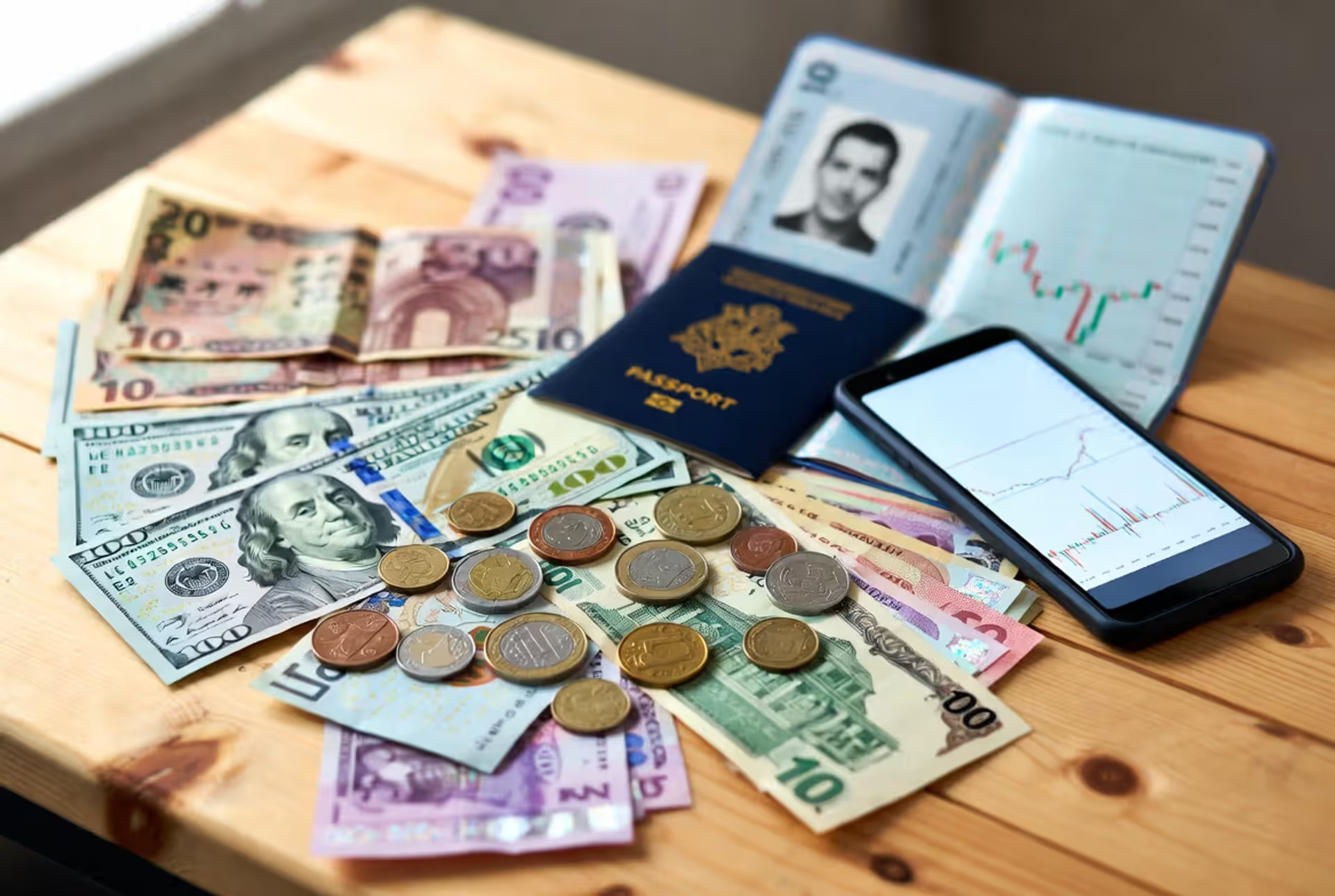
Top view of a wooden desk with international banknotes and coins including dollars euros pounds and yen next to an open passport and smartphone showing stock chart
Author: Marcus Ellington;Source: martinskikulis.com
Walk into any airport, scroll through an e-commerce site, or glance at your investment portfolio—you'll spot currency symbols instantly. That little $ mark, the distinctive €, or the elegant £ all communicate value without needing translation. These compact marks bridge languages and simplify transactions across borders.
Why should you care about getting them right? Last year, a U.S. supplier nearly lost a €200,000 contract because their invoice formatting confused European buyers. Travelers regularly overpay when they can't quickly distinguish between similar-looking symbols. Even experienced accountants sometimes fumble symbol placement rules when preparing international reports. A solid currency symbol reference prevents these expensive mistakes.
What Currency Symbols Are and Why They Matter
Think of currency symbols as monetary shorthand. Instead of writing "United States Dollar" repeatedly, you drop in a $ and move on. The € replaces "Euro," while £ stands in for "Pound Sterling." These visual markers evolved from centuries of merchant bookkeeping, where scribes needed faster ways to record transactions.
Currency codes serve a different master. Banking networks can't risk confusion when transferring millions, so ISO (the International Organization for Standardization) created three-letter designations—USD, EUR, GBP—that computers and humans interpret identically worldwide. Your corner coffee shop prints $ on receipts because customers recognize it instantly. Your bank uses USD in wire transfer confirmations because precision trumps convenience.
The split matters daily. Check your credit card statement after traveling abroad—you'll probably see symbols for quick scanning alongside codes for exact identification. Bloomberg terminals display both: symbols for traders making rapid decisions, codes for settlement systems processing the actual money movement. Restaurant menus in tourist areas might show €, $, and £ symbols simultaneously, letting diners mentally convert to familiar reference points.
Central banks began standardizing representations in the 1970s when cross-border transactions exploded. Before ISO 4217 formalized currency codes in 1978, international banks used inconsistent abbreviations that occasionally triggered payment errors. A single misread code could route $50,000 to the wrong account. Standardization wasn't academic—it was financial self-preservation.
Major Global Currency Symbols Explained
Dollar Sign Variations and Usage
Over twenty countries call their currency "dollars," from Jamaica to Namibia to Fiji. They all share that familiar $ symbol, though its exact origins remain disputed. Some historians point to Spanish colonial silver pieces marked with "PTSI" (shorthand for pesos), which scribes eventually compressed into $. Others credit the Pillars of Hercules that decorated Spanish coins, with fabric banners wrapped around them forming an S-like shape.
Here's where it gets interesting: you'll see both $ with one line and $ with two vertical strokes. Old accounting ledgers from the 1800s favor double lines. Modern digital fonts typically render single lines because they're simpler to draw. Neither version is "wrong"—IBM still uses the two-line variant in some documentation, while Apple standardizes on one line across its systems.
Distinguishing between dollar types requires prefixes. Canadian businesses write CAD$ or C$ before amounts. Australian companies use A$ or AU$. When you see plain $ in international contexts, it defaults to U.S. dollars roughly 90% of the time thanks to America's economic dominance. Singapore adds S$ to avoid confusion with its larger trading partners.
Symbol placement follows regional customs. Canadians and Americans both put $ before numbers ($43.50), but some Caribbean nations place it after (43.50$). Quebec often uses the trailing position as a nod to French conventions. Multinational companies maintain style guides specifying exact formatting for each market—Shopify's documentation runs 40+ pages covering these regional quirks.
Author: Marcus Ellington;
Source: martinskikulis.com
Euro Symbol Design and Adoption
Unlike symbols that emerged organically from merchant practices, the € came from a design competition in 1996. The European Commission wanted something distinctive, memorable, and symbolic. They picked a design resembling the Greek letter epsilon—nodding to European civilization's roots—crossed by two parallel lines representing stability.
The euro symbol origin involved deliberate brand strategy. European leaders knew their new currency would challenge dollar supremacy, so visual identity mattered. Compare this to the dollar's gradual evolution across centuries. The euro got logo design treatment, geometric specifications, and rollout campaigns worthy of a Fortune 500 product launch.
Introducing € across twelve nations in 1999 created massive logistical challenges. Cash registers needed reprogramming. Keyboard manufacturers added new keys. Schools taught children a symbol that hadn't existed when their parents were young. Ireland and Malta generally place € before numbers (€85), following British influences. France, Germany, Spain, and most continental countries put it after (85€), matching their pre-euro conventions with francs, marks, and pesetas.
Today, the € appears on price tags from Lisbon to Helsinki, but travelers still encounter inconsistent positioning. That Amsterdam hotel might quote €150 while the Rome restaurant menu shows 50€ for the same meal format. The European Central Bank permits both styles, prioritizing currency adoption over rigid formatting uniformity.
Pound Sterling Symbol History
The £ symbol traces back over a thousand years to Roman Britain. "Libra" meant a pound weight in Latin—specifically the weight of silver coins. Medieval monks copying financial manuscripts developed elaborate decorative L's crossed with horizontal bars, eventually standardizing into the £ we recognize now. It's among the world's oldest currency marks still in active daily use.
British convention always places £ before amounts (£240), and this rarely varies. Former colonies sometimes added distinguishing prefixes: E£ for Egyptian pounds, L£ for Lebanese pounds before civil war currency shifts. When you encounter £ without qualification in global business documents, assume British pounds unless context screams otherwise.
The pound sterling symbol carries particular weight (pun intended) in financial circles because sterling bonds represent one of the world's deepest government debt markets. Pension funds and central banks globally hold British gilts, making £ familiar to institutional investors everywhere. Unicode assigned it position U+00A3—a privileged spot in the character encoding universe reserved for commonly-used symbols.
Digital payment systems occasionally mix up pound and lira symbols (both derive from "libra"), causing headaches for tourists in Turkey. The Turkish lira uses ₺, adopted in 2012 to assert monetary identity distinct from the old double-barred design. Don't confuse them when checking exchange rates.
Yen and Yuan Symbols
Here's a source of genuine confusion: ¥ represents both Japanese yen and Chinese yuan (renminbi). Both currencies trace their names to the Chinese character 圓 (yuan), meaning "round" or "circle"—describing traditional coin shapes. When Japan modernized its monetary system in 1871, it borrowed Chinese terminology and simplified the character to ¥ for international use. China did the same decades later.
Practical differences help distinguish them. Japanese prices typically appear as round numbers (¥1,200 or ¥850) because Japan eliminated sub-yen denominations decades ago. Chinese pricing frequently shows decimals (¥12.50 or ¥88.88) accounting for jiao and fen subdivisions. That said, casual usage invites mistakes—always confirm whether ¥ means JPY or CNY in financial documents.
The yen symbol explained properly requires acknowledging how Japan's economic miracle from the 1960s through 1980s embedded ¥ in global consciousness. "The yen" became shorthand for Japanese economic power, even though China's currency shares the identical symbol. Professional forex traders never rely on symbols alone—they use JPY and CNY codes exclusively to prevent catastrophically expensive mix-ups.
Author: Marcus Ellington;
Source: martinskikulis.com
Swiss Franc and Other Franc Symbols
The franc symbol takes multiple forms depending on which francophone region you're discussing. Switzerland employs Fr., SFr., or CHF (Confoederatio Helvetica Franc, using Switzerland's Latin name). Historical French francs appeared as F or FF before the euro transition in 2002. West African nations use XOF, Central African countries use XAF, and both represent distinct CFA franc zones with different exchange rates.
"Franc" originated from medieval French gold coins stamped with "Francorum Rex" (King of the Franks). As French influence spread globally, the currency name followed, eventually fracturing into independent national systems. Unlike dollars, which maintain recognizable $ unity, franc variants developed completely separate identities.
Swiss francs deserve special attention. CHF functions as a global safe-haven currency—when markets panic, investors flee to Swiss francs, gold, and U.S. Treasury bonds. The Swiss National Bank's independence and Switzerland's political neutrality make CHF attractive during crises. That reputation means the franc symbol appears frequently in wealth management contexts even outside Switzerland.
Franc fragmentation means you can't assume which franc someone means without additional context. A contract referencing "franc" payments without further specification would be legally problematic. Modern practice demands explicit codes (CHF, XOF, XAF) avoiding ambiguity entirely.
How to Read and Use Currency Codes
ISO 4217 codes follow predictable logic: grab the country's two-letter identifier (US, CA, GB, JP), then add a letter indicating the currency name—usually D for dollar, P for pound, Y for yen. So you get USD, CAD, GBP, JPY. The pattern breaks for EUR because the euro serves multiple countries without a single "owner" nation.
Forex markets display currency ticker codes in pairs: EUR/USD, GBP/JPY, USD/CHF. Reading these becomes intuitive quickly. The first currency (base) equals exactly one unit. The second currency (quote) shows what you'd pay to acquire that single unit. When EUR/USD trades at 1.0850, you're looking at the cost of one euro expressed in dollars—$1.0850.
Learning how to read currency codes mostly requires pattern recognition. Most follow that country-plus-currency formula. AUD for Australian Dollar, NZD for New Zealand Dollar, MXN for Mexican Peso (the N represents "New" peso following devaluation decades ago). CAD means Canadian Dollar, ZAR represents South African Rand (from "Zuid-Afrikaanse Rand" in Afrikaans).
Special instruments get X prefixes. XAU represents gold (from "aurum," Latin for gold). XAG denotes silver. XDR designates IMF Special Drawing Rights—a synthetic reserve asset few non-economists ever encounter. Bitcoin's unofficial code XBT follows this supranational pattern, though BTC dominates actual usage.
Old currencies stick around in historical databases. DEM (Deutsche Mark) and FRF (French Franc) still appear in archived records from pre-euro transactions. Financial historians researching 1990s exchange rate movements need these retired codes to pull correct data sets. The codes never truly die—they just stop representing current transactions.
Author: Marcus Ellington;
Source: martinskikulis.com
Reserve and Fiat Currency Symbols Reference
Central banks worldwide stockpile reserve currencies as portions of their foreign exchange holdings. These currencies share a common trait: they're all fiat money, meaning government authority backs their value rather than gold or silver reserves. Since 1971, when Nixon ended dollar-gold convertibility, every major economy has operated on pure fiat systems. Fiat currency symbols dominate international finance because these currencies dominate reserve holdings.
Top Ten Reserve Currencies Comparison Table:
Currency
Symbol
Code
Central Bank Issuer
Approximate Global Reserve Share (2026)
United States Dollar
$
USD
Federal Reserve System
58.3%
Euro
€
EUR
European Central Bank
20.1%
Japanese Yen
¥
JPY
Bank of Japan
5.8%
British Pound Sterling
£
GBP
Bank of England
4.9%
Chinese Yuan Renminbi
¥
CNY
People's Bank of China
3.2%
Canadian Dollar
$
CAD
Bank of Canada
2.1%
Australian Dollar
$
AUD
Reserve Bank of Australia
1.9%
Swiss Franc
Fr.
CHF
Swiss National Bank
1.4%
South Korean Won
₩
KRW
Bank of Korea
0.6%
Singapore Dollar
$
SGD
Monetary Authority of Singapore
0.4%
Reserve currency symbols appear constantly throughout international trade documentation. Export contracts, import financing agreements, and cross-border investment flows overwhelmingly involve these ten currencies. Understanding their symbols and codes becomes non-negotiable for anyone touching international business operations.
The fiat designation doesn't show visually in the symbols themselves. You can't look at $ or € and determine they represent government-issued value rather than commodity-backed money. That transition happened systemwide decades ago, making the distinction largely academic for daily commerce purposes.
Currency symbols evolved from simple bookkeeping marks into declarations of monetary sovereignty. When nations design new symbols—like Turkey's ₺ or India's ₹—they're asserting economic independence on the world stage. The euro's committee-designed € versus the dollar's organic centuries-long development tells you everything about challenging established monetary hegemons
— Dr. Patricia Rothman
Complete Currency Symbols Directory by Region
This comprehensive currency symbols list covers the most actively traded and economically significant currencies worldwide, organized alphabetically within geographical regions. The placement column indicates whether standard convention positions symbols before or after numerical amounts.
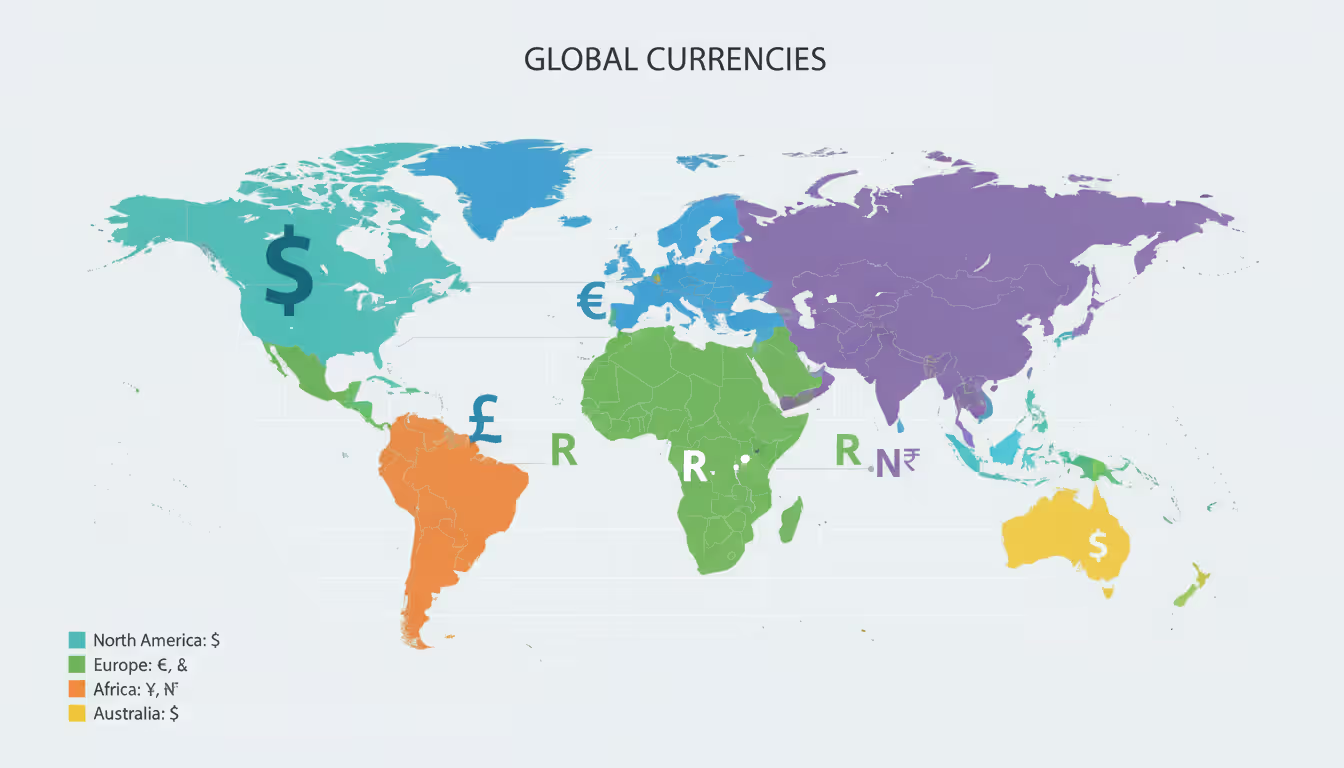
Americas: - Argentine Peso: $ (ARS) - Argentina - Before - Brazilian Real: R$ (BRL) - Brazil - Before - Canadian Dollar: $ (CAD) - Canada - Before - Chilean Peso: $ (CLP) - Chile - Before - Colombian Peso: $ (COP) - Colombia - Before - Mexican Peso: $ (MXN) - Mexico - Before - United States Dollar: $ (USD) - United States - Before
Europe: - British Pound Sterling: £ (GBP) - United Kingdom - Before - Czech Koruna: Kč (CZK) - Czech Republic - After - Danish Krone: kr (DKK) - Denmark - After - Euro: € (EUR) - Eurozone (20 member nations) - Varies by country - Hungarian Forint: Ft (HUF) - Hungary - After - Norwegian Krone: kr (NOK) - Norway - After - Polish Złoty: zł (PLN) - Poland - After - Romanian Leu: lei (RON) - Romania - After - Russian Ruble: ₽ (RUB) - Russia - After - Swedish Krona: kr (SEK) - Sweden - After - Swiss Franc: Fr. (CHF) - Switzerland - Before - Turkish Lira: ₺ (TRY) - Turkey - Before - Ukrainian Hryvnia: ₴ (UAH) - Ukraine - After
Asia-Pacific: - Australian Dollar: $ (AUD) - Australia - Before - Bangladeshi Taka: ৳ (BDT) - Bangladesh - Before - Chinese Yuan Renminbi: ¥ (CNY) - China - Before - Hong Kong Dollar: $ (HKD) - Hong Kong - Before - Indian Rupee: ₹ (INR) - India - Before - Indonesian Rupiah: Rp (IDR) - Indonesia - Before - Japanese Yen: ¥ (JPY) - Japan - Before - Malaysian Ringgit: RM (MYR) - Malaysia - Before - New Zealand Dollar: $ (NZD) - New Zealand - Before - Pakistani Rupee: ₨ (PKR) - Pakistan - Before - Philippine Peso: ₱ (PHP) - Philippines - Before - Singapore Dollar: $ (SGD) - Singapore - Before - South Korean Won: ₩ (KRW) - South Korea - Before - Sri Lankan Rupee: Rs (LKR) - Sri Lanka - Before - Taiwan Dollar: $ (TWD) - Taiwan - Before - Thai Baht: ฿ (THB) - Thailand - Before - Vietnamese Dong: ₫ (VND) - Vietnam - After
Middle East & Africa: - Egyptian Pound: £ (EGP) - Egypt - Before - Israeli New Shekel: ₪ (ILS) - Israel - Before - Kuwaiti Dinar: د.ك (KWD) - Kuwait - Before - Nigerian Naira: ₦ (NGN) - Nigeria - Before - Saudi Riyal: ﷼ (SAR) - Saudi Arabia - Before - South African Rand: R (ZAR) - South Africa - Before - UAE Dirham: د.إ (AED) - United Arab Emirates - Before
This directory reveals interesting patterns. Dollar symbols dominate throughout the Americas and former British territories reflecting colonial monetary influence. Meanwhile, Asian and Middle Eastern nations increasingly adopt distinctive national symbols—India introduced ₹ in 2010, Russia unveiled ₽ in 2014—asserting monetary independence through visual identity.
Author: Marcus Ellington;
Source: martinskikulis.com
Common Mistakes When Using Currency Symbols
Placement errors cause the most frequent problems. Americans instinctively write $50, then blindly extend this pattern when preparing invoices for European clients. A French invoice should display 50€, but American hands often produce €50 or even the doubly-wrong $50€. Each market expects specific formatting, and deviating signals unfamiliarity with local business practices.
The shared ¥ symbol for yen and yuan creates real-world confusion. I've watched traders nearly execute wrong-currency transactions because they relied on symbols instead of codes. Context usually clarifies intent, but "usually" isn't good enough when moving six-figure sums. Egypt uses E£ for pounds, Lebanon uses L£—applying plain £ to either would be incorrect despite "pound" appearing in both currency names.
People guess at currency codes and get them wrong constantly. Someone writes GBD instead of the correct GBP for British pounds. Others assume the third letter always matches the currency's first letter—but JPY (Japanese Yen) uses Y, not J. CAD uses D for dollar, NZD uses D for dollar, but MXN uses N (from "new peso" following 1993 redenomination). These codes require memorization, not guesswork.
Writing "$5,000 USD" creates redundancy—the $ already tells readers you mean dollars. International banking standards prefer "USD 5,000" or "5,000 USD" positioning the code where parsing software expects to find it. Mixing notation styles within a single document looks sloppy and occasionally confuses automated payment systems.
Decimal separators flip between regions, creating dangerous ambiguity. Americans format $1,000.50 with commas separating thousands and periods marking decimals. Germans write €1.000,50 with periods separating thousands and commas indicating decimals. See €1.500 without context? You're guessing between fifteen hundred euros or one euro fifty. Multinational contracts should specify which convention applies throughout.
Spacing rules vary wildly. Some style guides demand spacing between symbols and numbers ($ 100), others forbid it entirely ($100). European publications frequently space euros from amounts (€ 50), American outlets typically don't (€50). Pick one approach per document and maintain it consistently—mixing styles makes you look careless.
Frequently Asked Questions About Currency Symbols
Why does the dollar sign appear with either one or two vertical lines?
Both versions work equally well. Historical handwritten ledgers from the 1700s and 1800s often showed double strokes, probably evolving from how bookkeepers abbreviated Spanish peso notations. Single-line versions dominate now because digital fonts render them more cleanly—fewer strokes mean clearer symbols at small sizes or low resolutions. No authority has declared one version superior. Use whichever your chosen font provides.
What distinguishes yen from yuan when both use ¥?
Japanese yen and Chinese yuan both trace back to terms describing circular coins, explaining their shared symbol. Surrounding details usually clarify which currency applies—prices in Tokyo obviously mean yen, Shanghai prices mean yuan. Japanese amounts rarely show decimal places (¥1,200, ¥850) because Japan phased out sub-yen coins. Chinese pricing often includes cents (¥12.50, ¥88.88) accounting for jiao and fen denominations. Financial professionals always specify JPY versus CNY codes to eliminate guesswork.
Which keyboard methods produce different currency symbols?
Windows users can press Alt while typing number codes on the numeric keypad: Alt+0163 creates £, Alt+0128 produces €. Mac users hold Option plus other keys—Option+3 generates £, while Option+Shift+2 creates €. Smartphones let you long-press the dollar key to reveal additional currency choices, or switch to dedicated symbol keyboards. Most word processors include "Insert Symbol" menus displaying complete currency collections you can click. Web developers type HTML codes like £ or € which browsers render as proper symbols.
Do currency symbols and currency codes mean the same thing?
They serve completely different functions. Symbols (like $, €, £) work best in consumer-facing situations—price tags, receipts, casual correspondence—where instant visual recognition matters most. Three-letter codes (USD, EUR, GBP) follow ISO 4217 standards developed for banking networks, financial markets, and international wire transfers where absolute precision prevents expensive errors. Symbols optimize recognition speed. Codes optimize transaction accuracy. Neither substitutes for the other in their respective domains.
Why do multiple countries use identical currency symbols?
The dollar sign ($) appears across twenty-plus nations because many modeled their monetary systems on Spanish colonial dollars or U.S. dollars. Former British colonies often retained pound symbols while adding distinguishing prefixes to assert independent identity. Shared symbols require context or prefixes (US$, C$, A$) for clarity. This pattern reflects colonial history—monetary systems spreading through imperial influence, then fracturing into independent versions after decolonization.
Which currency symbol appears most frequently in global use?
The dollar sign ($) circulates most widely by far. U.S. dollars dominate international trade invoicing, central bank reserves, commodity pricing, and forex transactions. Add currencies from Canada, Australia, Singapore, Hong Kong, and dozens more using $ symbols, and you've got a mark appearing in more daily transactions worldwide than any competitor—even in countries whose official currencies use entirely different symbols.
Currency symbols function as universal value language, compressing complex monetary information into instantly recognizable marks. From $ dominating the Americas to €'s carefully engineered European identity, these symbols encode both practical utility and national character in compact graphical forms.
Developing fluency with currency symbols and their corresponding codes delivers tangible advantages in today's interconnected economy. Travelers accurately interpret foreign pricing. Businesses format international documentation properly. Investors execute time-sensitive trades without confusion. The difference between symbols (optimized for instant recognition) and codes (built for transaction precision) becomes second nature through regular exposure.
Currency symbol evolution continues as emerging economies assert monetary sovereignty through distinctive designs. Turkey unveiled ₺ in 2012. India introduced ₹ in 2010. Russia adopted ₽ in 2014. Yet established symbols—$, €, £, ¥—persist despite technological disruption, grounded in centuries of commercial practice. Mastering these symbols means understanding how societies create, communicate, and transfer value across geographical and cultural boundaries. That knowledge proves increasingly essential as economic integration accelerates globally.
The purchasing power of the US dollar has declined roughly 98% since 1913. While gradual erosion differs from collapse, understanding which assets retain value during currency crises provides practical preparation for scenarios that have played out repeatedly throughout monetary history
Volatility determines profit potential and risk in forex trading. Some currency pairs swing hundreds of pips daily while others barely move. This guide examines which pairs exhibit the highest price fluctuations, why certain currencies are more volatile, and how to trade them effectively with proper risk management
The forex market processes $7.5+ trillion daily, yet a handful of pairs dominate volume. Learn which currency pairs traders prefer, why EUR/USD captures 24% of global transactions, and how liquidity, spreads, and volatility shape pair selection for different trading strategies
Major currencies represent the backbone of global foreign exchange markets. These monetary units from economically stable nations account for over 90% of daily forex turnover. Understanding which currencies dominate trading, how they're classified, and why they matter helps traders and investors navigate international markets
The content on this website is provided for general informational and educational purposes only. It is intended to explain concepts related to Forex (FX) trading, currency markets, leverage, hedging, and risk management.
All information on this website, including articles, guides, and examples, is presented for general educational purposes. Forex trading carries significant risk, and outcomes may vary depending on market conditions, leverage, and individual decisions.
This website does not provide financial, investment, or trading advice, and the information presented should not be used as a substitute for consultation with qualified financial professionals.
The website and its authors are not responsible for any errors or omissions, or for any outcomes resulting from decisions made based on the information provided on this website.