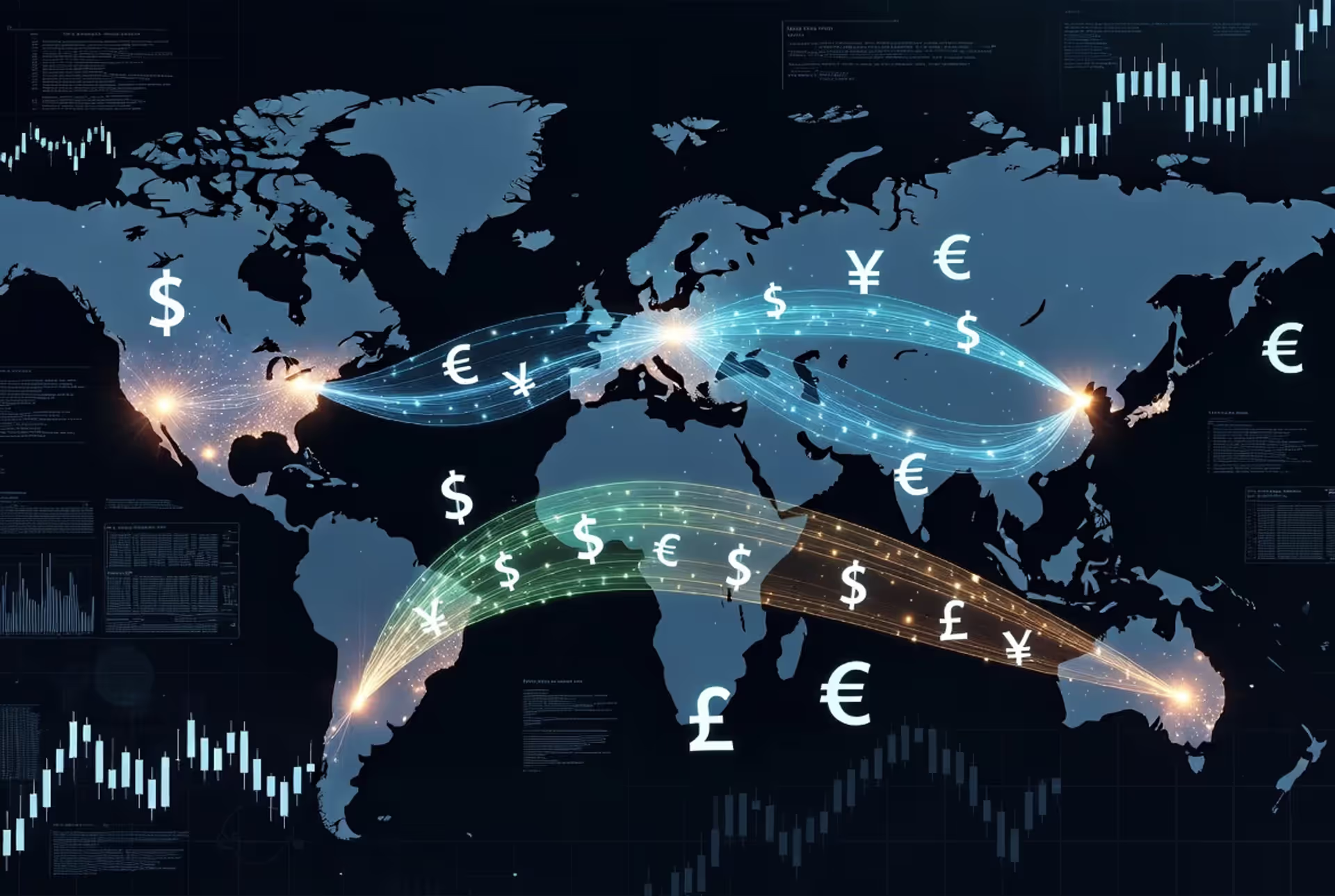
Global forex market concept with world map showing illuminated financial centers connected by glowing currency flow lines with dollar euro pound and yen symbols
Every day, over $7 trillion changes hands in the foreign exchange market—dwarfing every stock exchange combined. This massive marketplace operates continuously across time zones, connecting banks in Tokyo, traders in London, corporations in New York, and individual investors worldwide. Currency trading differs fundamentally from buying stocks or bonds because you're always making a two-sided bet: one currency against another.
What Is Forex Trading?
Think of forex trading as an ongoing global auction where currencies compete for value. Instead of owning a piece of a company like with stocks, you're exchanging one country's money for another's, anticipating which will gain strength.
Every trade pairs two currencies together. Take EUR/USD (euro against the dollar) as an example. The first currency—the euro here—is called the base. The second—the dollar—is the quote. That pairing tells you how many dollars you'd need to buy one euro.
Here's how it works in practice: You notice the EUR/USD pair showing 1.0800. You believe European economic data will surprise to the upside, so you buy at that rate. You've now purchased euros while simultaneously paying with dollars. Three days later, positive manufacturing data from Germany pushes the pair to 1.0850. You exit the trade, collecting the 50-point gain. Those euros you bought are now worth more dollars than you originally spent.
The reverse trade works too. If you'd sold EUR/USD at 1.0850 expecting it to drop, you'd profit when it fell to 1.0800. You're betting the base currency will weaken.
These price movements—often fractions of a percent—might seem tiny. That's where the concept of pips comes in. Traders measure forex moves in these standardized units, typically the fourth decimal in a price quote. A shift from 1.0800 to 1.0801? That's just one pip. But multiply that movement across a large position, and those fractions add up fast.
The most actively traded pairs involve the world's reserve currencies and largest economies. EUR/USD alone accounts for nearly a quarter of all forex volume. GBP/USD (British pound versus dollar), USD/JPY (dollar versus Japanese yen), and USD/CHF (dollar versus Swiss franc) round out the major pairs. Why these? They represent stable, liquid markets with tight pricing and constant activity.
Beyond majors, you'll find minor pairs that skip the dollar entirely—like EUR/GBP or AUD/NZD. Then there are exotics: pairings between a major currency and one from a developing economy. USD/TRY (dollar versus Turkish lira) or EUR/ZAR (euro versus South African rand) fall into this category. Exotics offer higher volatility but come with wider spreads and greater risk.
The foreign exchange market is the largest, most liquid financial market in the world. It trades over $7 trillion a day
— Janet Yellen
How the Forex Market Functions
No central building houses the forex market. There's no trading floor where specialists in colored jackets shout bids. Instead, forex operates as a vast electronic network connecting participants worldwide—a truly decentralized system.
Banks, brokers, institutions, and individual traders connect through electronic communication networks, transacting directly with each other. London hosts the largest share of activity, followed by New York, Singapore, Hong Kong, and Tokyo. As Earth rotates, the market shifts from one financial center to the next.
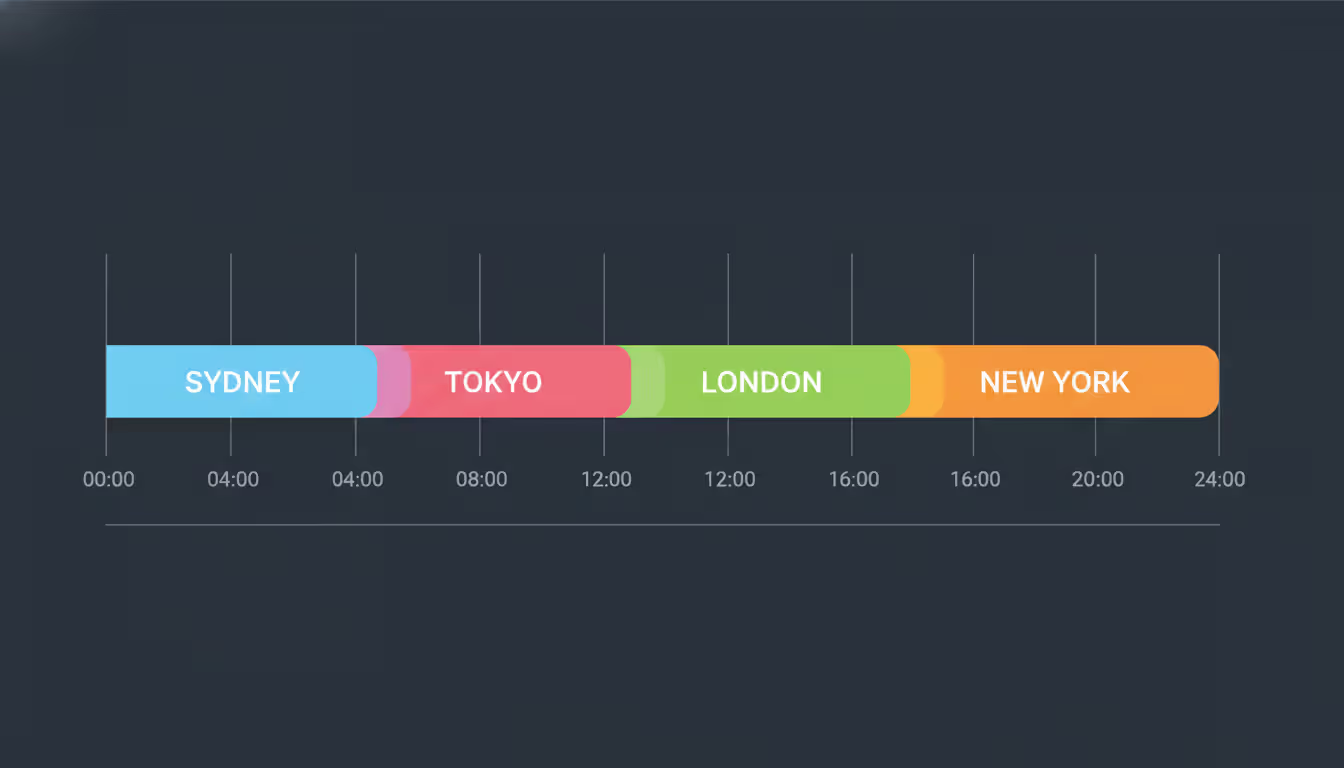
Trading begins when Wellington opens Sunday evening (Eastern Time). Sydney jumps in an hour later. Tokyo fires up next, followed by Hong Kong and Singapore. London—the undisputed heavyweight—starts in the early US morning. Finally, New York comes online, overlapping with London through midday. This sequencing creates 24-hour continuity from Sunday 5 PM ET through Friday 5 PM ET.
The juiciest trading happens during overlaps. When London and New York both operate (8 AM to noon Eastern), liquidity peaks. More participants mean tighter spreads, better prices, and easier execution. The quietest period? Sunday evening and the gap between New York's close and Tokyo's open, when only Wellington and Sydney operate.
At the top tier sits the interbank market—major financial institutions like JPMorgan Chase, Deutsche Bank, Citigroup, and Barclays trading directly with each other. These giants quote prices back and forth, establishing wholesale rates. Their transactions—often hundreds of millions per trade—form the foundation of forex pricing.
Retail brokers access these interbank rates through relationships with liquidity providers, then offer them to individual traders with a small markup. When you see a price on your trading platform, it's derived from these institutional quotes, filtered through your broker's pricing engine.
What moves prices? Economic data releases create immediate volatility. Employment numbers, inflation reports, GDP figures, retail sales—each can jolt a currency pair 50 pips in seconds. Central bank decisions carry even more weight. When the Federal Reserve adjusts interest rates or signals policy changes, dollar pairs swing dramatically as traders recalibrate expectations.
Geopolitical events matter too. Elections, trade negotiations, military conflicts, and diplomatic tensions all influence currency values. Brexit negotiations provided a perfect example: every rumor or development sent the pound on wild rides against other currencies.
Author: Vanessa Cole;
Source: martinskikulis.com
Liquidity varies dramatically by pair and time. Major pairs during active hours offer spreads of just 0.1 to 1 pip—the difference between buy and sell prices. You can trade millions without significantly moving the market. Try that with an exotic pair during the Asian session, and you might face 20-pip spreads with slippage on larger orders.
Who Trades Forex and Why
Retail traders—individuals like you—represent the visible face of forex, though not its largest segment. These traders analyze charts, follow economic calendars, and place trades hoping to build profits over time. Some risk a few hundred dollars. Others commit six or seven figures. Their holding periods range from seconds (scalping) to months (position trading).
Institutional players dwarf retail participation. Hedge funds deploy sophisticated algorithms and fundamental analysis across multiple currency pairs, managing billions in assets. Asset managers and pension funds need forex exposure to invest globally—buying European stocks requires converting dollars to euros first. These institutions think in terms of millions per trade.
Central banks enter the market with entirely different motivations. They're not seeking profit. The Bank of Japan might sell yen to prevent excessive appreciation that would hurt Japanese exporters. The Swiss National Bank famously maintained a EUR/CHF floor for years, intervening whenever the franc strengthened too much. These interventions inject massive volume instantly, sometimes billions within minutes, creating violent price swings traders must navigate.
Corporations trade currencies by necessity, not choice. Boeing sells aircraft to Singapore Airlines, invoicing in dollars. Singapore Airlines needs dollars to pay, creating natural demand. Meanwhile, Volkswagen manufactures in Europe but sells vehicles worldwide. When the euro strengthens, their cars become more expensive in dollar terms, hurting sales. To manage this risk, corporations hedge using forwards, options, and spot transactions, locking in rates ahead of time.
This creates two broad categories: hedgers and speculators. Hedgers want to reduce currency risk inherent in their business or investments. They're buying insurance, essentially. Speculators actively seek that risk, providing the liquidity hedgers need. Without speculators willing to take the other side, hedgers couldn't efficiently protect themselves.
Commercial and investment banks occupy both roles. They facilitate client trades—earning spreads and commissions—while also trading proprietary positions. A bank might execute a corporate client's EUR/USD hedge while simultaneously running its own EUR/USD strategy based on economic forecasts. They profit from order flow insight and their role as market makers, continuously quoting prices.
Forex Market Size and Daily Volume
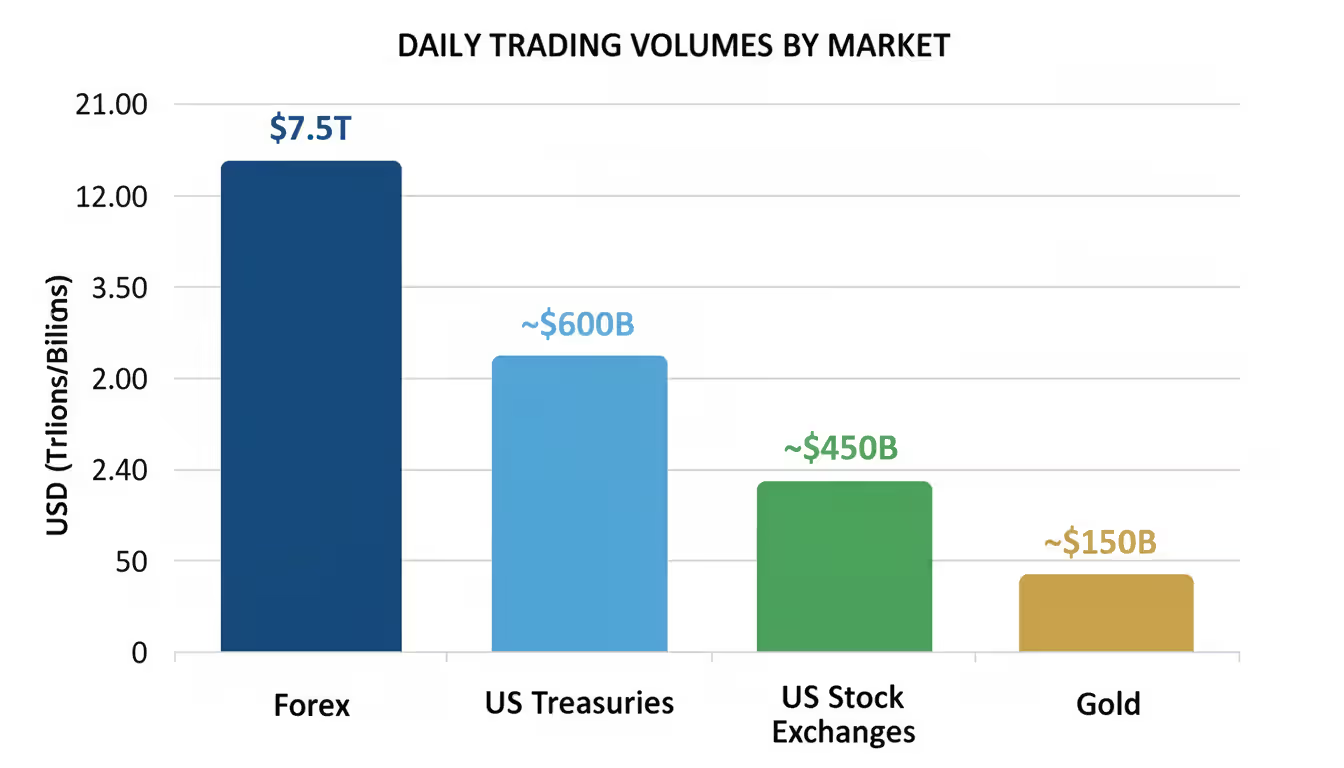
Here's a staggering number: approximately $7.5 trillion trades hands daily in forex markets as of 2025, according to the Bank for International Settlements. That's not annual volume. That's every single day.
To grasp the scale, consider that the New York Stock Exchange—Earth's largest equity market—processes around $200 billion daily. All US stock exchanges combined might hit $450-500 billion on a busy day. Forex is 15 times larger. Every three days, forex volume exceeds the annual GDP of the United States.
Author: Vanessa Cole;
Source: martinskikulis.com
Why so massive? International trade requires constant currency conversion. A Chinese manufacturer selling electronics to a US retailer needs dollars. A Canadian pension fund buying Japanese bonds needs yen. Every cross-border transaction touches forex. Add speculation, hedging, and institutional positioning, and the numbers explode.
The breakdown reveals interesting patterns. Spot transactions—immediate currency exchanges settling in two business days—account for roughly $2.1 trillion daily. But the biggest chunk comes from forex swaps ($3.8 trillion), where parties exchange currencies temporarily, agreeing to reverse the transaction later. Banks and corporations use swaps to manage short-term funding needs and hedge exposures. Outright forwards, options, and other derivatives make up the rest.
The dollar's dominance is almost absurd: it appears on one side of 88% of all transactions. Every currency trades heavily against the dollar, making it the universal intermediary. Want to exchange Brazilian reals for Thai baht? The market route typically goes through dollars: BRL/USD then USD/THB.
After the dollar, the euro claims second place at 31% of transactions, followed by the yen (17%), pound (13%), and Australian dollar (7%). These percentages exceed 100% because each trade involves two currencies—if you trade EUR/USD, both the euro and dollar count.
This enormous volume creates tangible benefits. Deep liquidity means your orders execute almost instantaneously at displayed prices—no waiting for buyers or sellers. Tight spreads reduce transaction costs, especially valuable for active traders. And the sheer size makes manipulation difficult, though not impossible, as various bank scandals have proven.
Compare this to commodities markets or even bond markets, and forex stands alone. Gold might trade $150 billion daily. US Treasuries approach $600 billion. Forex dwarfs them all, creating a unique trading environment where $100,000 trades register as insignificant drops in an ocean.
Forex vs Stock Market
Choosing between forex and stocks depends on your schedule, risk tolerance, capital, and trading style. They're fundamentally different beasts.
Feature
Forex Market
Stock Market
Trading Hours
Continuous 24/5 from Sunday evening through Friday afternoon
9:30 AM - 4 PM ET regular session; limited extended hours available
Market Structure
Decentralized OTC network spanning global banks and brokers
Centralized exchanges (NYSE, NASDAQ) with transparent order books
Liquidity
Exceptionally deep for major pairs; can trade millions instantly
Varies dramatically; Apple trades easily, microcaps barely move
Leverage Availability
Up to 50:1 for majors, 20:1 for minors (US retail regulations)
Standard 2:1 margin; day traders get 4:1 intraday
Typical Volatility
Major pairs move 0.5-1% daily; exotics much more
Individual stocks routinely swing 3-10%; indices more stable
Minimum Capital
Possible with $100 but $1,000+ recommended for proper risk management
Technically any amount; realistically $500+ for meaningful positions
Thousands of stocks across sectors, market caps, and geographies
The 24-hour forex schedule appeals to anyone with a day job. You can trade the Tokyo session from the US evening, or catch London's open before American markets fire up. Stock traders without flexibility need extended-hours access, which comes with wider spreads and lower volume.
Leverage represents the starkest difference. That 50:1 ratio available in forex means your $2,000 account controls a $100,000 position. A 1% favorable move yields $1,000—a 50% account gain. But a 1% adverse move loses $1,000, wiping out half your capital. Stock traders using 2:1 leverage experience much gentler amplification—and much gentler pain when wrong.
This double-edged leverage sword has destroyed countless forex accounts. It's why professional traders emphasize position sizing and risk management above all else. The capability to use 50:1 leverage doesn't mean you should.
Instrument selection works differently too. Forex's limited pair selection simplifies monitoring—you can realistically track all majors and several crosses. Stock traders face thousands of options, enabling diversification across sectors but creating analysis paralysis.
Market structure affects transparency and pricing. Stock exchanges display order books showing exactly how many shares await at each price level. Forex pricing comes from your broker's liquidity providers, varying slightly between brokers. Two stock traders see identical quotes; two forex traders might not.
Volatility patterns differ. Major currency pairs typically swing 50-100 pips daily—roughly 0.5-1% moves. Individual stocks can jump or crash 5%, 10%, even 20% on earnings announcements or unexpected news. The S&P 500 index might move 1-2% daily, while EUR/USD moves similarly. But a biotech stock awaiting FDA approval? That might double or halve overnight.
Basics of Forex for Beginners
Key Terminology
You'll hear traders throw around "lots" constantly. This standardized measure defines position size. A standard lot? That's 100,000 units of whichever currency sits first in the pair. Mini lots equal 10,000 units. Micro lots are 1,000 units. Many brokers now offer nano lots—just 100 units—letting you trade with tiny capital. Trading one micro lot of EUR/USD means controlling 1,000 euros.
Position sizing connects directly to lots. If you're trading a standard lot of EUR/USD at 1.0800, each pip movement equals $10 (with USD as quote currency). A 20-pip gain? That's $200. Mini lots make each pip worth $1. Micro lots? Just $0.10 per pip. This scalability lets you match position size to your account size and risk tolerance.
Now, leverage—the concept that makes forex uniquely powerful and dangerous. In the US, regulations cap retail forex leverage at 50:1 for major pairs and 20:1 for minors. What does 50:1 mean practically? You deposit $1,000, and you can open a position worth $50,000. Your broker only requires 2% margin.
Here's the calculation: If you want to control $50,000 worth of EUR/USD, divide that position by your leverage ratio. $50,000 ÷ 50 = $1,000 required margin. Your broker holds that $1,000 as collateral while you control the full position. Sounds great until the trade moves against you. A 2% loss on that $50,000 position equals $1,000—your entire margin, gone.
The spread—your cost per trade—represents the gap between bid and ask prices. You'll see quotes like EUR/USD 1.0800/1.0801. The first number (1.0800) is where you can sell. The second (1.0801) is where you can buy. That 1-pip difference is your spread, the broker's compensation. Major pairs during busy hours might offer 0.1-0.5 pip spreads. Exotics during quiet hours? Try 15-30 pips. You pay this every time you enter and exit, so narrower spreads save money, especially if you trade frequently.
Margin works as your good-faith deposit. Want to open that $50,000 EUR/USD position? Your broker locks up $1,000 of your account balance as margin. The rest stays available for other trades or to absorb drawdowns. If your position moves against you and your account equity drops too low, you'll receive a margin call—either add funds or the broker closes positions to prevent your account going negative.
A pip measures the smallest standard price increment in most pairs. For pairs quoted to four decimals (like EUR/USD or GBP/USD), one pip equals 0.0001. Japanese yen pairs quote to two decimals, so USD/JPY moves in 0.01 increments—that's one pip. EUR/USD moving from 1.0800 to 1.0825 traveled 25 pips. Simple enough, but profitable trading requires capturing far more pips than you lose.
Going long means buying the pair—you're betting the base currency strengthens against the quote currency. Going short means selling the pair, expecting the base currency to weaken. Unlike stock short-selling with borrowed shares and hard-to-borrow fees, forex shorting is just the opposite side of the same transaction. Selling EUR/USD is simultaneously shorting euros and going long dollars.
How Currency Pairs Are Quoted
Here's what often confuses beginners: currency pairs always show two prices, and the first currency listed determines what you're actually trading.
Look at EUR/USD quoted at 1.0800. That number answers the question: "How many US dollars does one euro cost?" In this case, 1.08 dollars. The euro is your base—what you're buying or selling. The dollar is your quote—what you're using to measure value or paying with.
When you click "buy" on EUR/USD at 1.0800, you're purchasing euros while paying with dollars. Think of it like exchanging cash at the airport, but you're speculating rather than traveling. You believe the euro will strengthen. If it rises to 1.0850, those euros you bought are now worth more dollars. Close the trade, and you've captured a 50-pip profit.
Selling EUR/USD at 1.0850 flips the transaction. You're now selling euros, receiving dollars. You believe the euro will weaken. When it drops to 1.0800, you've gained 50 pips because you can now buy back those euros for fewer dollars than you sold them for.
Major pairs always feature the US dollar, but watch which position it occupies. EUR/USD, GBP/USD, AUD/USD, and NZD/USD list the dollar second (as quote currency). USD/JPY, USD/CHF, and USD/CAD list it first (as base currency). This convention reflects historical trading patterns and occasionally confuses new traders. Just remember: you're always trading the base currency—buying or selling it.
Cross pairs remove the dollar entirely: EUR/GBP, EUR/JPY, GBP/JPY, AUD/NZD. These pairs let you trade relationships between non-dollar currencies directly. If you believe the euro will strengthen against the pound specifically, EUR/GBP is your vehicle. These crosses often move differently than major pairs and can provide opportunities when dollar direction remains unclear.
Understanding bid and ask prevents confusion. The bid (lower number) shows where the market will buy the base currency from you—where you can sell. The ask (higher number) shows where the market will sell the base currency to you—where you can buy. So when you want to buy, you pay the higher ask. When you want to sell, you receive the lower bid. The difference is the spread—your transaction cost. You're always starting slightly in the hole, which means you need favorable price movement just to break even.
Common Mistakes to Avoid
Author: Vanessa Cole;
Source: martinskikulis.com
Overleveraging kills more accounts than bad analysis ever could. New traders see that 50:1 leverage capability and immediately maximize position size. They control $50,000 with a $1,000 account, thinking "more is better." Then a 2% adverse move—completely normal, happens daily—obliterates their capital. Experienced traders risk just 1-2% of total capital per trade, sizing positions accordingly. On a $5,000 account, that means risking $50-100 per trade, not thousands.
Trading without stops is financial suicide. A stop-loss automatically exits your position when price hits a predetermined level, capping your loss. Without one, you're hoping price reverses, watching losses mount. Gaps during low-liquidity hours or news events can blow through your account. On the flip side, setting stops too tight gets you "stopped out" by normal noise before your thesis has time to develop. Finding the balance—stops wide enough to avoid noise but tight enough to limit damage—separates surviving traders from vanishing ones.
Ignoring economic calendars guarantees unpleasant surprises. Nonfarm payrolls (first Friday each month), Federal Reserve decisions (eight times yearly), GDP releases, inflation data—these events can move pairs 75-150 pips in seconds. Holding a position through NFP without awareness is gambling, not trading. Many professionals close everything before major releases or reduce position size dramatically.
Revenge trading after losses compounds problems fast. You take a 50-pip loss on EUR/USD. Frustration builds. You immediately re-enter with double the position size to "win it back quickly." That emotional decision usually results in a larger loss, creating a downward spiral. Successful traders accept losses as a business cost, taking breaks after tough trades rather than forcing action.
Neglecting correlation between pairs creates hidden concentration risk. Long EUR/USD and long GBP/USD simultaneously? You've doubled your bet against the dollar. These pairs move together 70-80% of the time. If dollar strength emerges, both trades lose together. Understanding correlations prevents inadvertent risk concentration. EUR/USD and USD/CHF typically move inversely—one up, one down—providing natural hedging if desired.
Trading exotic pairs without specialized knowledge invites pain. USD/TRY, USD/ZAR, or EUR/TRY offer tempting volatility—200-pip days aren't uncommon. But spreads might run 15-50 pips, liquidity dries up quickly, and sudden political or economic crises can gap prices hundreds of pips. A Turkish central bank surprise or South African election result can move these pairs 5-10% overnight. Stick to majors until you've built consistent profitability.
Frequently Asked Questions About Forex
Is forex trading legal in the US?
Absolutely—forex trading is fully legal throughout the United States, though it operates under strict regulatory oversight. The Commodity Futures Trading Commission (CFTC) and National Futures Association (NFA) enforce rules protecting retail traders from fraud and excessive risk. You can only trade through CFTC-registered, NFA-member brokers. US regulations impose leverage limits (maximum 50:1 for major pairs, 20:1 for minor pairs), ban hedging where you hold both long and short positions on the same pair simultaneously, and require FIFO (first in, first out) position closing. While these restrictions eliminate some strategies available to international traders, they provide substantial consumer protection. Always verify your broker's regulatory status before depositing funds—check the NFA's BASIC search tool online.
How much money do I need to start forex trading?
Brokers advertise minimum deposits as low as $50-100, and nano lots let you trade with minimal capital. But here's reality: starting with $100-500 makes proper risk management nearly impossible. If you're risking 1-2% per trade on a $100 account, you can only risk $1-2. That severely restricts stop placement and position sizing, forcing you into unrealistically tight stops that trigger constantly. Most professionals suggest beginning with at least $1,000-2,000 to trade micro lots comfortably while implementing sound risk management. With $5,000-10,000, you can trade mini lots with appropriate position sizing. More importantly, only deposit capital you can afford to lose entirely without affecting your financial security. Forex is speculative—treat it like gambling money, not your rent fund.
What are the risks of forex trading?
Forex carries substantial risk across multiple dimensions. Leverage amplifies losses just as dramatically as gains—that 50:1 capability means a 2% adverse move wipes out your margin completely. Market risk involves unexpected price movements from news events, central bank surprises, or geopolitical developments. Liquidity risk emerges during fast markets or with exotic pairs where you can't exit positions without significant slippage. Counterparty risk involves broker insolvency, though US regulations and segregated accounts mitigate this substantially. Beyond market risks, psychological dangers—overtrading, revenge trading, fear, greed—often prove more destructive. The complexity of analyzing multiple economic factors, technical patterns, and sentiment indicators simultaneously makes consistent profitability challenging even for experienced traders. Statistics vary, but estimates suggest 70-85% of retail forex traders lose money over time.
Can you make a living trading forex?
Possible? Yes. Common? No. Making consistent income from forex demands substantial capital (typically $50,000 minimum), extensive knowledge, iron discipline, emotional control, and realistic return expectations. Professional traders often target 3-10% monthly returns. On $50,000, that's $1,500-5,000 monthly before taxes, software costs, and data fees. Most successful full-time traders spent years developing their edge while maintaining other income sources, treating trading as a serious business requiring continuous learning and adaptation. The statistics are sobering: various studies indicate 70-90% of retail traders lose money. Those rare individuals who succeed long-term typically share traits—patience, discipline, detailed record-keeping, constant strategy refinement, and acceptance that losses are unavoidable. They treat it like running a business, not chasing quick riches. If you're starting out, maintain your day job while building skills gradually.
What is leverage in forex?
Leverage multiplies your market exposure beyond your actual capital. US retail forex brokers offer up to 50:1 on major currency pairs, meaning every dollar in your account can control fifty dollars' worth of currency. Deposit $2,000, and you can open positions worth $100,000. How does this work mechanically? Your broker requires a certain margin percentage—with 50:1 leverage, that's 2% of position size. So a $50,000 EUR/USD position needs $1,000 margin (2% of $50,000). The math: if EUR/USD moves 1% in your favor, you gain $500 on that $50,000 position—a 50% return on your $1,000 margin. But that 1% move against you also loses $500, cutting your margin in half. Leverage is neutral—a tool that amplifies outcomes in both directions. Many professionals use far less than maximum available leverage, understanding capital preservation matters more than maximizing position size. A conservative trader might use only 5:1 or 10:1 leverage, controlling risk far better than maxing out at 50:1.
When is the forex market open?
Forex operates continuously 24 hours daily, five days weekly, beginning Sunday 5:00 PM Eastern when Wellington and Sydney start their Monday, and closing Friday 5:00 PM Eastern when New York ends its week. The market progresses through four primary sessions with these approximate times: Sydney (5:00 PM - 2:00 AM ET), Tokyo (7:00 PM - 4:00 AM ET), London (3:00 AM - 12:00 PM ET), and New York (8:00 AM - 5:00 PM ET). These overlap at certain hours—London and New York both operate from 8:00 AM to noon ET, creating the highest volume and tightest spreads of the day. Most significant price movement happens during this overlap. The quietest period runs from roughly 5:00 PM to 7:00 PM ET, after New York closes but before Tokyo becomes active, when only Wellington and Sydney operate. Major pairs remain liquid throughout the 24-hour cycle, though spreads widen during quiet hours. The market closes weekends, though exact timing varies slightly by broker. It also pauses for certain holidays depending on which countries are involved, though never completely shuts down unless all major centers close simultaneously (rare).
Forex stands apart from every other financial market—larger, faster, more accessible, and operating continuously across time zones. Its decentralized structure, leverage availability, and 24-hour nature create opportunities impossible in stocks, bonds, or commodities. Understanding these unique characteristics is essential before risking capital.
But understanding mechanics doesn't guarantee profits. Success demands realistic expectations about risk and returns, adequate capital to weather inevitable losing streaks, a detailed trading plan with specific risk management rules, and the psychological discipline to execute that plan when emotions scream otherwise. The market's accessibility attracts beginners, yet those sobering statistics about retail trader success should temper enthusiasm.
For traders willing to invest years learning proper analysis, developing emotional control, and treating forex as a serious business rather than gambling, genuine opportunities exist. Whether you're a corporation hedging international revenue, an institutional investor diversifying portfolios, or a retail trader seeking profit from currency fluctuations, the forex market provides a unique venue with distinct advantages and dangers.
Begin small, use conservative leverage well below maximums, maintain strict risk limits, and commit to continuous education. The traders who survive their first year and eventually thrive share common traits: they respect the market's power to both reward and destroy, they learn from losses without being eliminated by them, and they understand that modest, consistent gains compound into meaningful returns over months and years. There are no shortcuts, no secret systems, no guaranteed methods—just hard work, discipline, and the humility to adapt when markets change.
The purchasing power of the US dollar has declined roughly 98% since 1913. While gradual erosion differs from collapse, understanding which assets retain value during currency crises provides practical preparation for scenarios that have played out repeatedly throughout monetary history
Volatility determines profit potential and risk in forex trading. Some currency pairs swing hundreds of pips daily while others barely move. This guide examines which pairs exhibit the highest price fluctuations, why certain currencies are more volatile, and how to trade them effectively with proper risk management
The forex market processes $7.5+ trillion daily, yet a handful of pairs dominate volume. Learn which currency pairs traders prefer, why EUR/USD captures 24% of global transactions, and how liquidity, spreads, and volatility shape pair selection for different trading strategies
Major currencies represent the backbone of global foreign exchange markets. These monetary units from economically stable nations account for over 90% of daily forex turnover. Understanding which currencies dominate trading, how they're classified, and why they matter helps traders and investors navigate international markets
The content on this website is provided for general informational and educational purposes only. It is intended to explain concepts related to Forex (FX) trading, currency markets, leverage, hedging, and risk management.
All information on this website, including articles, guides, and examples, is presented for general educational purposes. Forex trading carries significant risk, and outcomes may vary depending on market conditions, leverage, and individual decisions.
This website does not provide financial, investment, or trading advice, and the information presented should not be used as a substitute for consultation with qualified financial professionals.
The website and its authors are not responsible for any errors or omissions, or for any outcomes resulting from decisions made based on the information provided on this website.