Flip through Bloomberg terminals at any investment bank or scroll Twitter during market hours, and "FX" pops up constantly. Everyone uses it. But ask them to explain precisely what it covers? Most answers get vague fast.
Here's the scale we're discussing: the Bank for International Settlements' 2022 triennial report clocked daily FX volume at $7.5 trillion. That's roughly triple the entire market capitalization of Apple getting traded every single day. All stock exchanges worldwide combined don't touch these numbers.
What Does FX Stand For in Finance?
FX is Wall Street's abbreviation for foreign exchange—the buying and selling of national currencies. It refers both to the actual swap transactions and the massive global network where those swaps happen.
The core idea is straightforward. Currencies trade in pairs, always. You can't just "buy yen." You're simultaneously selling something else to acquire those yen. Head to Charles de Gaulle Airport and exchange $500 for euros? You've just participated in foreign exchange. You sold dollars and purchased euros in one combined action. The exchange rate is simply the ratio: how many euros do your dollars fetch?
Professional foreign exchange trading extends far beyond airport currency windows, though. We're describing an interconnected web spanning continents where Citigroup, Toyota, the European Central Bank, and thousands of other players execute currency deals. Their motivations range from paying international invoices to hedging balance sheet exposure to pure speculation.
Nearly every international transaction touches FX somewhere. When Netflix pays for Korean drama production, that's an FX deal. Pfizer repatriating profits from European drug sales? Involves foreign exchange. A Miami retiree buying Australian bonds through Schwab? Currency conversion is happening behind the scenes.
These markets exist because every country issues its own money, yet global business ignores borders. One critical point beginners miss: you're always working with pairs like EUR/USD or USD/JPY. The pairing isn't optional or cosmetic. Every purchase of one currency mathematically requires selling another. Understanding this paired structure is essential—skip it and you'll fundamentally misunderstand how these markets function.
Author: Ethan Blackwell;
Source: martinskikulis.com
FX vs Forex: Are They the Same Thing?
Newcomers constantly ask about the fx vs forex difference. They wonder if these represent separate markets or different products.
Short answer: they're identical. Same market. Same transactions. Same everything.
"Forex" is just a portmanteau—squashing "foreign exchange" into one word. Both labels describe precisely the same activity. You'll notice different groups gravitating toward different terms. Bank research departments, institutional white papers, and Bloomberg articles lean toward "FX." Retail trading platforms, beginner guides, and broker marketing materials favor "forex."
Some practitioners make subtle contextual distinctions. A multinational treasurer discussing balance sheet risks typically says "FX exposure." A college student day-trading from their dorm room probably says they "trade forex." These aren't official rules, just industry patterns.
No substantive difference exists whatsoever between the two terms. Your euro position behaves identically whether you call it FX or forex. The interbank network doesn't transform based on which abbreviation you prefer. Both carry equal legitimacy.
Regional preferences show slight variations. European financial centers like Frankfurt and Zurich tilt toward "FX." British and Australian retail brokers often choose "forex." American institutions bounce freely between both. Don't read significance into which abbreviation someone uses—their actual point matters far more than those two letters.
How the FX Market Works
Currency markets operate on completely different principles than exchanges like Nasdaq or the Chicago Mercantile Exchange. There's no trading pit. No central building. No exchange floor hosting all transactions.
FX Market Structure and Trading Sessions
Foreign exchange functions as a decentralized network—an electronic web connecting thousands of banks, brokers, and platforms scattered across every time zone. This over-the-counter structure means trades execute directly between two parties rather than through a centralized clearinghouse.
Activity literally follows the sun westward through three major sessions. Trading starts in Wellington and Sydney (Asian session), shifts to Tokyo and Hong Kong, then crosses to Frankfurt and London (European session), and finally lands in New York and Chicago (North American session). The market opens Sunday evening around 5 PM Eastern when Asian trading desks start their Monday morning. It runs continuously until Friday afternoon when New York closes up shop.
Author: Ethan Blackwell;
Source: martinskikulis.com
London handles the lion's share—roughly 38% of global FX transactions flow through UK banks and platforms. Peak liquidity concentrations occur during the London-New York overlap, that roughly four-hour stretch from 8 AM to noon Eastern. Spreads tighten, execution quality improves, and volatility often intensifies. Major institutional orders frequently wait for this window.
Why continuous 24-hour operation? Global commerce doesn't pause. Sony needs to settle a payment with a Brazilian supplier at 2 AM New York time? That transaction clears immediately. No waiting for opening bells. This perpetual availability fundamentally distinguishes currency trading from traditional stock and bond markets.
Who Participates in the FX Market
Currency pricing reflects something fundamentally different than stocks. You're not analyzing quarterly earnings or management quality. You're essentially comparing the economic health and monetary policy trajectory of entire nations against each other
— Michael Hewson
Market participants organize into distinct tiers with vastly different access levels, transaction sizes, and objectives.
Tier one belongs to major international banks—JPMorgan Chase, Barclays, UBS, Deutsche Bank, and similar giants. These institutions trade with each other in the interbank market, providing client quotes and moving staggering volumes. They'll execute a $400 million EUR/JPY swap without creating visible price disturbance.
Central banks play a unique role in FX dynamics. The Federal Reserve, Bank of England, Reserve Bank of Australia, and counterparts worldwide intervene strategically to influence their currency's value, achieve inflation mandates, or build foreign reserves. When Japan's central bank stepped in during September 2022 to defend the yen, they weren't chasing profits—they were pursuing national monetary policy.
Corporations participate primarily for operational reasons, not speculation. Boeing needs to manage currency risk when selling 787s priced in dollars but facing euro-denominated Airbus competition. Nestlé converts revenue from dozens of countries back to Swiss francs. These commercial flows create sustained demand patterns that often drive multi-month currency trends.
Hedge funds and asset managers approach currencies differently—they're hunting returns. Their positions might stem from interest rate differential strategies, GDP growth forecasts, or technical breakout patterns. They inject substantial liquidity but can amplify volatility during uncertain market conditions.
Retail traders—individuals accessing markets through online brokers—represent the smallest tier by transaction size. Collectively, though, they've become significant. Technology advances have democratized access dramatically. Someone in Phoenix with $2,000 can now trade the same EUR/USD pair that Citigroup's derivatives desk trades, just at different scale.
FX vs Stocks: Key Differences Traders Should Know
Many traders dabble in both markets, but FX and equities operate under fundamentally different mechanics.
Feature
FX Market
Stock Market
Trading Hours
Continuous access Sunday 5 PM through Friday 5 PM ET with no breaks
Limited to exchange hours, typically 9:30 AM–4:00 PM ET for US stocks
Market Structure
Decentralized OTC network with no central exchange
Centralized through NYSE, Nasdaq, and other regulated exchanges
Liquidity
Extraordinary depth; EUR/USD handles billions without price disturbance
Wildly variable—Apple trades smoothly, but micro-caps suffer massive slippage
Leverage Availability
US retail brokers offer up to 50:1 on majors (international brokers go higher)
Typically capped at 2:1 for standard accounts, 4:1 for pattern day traders
Minimum Investment
Many brokers accept $100–$500 initial deposits
Theoretically one share, though practical minimums vary by broker
Volatility
Major pairs typically move 0.5–1% daily; emerging market currencies swing harder
Massive range—some stocks barely budge while biotech names jump 15% on FDA news
The fx vs stocks comparison reveals important tradeoffs. Currency markets never close during the trading week. Non-farm payrolls drops at 8:30 AM? GBP/USD reacts instantly—no waiting for exchanges to open. Stock traders either scramble through illiquid pre-market sessions or watch helplessly as overnight developments gap their positions at the opening bell.
Liquidity differences create enormous practical consequences. Want to execute $5 million in USD/JPY? Done instantly with minimal spread and zero visible market impact. Now try pushing $5 million through a small-cap pharmaceutical stock. You'll absolutely move prices against yourself. This liquidity advantage makes FX particularly attractive for algorithmic strategies and larger accounts.
Leverage cuts both ways like a chainsaw. Higher FX leverage magnifies gains rapidly but destroys accounts just as fast. A 2% adverse move against you with 50:1 leverage? You're essentially wiped out. Stock trading's conservative leverage constraints force more cautious position sizing, limiting both spectacular wins and catastrophic losses.
Selection breadth differs dramatically. Currency traders typically focus on 6–10 major pairs, occasionally branching into crosses or emerging market currencies. Stock traders choose from thousands of companies spanning every conceivable sector, geography, and market cap. Some traders prefer FX's concentrated focus. Others value stocks for applying specialized industry expertise.
Fundamental analysis takes completely different forms. Equity research involves dissecting balance sheets, evaluating management teams, analyzing competitive positioning, and forecasting earnings. Currency analysis examines employment data, inflation trajectories, central bank communications, interest rate differentials, and geopolitical tensions. You're essentially analyzing entire national economies rather than individual corporate entities.
Essential FX Terminology Every Beginner Should Understand
Mastering basic terminology prevents costly misunderstandings and helps you decode market analysis or communicate with fellow traders effectively.
Currency pairs represent two currencies using three-letter ISO codes. When you encounter GBP/USD, you're looking at British pounds relative to US dollars. The first position (GBP here) is the "base currency"—what you're buying or selling. The second position (USD) becomes the "quote currency"—what you're paying or receiving. If GBP/USD shows 1.2650, each British pound will cost you $1.2650.
Pips measure price movements in standardized increments. For most pairs, the fourth decimal spot represents one pip (0.0001). EUR/USD climbing from 1.0850 to 1.0855 gained five pips. Yen pairs break this convention—USD/JPY quotes to two decimals, so movement from 149.50 to 149.55 equals five pips. Pips create a universal measurement language regardless of which pair you're analyzing.
Author: Ethan Blackwell;
Source: martinskikulis.com
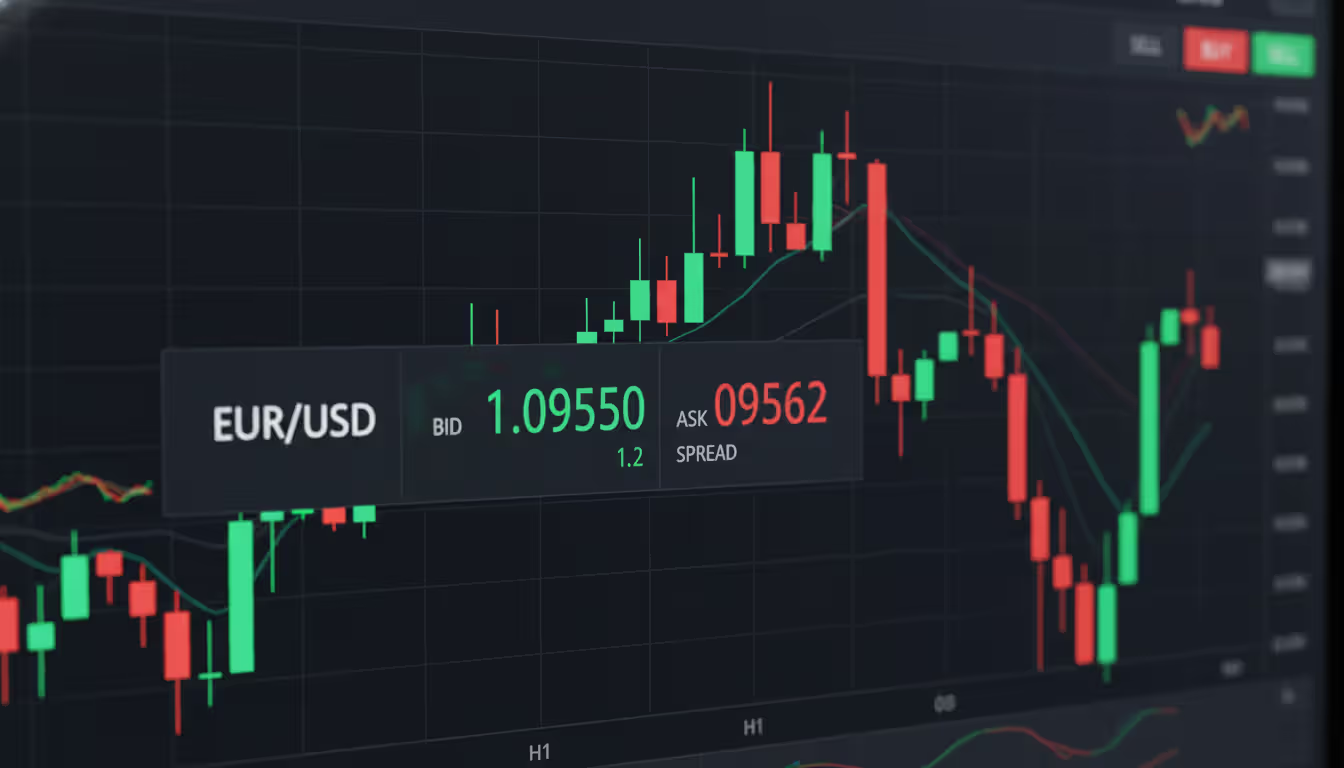
Spreads represent the gap between where you can sell (bid price) and where you can buy (ask price). EUR/USD quoted 1.0850/1.0852 carries a two-pip spread. You'll pay the higher ask when opening long positions and receive the lower bid when closing. Tighter spreads reduce transaction costs—reputable brokers offer sub-one-pip spreads on majors, while exotic pairs might carry spreads of 20–50 pips.
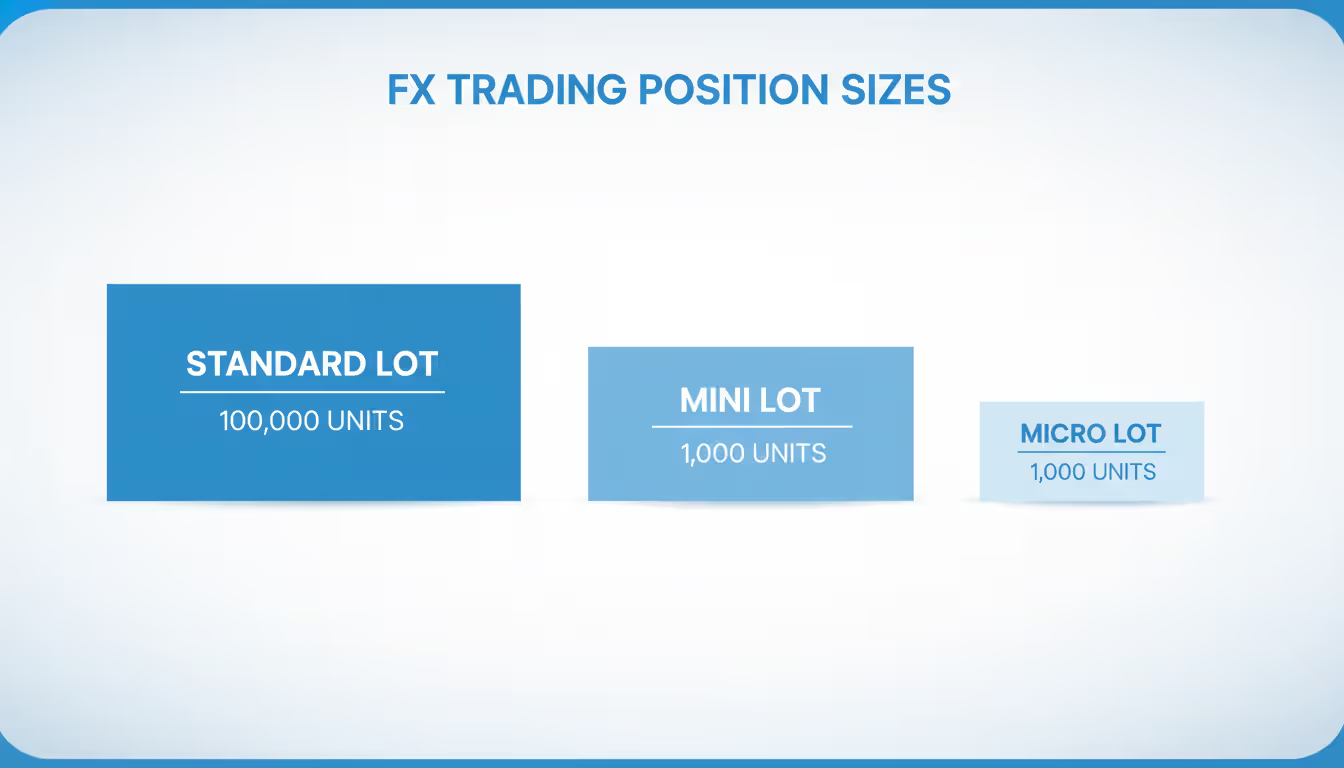
Lots standardize position sizing in the FX world. A standard lot controls 100,000 units of whichever currency comes first in the pair. Mini lots represent 10,000 units. Micro lots scale down to just 1,000 units. Trading one standard lot of AUD/USD? You're controlling A$100,000 worth of exposure. Lot sizing determines how much profit or loss each pip movement generates.
Leverage allows you to control positions far exceeding your actual account balance. With 30:1 leverage, your $2,000 account controls $60,000 in market exposure. Leverage doesn't change pip values directly—it just enables dramatically larger positions (carrying proportionally larger risks) with limited capital. Beginners consistently make the same mistake: maxing out available leverage on every trade, virtually guaranteeing eventual account blowup.
Major pairs always include US dollars paired with another widely-traded currency: EUR/USD, GBP/USD, USD/JPY, USD/CHF, AUD/USD, USD/CAD, and NZD/USD. These pairs deliver the best spreads and strongest liquidity.
Minor pairs (also called crosses) skip the dollar entirely: EUR/GBP, GBP/JPY, AUD/NZD, and similar combinations. Spreads widen slightly compared to majors but remain quite reasonable with solid liquidity.
Exotic pairs match major currencies against emerging market money: USD/TRY (Turkish lira), EUR/PLN (Polish zloty), GBP/ZAR (South African rand). Exotics carry substantially wider spreads, shallower liquidity, and heightened volatility. Beginners should avoid them despite tempting dramatic price swings—those wild movements typically accelerate losses rather than creating easy profits.
Practical suggestion? Stick exclusively with majors until you've genuinely mastered basic market dynamics. The extra volatility in exotic pairs doesn't translate into easier trading—usually just faster account destruction for inexperienced participants.
Author: Ethan Blackwell;
Source: martinskikulis.com
Frequently Asked Questions About FX Trading
Is FX trading legal in the US?
Completely legal, though tightly regulated. Retail forex brokers operating domestically must register with the Commodity Futures Trading Commission (CFTC) and join the National Futures Association (NFA). These regulatory agencies protect traders by enforcing minimum capital reserves, requiring segregated customer funds, and capping leverage at 50:1 for majors (20:1 for minors). Before funding any account, verify the broker's NFA registration status—takes 90 seconds and prevents catastrophic errors.
How much money do I need to start FX trading?
Minimum deposits at various US brokers range from $100–$500, though some require $1,000 or more. Here's the smarter question: how much can you afford to lose during the learning curve? Most beginners lose money initially—that's simply reality. Starting with $3,000–$5,000 provides adequate capital to survive inevitable mistakes, practice proper position sizing (risking just 1–2% per trade), and avoid the psychological destruction that accompanies trading your last few hundred dollars. Underfunded accounts force terrible risk decisions and typically implode rapidly.
What are the risks of FX trading?
Leverage represents the primary danger—it amplifies losses just as powerfully as gains. A 2% adverse price move against a heavily leveraged position can evaporate substantial capital within minutes. Market risk emerges from unexpected economic data, surprise central bank announcements, or geopolitical shocks triggering violent price movements. Counterparty risk exists when brokers lack proper regulation or face financial distress (another critical reason to use exclusively NFA-registered firms). Don't underestimate psychological risk—24-hour market access and instant execution can trigger overtrading, revenge trading after losses, and emotional decisions that destroy accounts faster than poor strategy.
What time does the FX market open and close?
Markets start Sunday around 5 PM Eastern as Wellington, New Zealand begins their Monday. Trading continues without pause until Friday at 5 PM Eastern when New York winds down. Throughout those five days, activity flows seamlessly as sessions transition from Asia to Europe to North America. A brief low-liquidity period exists between Friday's New York close and Sunday's Wellington open, but no formal closure happens—the market essentially operates continuously during the trading week.
Can you make money trading FX?
Definitely possible, though most retail participants don't. Multiple studies consistently show 70–80% of retail FX traders lose money over extended periods. Profitable traders typically share common characteristics: strict risk management protocols, realistic profit expectations, emotional discipline, and sufficient capital to weather inevitable drawdowns. Those achieving consistent profitability treat FX like a legitimate business requiring education, extensive practice, and psychological control—not a lottery ticket. Earning consistent returns is absolutely achievable but far from guaranteed or easy. Most successful traders invest six months to several years learning before reaching sustainable profitability.
What's the most traded currency pair?
EUR/USD absolutely dominates, representing approximately 23% of daily global FX volume. Its popularity stems from several factors: the combined economic weight of Europe and America, exceptionally tight spreads (frequently under one pip), deep liquidity during all sessions, and abundant available analysis. USD/JPY ranks second, with GBP/USD claiming third position. These three pairs alone account for nearly half of worldwide FX trading volume. For newcomers, EUR/USD offers the optimal blend of narrow spreads, consistent liquidity, and relatively predictable behavioral patterns.
Understanding what FX actually means opens access to Earth's largest and most liquid financial marketplace. Foreign exchange enables international commerce, creates speculation opportunities, and serves as a critical mechanism for implementing monetary policy.
The terminology, structural organization, and participant ecosystem differ substantially from equity markets. Round-the-clock decentralized operation offers tremendous flexibility but demands corresponding discipline. High leverage availability creates opportunities but requires rigorous risk control. The relatively focused universe of currency pairs simplifies analysis but necessitates deep understanding of macroeconomic forces.
Whether you're exploring FX to hedge business currency exposure, diversify investment portfolios, or pursue active speculation, success requires education before execution. Online brokers make market access ridiculously simple—but easy access absolutely doesn't translate into easy profits. Most professionals recommend spending months practicing with demo accounts, studying both technical price action and fundamental economic drivers, and developing detailed written trading plans before risking real capital.
The FX market isn't vanishing. As long as nations maintain sovereign currencies while engaging in cross-border trade and investment, foreign exchange will remain central to global finance. Investing time now to properly understand its mechanics, risks, and opportunities positions you to participate more effectively—whether as a corporate hedger, portfolio investor, or speculative trader.
The purchasing power of the US dollar has declined roughly 98% since 1913. While gradual erosion differs from collapse, understanding which assets retain value during currency crises provides practical preparation for scenarios that have played out repeatedly throughout monetary history
Volatility determines profit potential and risk in forex trading. Some currency pairs swing hundreds of pips daily while others barely move. This guide examines which pairs exhibit the highest price fluctuations, why certain currencies are more volatile, and how to trade them effectively with proper risk management
The forex market processes $7.5+ trillion daily, yet a handful of pairs dominate volume. Learn which currency pairs traders prefer, why EUR/USD captures 24% of global transactions, and how liquidity, spreads, and volatility shape pair selection for different trading strategies
Major currencies represent the backbone of global foreign exchange markets. These monetary units from economically stable nations account for over 90% of daily forex turnover. Understanding which currencies dominate trading, how they're classified, and why they matter helps traders and investors navigate international markets
The content on this website is provided for general informational and educational purposes only. It is intended to explain concepts related to Forex (FX) trading, currency markets, leverage, hedging, and risk management.
All information on this website, including articles, guides, and examples, is presented for general educational purposes. Forex trading carries significant risk, and outcomes may vary depending on market conditions, leverage, and individual decisions.
This website does not provide financial, investment, or trading advice, and the information presented should not be used as a substitute for consultation with qualified financial professionals.
The website and its authors are not responsible for any errors or omissions, or for any outcomes resulting from decisions made based on the information provided on this website.