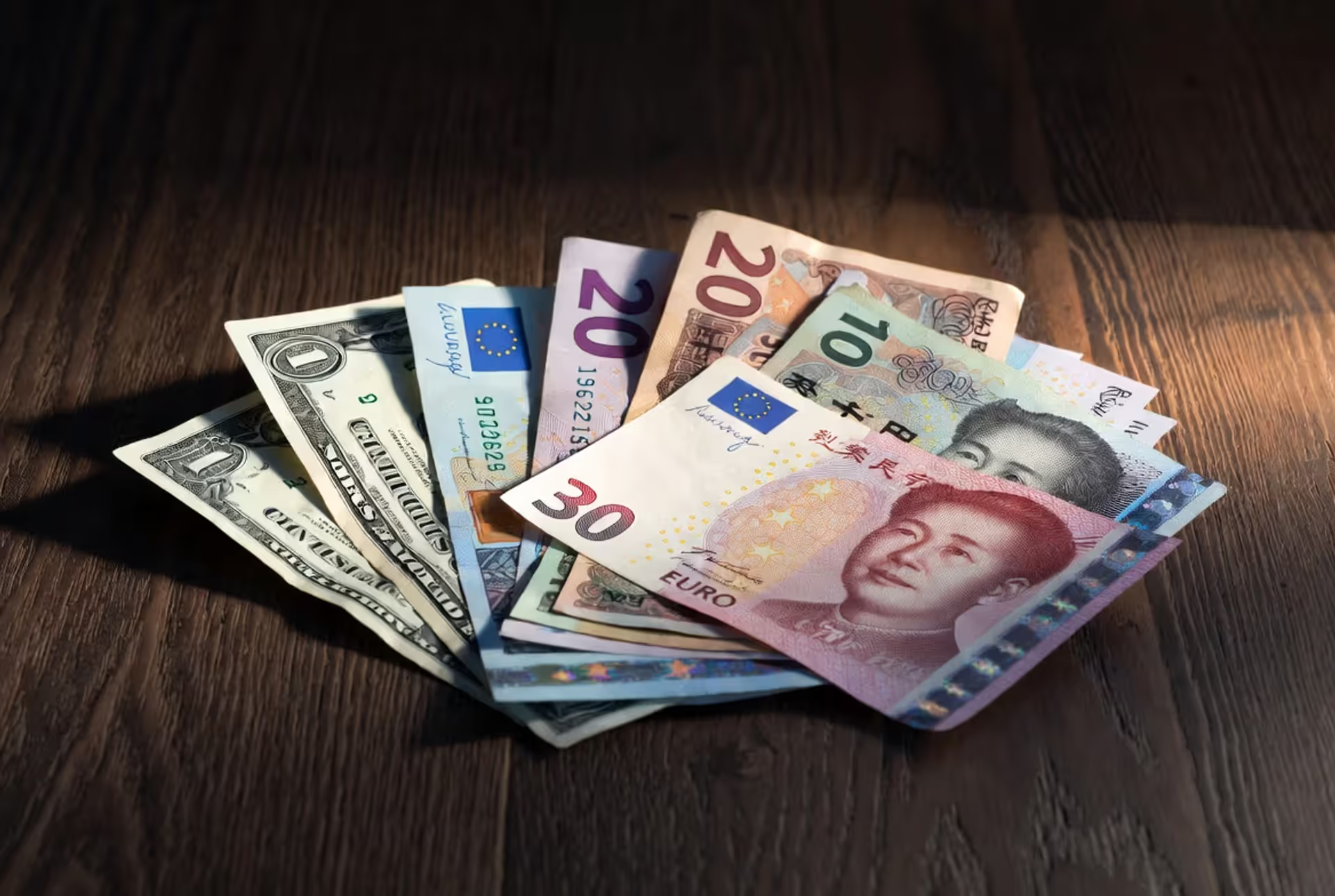
Colorful banknotes from multiple countries including US dollars, euros, Japanese yen, British pounds, and Chinese yuan spread in a fan shape on a dark wooden surface
Money takes hundreds of forms across the planet. Each nation—or group of nations—issues its own legal tender, creating a complex web of exchange rates, symbols, and denominations that shape international commerce, tourism, and investment. Whether you're a business owner hedging foreign-exchange risk, a traveler planning a multi-country trip, or simply curious about the monetary landscape, understanding the scope and structure of world currencies helps you navigate an interconnected economy.
This guide walks through the total number of currencies in circulation, highlights the major players in global trade, breaks down currency names by geography, and explains practical distinctions like fiat versus commodity-backed money. By the end, you'll have a clear framework for identifying any currency and using that knowledge in real-world scenarios.
How Many Currencies Exist Worldwide
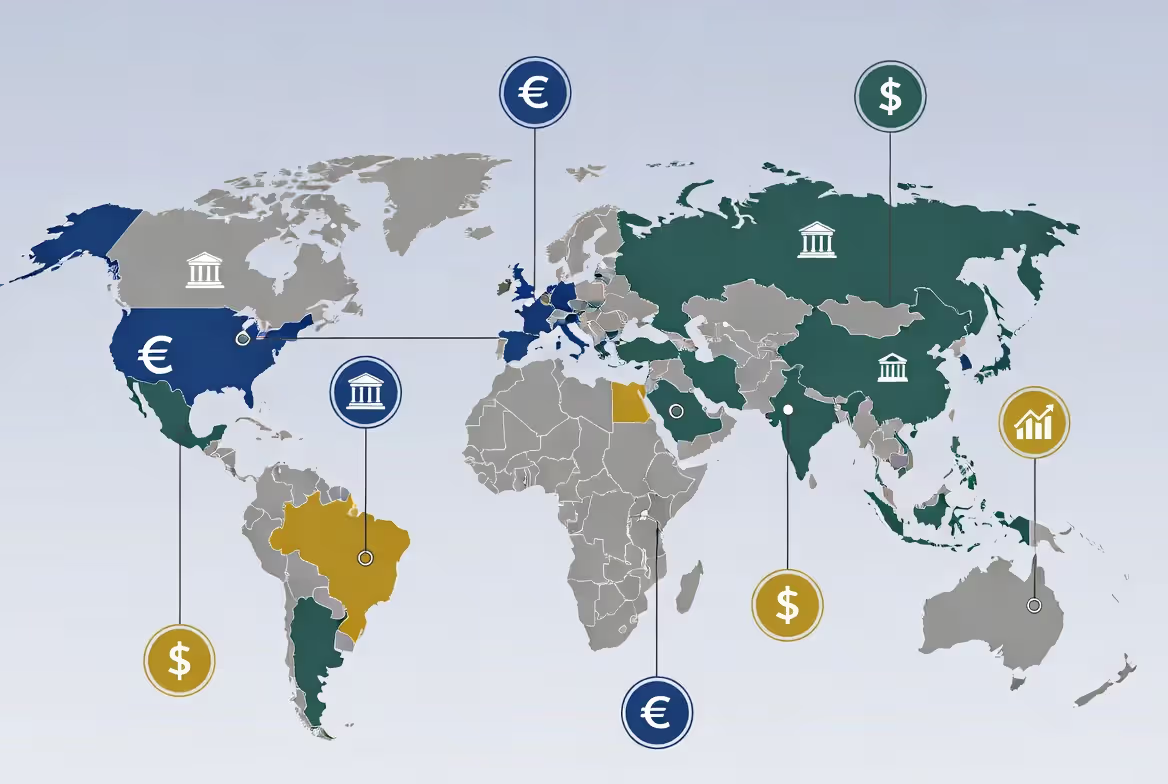
As of 2026, approximately 180 currencies are recognized as official legal tender by sovereign states and territories. The exact count fluctuates when governments introduce new notes, abandon old ones, or merge monetary systems. The United Nations currently recognizes 193 member states, yet the currency tally sits lower because several countries share a common currency—most notably the 20 European Union members that adopted the euro.
Beyond these 180 actively circulating currencies, dozens of obsolete or partially recognized notes remain in collectors' hands or limited local use. For example, the Somaliland shilling circulates in a self-declared state not widely recognized internationally, and various micronations print symbolic tokens that lack legal-tender status. Historical currencies—such as the Spanish peseta, Italian lira, or Greek drachma—were withdrawn when the euro launched in 1999 (physical notes and coins arrived in 2002), but old banknotes occasionally surface in estate sales or museum exhibits.
Another layer of complexity comes from dual-currency economies. Zimbabwe officially uses the U.S. dollar and South African rand alongside the reintroduced Zimbabwean dollar. Ecuador and El Salvador rely on the U.S. dollar as their primary currency, having abandoned domestic issuance years ago. These arrangements reduce the total unique currency count while adding nuance to any comprehensive list.
When compiling a global currency list, most references stick to the ISO 4217 standard, which assigns three-letter codes (USD, EUR, JPY) to each recognized currency. The International Organization for Standardization updates this registry periodically, ensuring businesses and financial institutions use consistent identifiers across borders.
Author: Olivia Kensington;
Source: martinskikulis.com
Major World Currencies Used in International Trade
A handful of currencies dominate cross-border transactions, foreign-exchange reserves, and commodity pricing. These major world currencies benefit from deep liquidity, stable governance, and widespread acceptance, making them the backbone of the global financial system.
U.S. Dollar (USD): The undisputed leader, accounting for roughly 88% of one side of all forex trades (since every trade involves two currencies, percentages sum to 200%). Central banks hold about 59% of their official reserves in dollars. Oil, gold, and many agricultural commodities are priced in USD, reinforcing its dominance.
Euro (EUR): The second-most-traded currency, representing around 31% of daily forex turnover. Twenty EU member states use the euro, creating a unified market of more than 340 million people. The European Central Bank's policies influence everything from German manufacturing to Greek tourism.
Japanese Yen (JPY): Japan's currency ranks third, capturing approximately 17% of forex volume. The yen serves as a funding currency for carry trades—investors borrow yen at low interest rates to invest in higher-yielding assets elsewhere—amplifying its role in global capital flows.
British Pound Sterling (GBP): Despite the United Kingdom's exit from the European Union, the pound remains a top-five currency, with roughly 13% of forex market share. London's status as a financial hub sustains sterling's liquidity.
Swiss Franc (CHF): Known for stability, the franc attracts safe-haven flows during geopolitical turmoil. It accounts for about 5% of daily forex trades. Switzerland's neutral stance and strong banking sector underpin the franc's reputation.
Canadian Dollar (CAD) and Australian Dollar (AUD): Both are commodity-linked currencies. Canada exports oil and natural gas; Australia ships iron ore and coal. Traders watch commodity prices to gauge CAD and AUD strength. Each captures 6–7% of forex volume.
Chinese Yuan (CNY): Also called the renminbi, the yuan has grown rapidly, now representing around 7% of global forex turnover and roughly 3% of central-bank reserves. China's capital controls limit full convertibility, but internationalization efforts—such as yuan-denominated trade settlements and bond markets—continue to expand its footprint.
These eight currencies form the core of reserve currency holdings. Central banks stockpile them to stabilize their own exchange rates, service foreign debt, and intervene in currency markets. The International Monetary Fund's Special Drawing Rights (SDR) basket includes USD, EUR, CNY, JPY, and GBP, reflecting their systemic importance.
Rank
Currency Name
ISO Code
Symbol
Country/Region
% of Daily Forex Volume
1
U.S. Dollar
USD
$
United States
88.0%
2
Euro
EUR
€
Eurozone (20)
31.0%
3
Japanese Yen
JPY
¥
Japan
17.0%
4
British Pound Sterling
GBP
£
United Kingdom
13.0%
5
Chinese Yuan
CNY
¥
China
7.0%
6
Australian Dollar
AUD
$
Australia
6.5%
7
Canadian Dollar
CAD
$
Canada
6.2%
8
Swiss Franc
CHF
CHF
Switzerland
5.0%
9
Hong Kong Dollar
HKD
$
Hong Kong
2.6%
10
Singapore Dollar
SGD
$
Singapore
2.4%
Note: Percentages sum to more than 100% because each trade involves two currencies. Data reflects 2026 Bank for International Settlements triennial survey estimates.
Currency Names by Country and Region
Organizing the world's currencies by continent reveals regional patterns—colonial legacies, currency unions, and economic ties that shape monetary choices.
Africa: The continent uses more than 40 distinct currencies. The West African CFA franc (XOF) and Central African CFA franc (XAF) each serve multiple countries, pegged to the euro through agreements with France. South Africa's rand (ZAR) circulates not only domestically but also in Lesotho, Eswatini, and Namibia under the Common Monetary Area. Nigeria issues the naira (NGN), Egypt the pound (EGP), and Kenya the shilling (KES). Many African nations peg their currencies to the dollar or euro to curb inflation volatility.
Asia: Home to the yuan, yen, and several fast-growing economies. India's rupee (INR) serves 1.4 billion people. Indonesia uses the rupiah (IDR), South Korea the won (KRW), and Thailand the baht (THB). The Middle East features the Saudi riyal (SAR), UAE dirham (AED), and Israeli shekel (ILS). Many Gulf states peg their currencies to the U.S. dollar, stabilizing oil revenues.
Europe: Beyond the 20 eurozone members—including Germany, France, Italy, Spain, and the Netherlands—several nations retain independent currencies. The United Kingdom uses the pound sterling (GBP), Switzerland the franc (CHF), Norway the krone (NOK), Sweden the krona (SEK), and Poland the złoty (PLN). Candidate countries such as Croatia adopted the euro in 2023, illustrating ongoing monetary integration.
North America: The U.S. dollar dominates. Canada issues its own dollar (CAD), and Mexico circulates the peso (MXN). Several Caribbean nations use the Eastern Caribbean dollar (XCD), a shared currency among eight island states.
South America: Brazil's real (BRL), Argentina's peso (ARS), and Colombia's peso (COP) are the largest by economic weight. Chile uses the peso (CLP), Peru the sol (PEN), and Uruguay the peso (UYU). Venezuela's bolívar (VES) has undergone multiple redenominations due to hyperinflation, with many Venezuelans turning to the U.S. dollar for daily transactions.
Oceania: Australia's dollar (AUD) and New Zealand's dollar (NZD) anchor the region. Pacific island nations often adopt the Australian dollar, U.S. dollar, or maintain small independent currencies like the Fijian dollar (FJD) and Papua New Guinean kina (PGK).
Author: Olivia Kensington;
Source: martinskikulis.com
This geographic lens highlights how international currency names often reflect historical ties—many former British colonies call their money "dollar" or "pound," while French-influenced territories use "franc." Regional trade agreements and currency pegs further blur national boundaries, creating clusters of shared monetary policy.
Understanding Currency Denominations and Symbols
Every currency divides into subunits—smaller fractions that facilitate everyday transactions. The U.S. dollar splits into 100 cents, the British pound into 100 pence, and the Japanese yen technically into 100 sen (though sen coins disappeared from circulation decades ago). Most modern currencies use a decimal system, making mental math straightforward: 2.50 EUR equals two euros and fifty cents.
Currency symbols provide visual shorthand. The dollar sign ($) appears in multiple countries—USD, CAD, AUD, MXN—so context or additional letters (US$, C$, A$) clarify which dollar is meant. The euro symbol (€) is unique to the eurozone. The pound sterling (£) and yen (¥) also have distinct glyphs. The Indian rupee adopted the symbol ₹ in 2010, joining a select group of currencies with custom typographic marks.
ISO 4217 codes offer unambiguous three-letter identifiers. The first two letters usually match the country code (US for United States, JP for Japan), and the third denotes the currency name (D for dollar, Y for yen). Exceptions exist—EUR doesn't follow a single country code because it spans multiple nations. Financial software, airline booking systems, and e-commerce platforms rely on these codes to prevent confusion.
Denominations worldwide vary in size and material. Polymer banknotes—pioneered by Australia in 1988—resist wear and counterfeiting better than paper. Canada, the United Kingdom, and New Zealand have since switched to polymer. Coin denominations range from small fractions (the U.S. penny, worth 0.01 USD) to large units (Switzerland's 5-franc coin). Some countries phase out low-value coins when inflation erodes purchasing power; Canada stopped distributing pennies in 2013, rounding cash transactions to the nearest five cents.
Travelers often encounter commemorative or regional notes. Scotland and Northern Ireland print their own pound sterling banknotes, legal throughout the UK but sometimes met with confusion in England. Hong Kong allows three commercial banks to issue distinct HKD designs. Understanding these quirks prevents panic when a banknote looks unfamiliar despite being valid legal tender.
Fiat Currencies vs. Other Currency Types
A fiat currency derives value from government decree rather than physical commodity backing. The U.S. dollar, euro, yen, and nearly every modern national currency fall into this category. Central banks control supply through interest rates, reserve requirements, and open-market operations, aiming to balance inflation and employment. Fiat money's flexibility allows rapid policy responses—quantitative easing during the 2008 financial crisis and pandemic-era stimulus in 2020–2021 exemplified this agility.
Historically, many currencies were commodity-backed, pegged to gold or silver. The Bretton Woods system (1944–1971) anchored the U.S. dollar to gold at $35 per ounce, with other currencies pegged to the dollar. President Nixon ended dollar-gold convertibility in 1971, completing the global shift to fiat. A few nations still hold significant gold reserves—the United States stores about 8,100 metric tons—but these reserves no longer back currency issuance directly.
Cryptocurrencies such as Bitcoin and Ethereum operate outside government control, using blockchain technology to record transactions. As of 2026, no cryptocurrency enjoys legal-tender status in major economies, though El Salvador adopted Bitcoin in 2021 (alongside the U.S. dollar). Central banks worldwide are exploring central bank digital currencies (CBDCs)—digital versions of fiat money. China's digital yuan has progressed furthest, with pilot programs in multiple cities. The European Central Bank and Federal Reserve are researching digital euro and dollar projects, but full rollouts remain years away.
Stablecoins—cryptocurrencies pegged to fiat currencies—blur the line further. Tether (USDT) and USD Coin (USDC) aim to maintain a 1:1 ratio with the U.S. dollar, offering crypto's speed and programmability with fiat's stability. Regulators scrutinize stablecoin reserves to ensure they can honor redemption requests, a key distinction from unbacked cryptocurrencies.
When compiling a list of all fiat currencies, the count aligns closely with the 180 official currencies mentioned earlier. Cryptocurrencies and commodity monies exist in parallel but occupy separate regulatory and functional spaces. For most practical purposes—paying taxes, settling international trade, or booking hotels—fiat currencies remain the standard.
Author: Olivia Kensington;
Source: martinskikulis.com
How to Use a World Currencies List for Travel or Business
A comprehensive world currency overview serves multiple real-world needs beyond academic curiosity.
Travel planning: Knowing which currency a destination uses prevents last-minute ATM scrambles. If you're flying into Switzerland, you'll need Swiss francs, not euros, despite Switzerland's location in the heart of Europe. Some tourist-heavy businesses accept euros informally, but exchange rates are poor. Checking currency in advance also reveals whether credit cards are widely accepted or cash dominates—Japan, for instance, remains surprisingly cash-centric compared to Scandinavia's near-cashless societies.
Foreign-exchange strategy: Business travelers and expatriates benefit from monitoring exchange-rate trends. If the U.S. dollar strengthens against the euro, American tourists gain purchasing power in Paris. Conversely, European exporters become more competitive in U.S. markets. Tools like XE.com or OANDA provide real-time rates, but remember that retail exchange counters and credit-card processors add margins—typically 2–5%—above the interbank rate you see online.
Avoiding scams: Unscrupulous vendors in tourist zones may quote prices in your home currency at inflated rates, a practice called dynamic currency conversion. Always pay in the local currency and let your bank handle conversion at more favorable rates. Similarly, airport exchange kiosks often charge hefty commissions; withdrawing cash from an in-network ATM usually yields better value.
Invoicing and contracts: Companies engaged in international trade must specify currency in contracts. A U.S. exporter selling machinery to Brazil might invoice in USD to avoid currency risk, or accept Brazilian reais if offering a competitive edge. Hedging instruments—forward contracts, options—lock in exchange rates months ahead, protecting profit margins from volatility.
Author: Olivia Kensington;
Source: martinskikulis.com
Dual-currency economies: In countries like Cambodia (where U.S. dollars circulate alongside the riel) or Zimbabwe (using multiple currencies), vendors often accept several options. Carry small-denomination bills; a $100 note may be refused or attract suspicion of counterfeiting. Understanding the local preference—dollars for large purchases, local currency for street food—smooths transactions.
Regulatory compliance: Importing or exporting currency above certain thresholds triggers reporting requirements. The U.S. mandates declaration of amounts exceeding $10,000 when crossing borders. Violating these rules can result in confiscation and fines, so consult customs regulations before traveling with large cash sums.
A global currency list also aids numismatists, educators designing geography curricula, and software developers building fintech apps. Maintaining an up-to-date reference ensures accuracy whether you're programming a currency converter or teaching students about economic sovereignty.
The existence of nearly 180 distinct currencies reflects both the diversity of sovereign economic policies and the persistent importance of national identity in monetary affairs. While reserve currencies like the dollar and euro dominate headlines, smaller currencies provide governments critical tools to manage inflation, employment, and trade balances tailored to local conditions. The challenge lies in balancing this autonomy with the efficiency gains of currency unions and the growing influence of digital assets
— Dr. Elena Rodriguez
Dr. Rodriguez's observation underscores a fundamental tension: currency proliferation offers policy flexibility but complicates cross-border commerce. The euro demonstrated that political will can unify monetary systems, yet the United Kingdom's choice to retain the pound—and Brexit's broader implications—shows that sovereignty concerns remain potent. As digital currencies and stablecoins mature, the definition of "currency" itself may expand, adding new layers to any global inventory.
Frequently Asked Questions About World Currencies
What is the most widely used currency in the world?
The U.S. dollar holds the top position, involved in roughly 88% of all foreign-exchange transactions and comprising about 59% of global central-bank reserves. Its dominance stems from the size of the U.S. economy, deep financial markets, and historical role as the anchor of the Bretton Woods system. The euro ranks second, but the dollar's lead remains substantial.
How many countries use the Euro as their official currency?
As of 2026, 20 European Union member states have adopted the euro: Germany, France, Italy, Spain, Netherlands, Belgium, Austria, Portugal, Finland, Ireland, Greece, Luxembourg, Slovenia, Cyprus, Malta, Slovakia, Estonia, Latvia, Lithuania, and Croatia. Several non-EU territories and microstates (Monaco, San Marino, Vatican City, Andorra) also use the euro under formal agreements. Other EU members—such as Poland, Hungary, and Sweden—retain their own currencies.
What is the difference between a currency code and a currency symbol?
A currency symbol is a graphical character (like $ or €) used for brevity in everyday writing. Multiple currencies may share the same symbol—dollar signs appear in the U.S., Canada, Australia, and Mexico—requiring context to distinguish them. A currency code is a standardized three-letter abbreviation (USD, EUR, JPY) defined by ISO 4217, ensuring precision in financial systems, contracts, and international transactions. Codes eliminate ambiguity that symbols can introduce.
Are cryptocurrencies considered part of the global currency list?
Most official tallies of world currencies exclude cryptocurrencies because they lack legal-tender status in nearly all jurisdictions and are not issued by governments. Cryptocurrencies like Bitcoin operate as decentralized digital assets rather than sovereign money. However, the landscape is evolving—El Salvador recognizes Bitcoin as legal tender, and central bank digital currencies under development may eventually appear on official lists. For now, traditional fiat currencies dominate the count.
Which currency is the strongest by exchange rate value?
Kuwaiti Dinar (KWD) consistently ranks as the highest-valued currency per unit, trading at roughly 3.25 USD per 1 KWD in 2026. The Bahraini Dinar (BHD) and Omani Rial (OMR) also boast high per-unit values. However, a strong exchange rate doesn't necessarily indicate a robust economy—it often reflects oil wealth, small population, and pegged exchange-rate regimes. Currency strength is better measured by purchasing power, stability, and reserve status than by nominal exchange rates.
How often do new currencies get introduced?
New currency launches are rare but not unheard of. South Sudan introduced the South Sudanese pound (SSP) in 2011 following independence. Redenominations—removing zeros from existing currencies—occur more frequently, especially in countries battling hyperinflation. Venezuela redenominated the bolívar multiple times in the 2020s. Currency unions like the euro represent another form of "new" currency, replacing multiple national units. On average, one or two significant currency changes happen globally each year, whether through new state formation, redenomination, or monetary union expansion.
Navigating the world's monetary landscape requires more than memorizing symbols and codes. Understanding how many currencies exist, which dominate international trade, and how fiat systems differ from digital alternatives equips you to make informed decisions—whether booking a flight, negotiating a contract, or simply satisfying intellectual curiosity. The approximately 180 recognized currencies reflect a balance between national sovereignty and global integration, a dynamic that continues to evolve as technology and geopolitics reshape finance.
Keep a reliable currency reference handy, stay alert to exchange-rate trends, and remember that behind every banknote lies a story of economic policy, cultural identity, and historical accident. The global currency list is not static; it adapts as nations rise, merge, or redefine what money means in an increasingly digital age.
The purchasing power of the US dollar has declined roughly 98% since 1913. While gradual erosion differs from collapse, understanding which assets retain value during currency crises provides practical preparation for scenarios that have played out repeatedly throughout monetary history
Volatility determines profit potential and risk in forex trading. Some currency pairs swing hundreds of pips daily while others barely move. This guide examines which pairs exhibit the highest price fluctuations, why certain currencies are more volatile, and how to trade them effectively with proper risk management
The forex market processes $7.5+ trillion daily, yet a handful of pairs dominate volume. Learn which currency pairs traders prefer, why EUR/USD captures 24% of global transactions, and how liquidity, spreads, and volatility shape pair selection for different trading strategies
Major currencies represent the backbone of global foreign exchange markets. These monetary units from economically stable nations account for over 90% of daily forex turnover. Understanding which currencies dominate trading, how they're classified, and why they matter helps traders and investors navigate international markets
The content on this website is provided for general informational and educational purposes only. It is intended to explain concepts related to Forex (FX) trading, currency markets, leverage, hedging, and risk management.
All information on this website, including articles, guides, and examples, is presented for general educational purposes. Forex trading carries significant risk, and outcomes may vary depending on market conditions, leverage, and individual decisions.
This website does not provide financial, investment, or trading advice, and the information presented should not be used as a substitute for consultation with qualified financial professionals.
The website and its authors are not responsible for any errors or omissions, or for any outcomes resulting from decisions made based on the information provided on this website.