Professional forex trading floor with multiple monitors displaying candlestick charts of currency pairs, traders at workstations, night city skyline visible through panoramic windows
Daily forex turnover exceeds $7.5 trillion. Walk into any trading floor in London, New York, or Singapore, and you'll notice something odd: despite thousands of possible currency combinations, about 70% of all transactions cluster around just seven pairs.
Why do institutional desks, retail platforms, and algorithmic systems all gravitate toward the same handful of markets? The answer involves transaction costs, execution reliability, and economic fundamentals—factors that matter whether you're testing your first $100 trade or deploying pension fund capital.
What Makes a Currency Pair Popular in Forex Trading
Forget social media buzz. A pair's genuine popularity shows up in metrics that directly impact your bottom line.
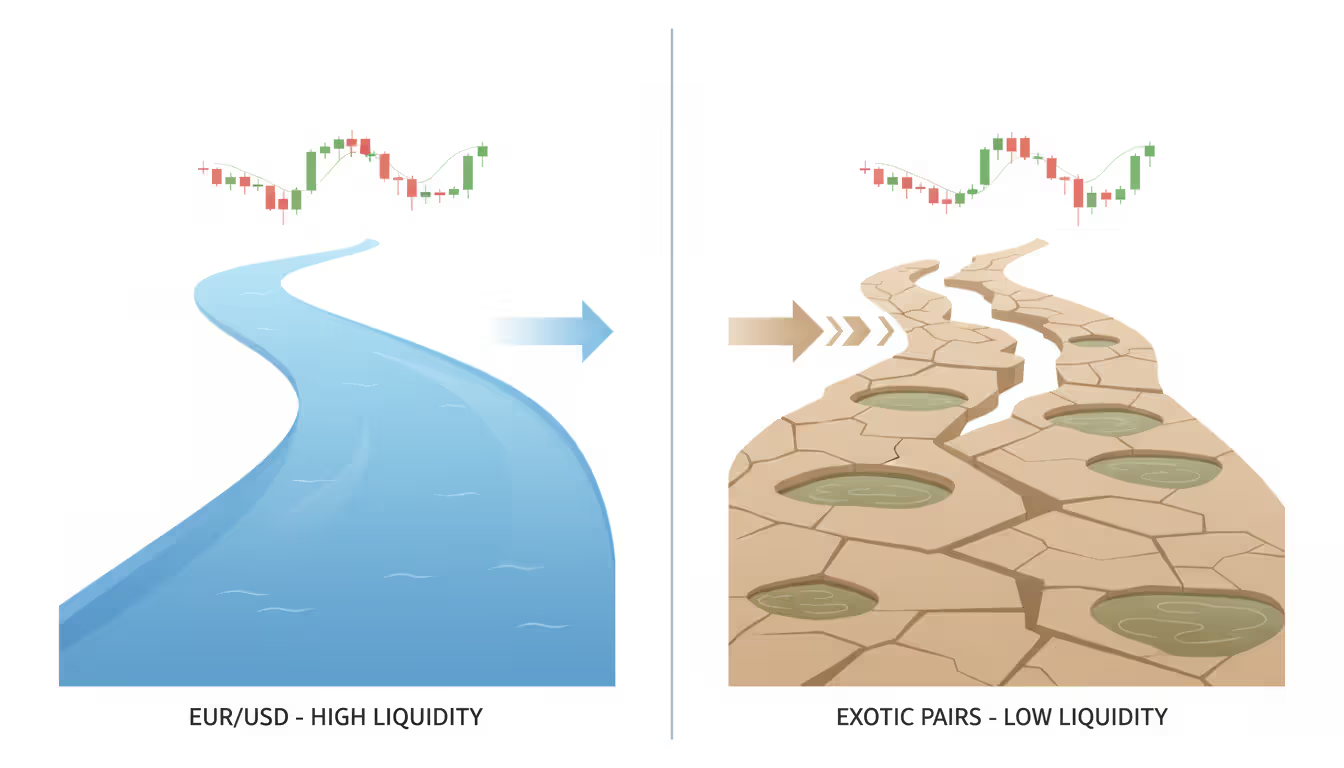
Trading volume creates the foundation. EUR/USD moves $1.8 trillion on a typical Tuesday—that's more than Canada produces in a year. This massive participation means something practical: your market orders fill instantly at the price you see. No waiting. No requotes.
Try executing the same order size in a neglected pair like USD/THB. You'll watch helplessly as the market gaps against you, the price slipping 10, 20, sometimes 50 pips away before your broker can match you with a counterparty.
Liquidity determines whether you can exit when you need to. Dump $10 million worth of EUR/USD into the market? It disappears without a trace, absorbed by the constant flow of commercial banks, hedge funds, and multinational corporations exchanging currency for actual business purposes. The price barely flickers.
Attempt that same sale in a thinly-traded exotic pair. You'll move the market violently against yourself, transforming what should've been a profitable exit into a losing proposition before the trade even settles.
Bid-ask spreads function as your per-transaction tax. During prime London-New York overlap hours, EUR/USD spreads compress to 0.1 pips. That's essentially free—the closest forex gets to zero-cost execution.
Minor pairs cost you 2-5 pips per round turn. Exotics? They'll bite off 20-50 pips just for the privilege of entering a position. Execute 50 trades monthly and these differences determine whether you're profitable or slowly bleeding capital to your broker.
Traders cluster around identical pairs because of behavioral predictability. You can backtest strategies against decades of consistent data. News releases produce measurable responses rather than chaotic randomness. Even the sophisticated algorithms prefer these markets—their statistical models break down when confronted with the weird price action that plagues illiquid pairs.
Author: Vanessa Cole;
Source: martinskikulis.com
Economic weight drives participation too. Pairs featuring USD, EUR, or JPY represent economies that actually matter on the global stage. Federal Reserve announcements, ECB policy shifts, and Bank of Japan interventions move these markets within milliseconds. That creates real trading opportunities for anyone who understands macroeconomic analysis.
The Major Forex Pairs and Their Characteristics
Seven combinations earn "major" status by pairing the US dollar with another globally significant currency. Combined, they handle roughly 68% of worldwide forex volume.
Their shared trait? Liquidity that functions 24 hours daily, spreads that won't bankrupt your strategy before it starts, and analytical coverage so comprehensive you could read institutional research for eight hours straight and not finish. Bloomberg terminals track dozens of sentiment indicators, positioning data, and bank forecasts for any major pair. This information density separates informed decisions from pure gambling.
Volatility patterns differ dramatically despite similar liquidity profiles. EUR/USD might travel 60-80 pips in a routine session. GBP/USD facing identical news events? It'll swing 100-150 pips because British economic surprises tend to hit harder, and the UK's smaller economy makes Cable more reactive to data shifts. USD/JPY often grinds sideways for days, then explodes during risk-off panics when frightened money stampedes into Japanese government bonds.
Trading sessions create natural rhythms. EUR/USD reaches maximum activity from 8 AM to noon Eastern—both European and American trading desks operating simultaneously generates the deepest liquidity pools. USD/JPY wakes up during Tokyo hours, though Japan's economic importance keeps it reasonably liquid even when Tokyo traders are sleeping.
EUR/USD: The World's Most Traded Currency Pair
Roughly one dollar in every four changing hands globally flows through EUR/USD. That works out to approximately 24% of total forex volume. This dominance didn't happen by accident.
The eurozone plus United States account for over 40% of global GDP. Physical trade between these regions requires constant currency exchange. A German automotive manufacturer selling cars in California needs dollars. An American tech company paying Dublin employees needs euros. This commercial foundation creates permanent baseline demand that exists completely independent of speculative positioning.
Author: Vanessa Cole;
Source: martinskikulis.com
Interest rate differentials between the Federal Reserve and ECB dictate medium-term directional bias. When US rates run 200 basis points above eurozone rates—like they did in early 2024—capital naturally flows toward higher dollar yields, gradually pulling EUR/USD lower. Experienced traders position ahead of central bank meetings, and their collective positioning creates the explosive volatility surrounding policy announcements.
Spreads approach theoretical minimums here. During peak liquidity windows, you're paying just 0.1-0.3 pips. For scalpers capturing 5-10 pip moves across dozens of weekly trades, this makes the difference between profitability and failure. Two-pip spreads on alternative pairs would completely destroy their edge.
Technical analysis works more reliably on EUR/USD because massive participation creates self-fulfilling dynamics. When several million traders worldwide watch the same support at 1.0800, that level tends to hold better than on a pair with one-tenth the volume. Breakouts frequently follow through cleanly rather than immediately reversing, rewarding traders who correctly identify genuine momentum shifts.
Don't confuse popularity with easy profits though. EUR/USD attracts the planet's sharpest algorithmic systems. These programs detect and ruthlessly exploit predictable retail behavior. New traders definitely benefit from low transaction costs, but consistent profitability still requires disciplined risk management and thoroughly tested strategies.
Other Major Pairs Worth Watching
USD/JPY functions as the market's fear gauge. Stock markets rallying? Risk appetite strong? USD/JPY typically climbs as traders dump safe-haven yen for higher-yielding assets. Markets tanking? The pair plunges as capital floods into Japanese bonds. This relationship makes USD/JPY invaluable for confirming what broader markets are actually feeling versus what financial media reports.
GBP/USD—called "Cable" in trading slang—delivers substantially higher volatility than its European cousin. That creates bigger profit potential, naturally paired with elevated risk. British economic surprises, particularly inflation reports and Bank of England rate decisions, can rocket Cable 150+ pips in literal minutes. Traders who thrive on adrenaline and volatility migrate here. Those preferring calmer conditions usually sleep better elsewhere.
Author: Vanessa Cole;
Source: martinskikulis.com
USD/CHF essentially mirrors EUR/USD in reverse since Switzerland's economy interlocks with the eurozone. EUR/USD climbing? USD/CHF usually falls. The Swiss franc's safe-haven reputation means USD/CHF drops during geopolitical crises as nervous capital seeks stability in Zurich bank accounts.
AUD/USD and NZD/USD get nicknamed "commodity dollars" because their economies depend heavily on raw materials. Australia exports iron ore and coal globally. New Zealand ships dairy and agricultural products. When commodity prices rally, these currencies typically strengthen. Many traders use them as proxies for global growth sentiment—strong AUD/NZD suggests confidence in worldwide economic expansion.
USD/CAD moves inversely with crude oil prices thanks to Canada's petroleum-heavy economy. Oil rallying? USD/CAD tends to drop as petrodollars strengthen Canadian fundamentals. This correlation occasionally breaks down, creating opportunities when the pair diverges significantly from oil's trajectory.
How Currency Pairs Are Quoted and Priced
Every forex quote shows two prices: the bid and the ask. The bid indicates what dealers will pay if you're selling them the base currency. The ask reveals what they'll charge if you're buying it from them. That gap—the spread—covers broker operations and market maker profits.
Say you're watching EUR/USD displaying 1.0850/1.0851. EUR sits on the left as the base currency, with USD on the right as the quote currency. That 1.0850 bid means dealers will hand you $1.0850 per euro if you're selling. Want to buy euros? You'll pay the 1.0851 ask price.
Pip measurements represent the smallest standard price increment. For EUR/USD, one pip equals 0.0001. Moving from 1.0850 to 1.0851? That's a one-pip gain. Trading a standard lot (100,000 units), each pip movement generates roughly $10 of profit or loss. Mini lots (10,000 units) see $1 per pip. Micro lots (1,000 units) move $0.10 per pip.
Yen pairs use different conventions. USD/JPY quoted at 149.50 shows just two decimal places rather than four. One pip here equals 0.01, so moving from 149.50 to 149.51 represents one pip. The math still produces approximately $10 per pip on standard lots, though the precise amount fluctuates with current exchange rates.
Cross rates for pairs excluding USD get calculated indirectly through dollar pairs. Determining EUR/GBP pricing requires both EUR/USD and GBP/USD. This mathematical detour typically produces wider spreads on crosses compared to dollar-based majors.
Quote reading becomes second nature quickly, though beginners often confuse which direction benefits their position. Simple rule: bought (went long) the base currency? You profit when the quote rises. Sold (went short) the base currency? You profit when it falls. Going long EUR/USD at 1.0850 makes money if the pair climbs toward 1.0900 since each euro now converts to more dollars.
Minor and Exotic Pairs: What Sets Them Apart
Minor pairs—sometimes called crosses—skip the US dollar while pairing two other major currencies. Common examples include EUR/GBP, EUR/JPY, and GBP/JPY. These offer acceptable liquidity, nowhere near the majors but perfectly workable for most trading styles.
Real differences emerge in spreads and volatility. EUR/GBP might display a 1.5-pip spread compared to EUR/USD's 0.2 pips. Higher transaction costs mean you need larger price movements just to break even. Volatility often runs hotter than majors because crosses combine two separate currencies' movements against the dollar.
Minor pairs excel when you hold specific convictions. Believe the euro will strengthen against the pound regardless of dollar fluctuations? EUR/GBP provides direct exposure to that thesis. Trying to express the same view by trading EUR/USD and GBP/USD separately costs you two spreads and complicates position sizing calculations.
Exotic pairs combine a major currency with an emerging market currency. Examples include USD/TRY (Turkish lira), EUR/ZAR (South African rand), and USD/MXN (Mexican peso). These introduce serious challenges that make them problematic for developing traders.
Spreads reaching 20-50 pips immediately handicap you severely. A 30-pip spread means the market must move 30 pips in your favor just for you to break even—before capturing a single dollar of actual profit.
Liquidity evaporates at inconvenient moments. During Asian hours or unexpected news, exotic pair quotes can vanish entirely. Your carefully placed stop-loss might execute 100+ pips away from your intended level, transforming a manageable loss into an account-threatening disaster.
Political and economic instability in emerging economies produces jaw-dropping price swings. A surprise government policy announcement or central bank intervention might move an exotic pair 5-10% overnight—movements that would take months in EUR/USD even during severe financial crises.
Positive carry attracts some traders to exotics. Countries like Turkey or Brazil sometimes offer interest rates 10-15 percentage points above developed nations. Holding long positions earns you daily interest payments. There's a significant catch: high interest rate currencies frequently depreciate over time, erasing your interest gains through capital losses that exceed what you collected.
Experienced traders occasionally deploy exotics for portfolio diversification or capitalizing on specific emerging market opportunities they've researched extensively. Beginners absolutely should master majors first, building skills in lower-cost environments with more predictable behavior patterns.
Most Traded Forex Pairs by Volume in 2025
Recent compilation from the Bank for International Settlements and leading forex platforms shows this trading activity distribution:
Currency Pair
Share of Daily Volume
Typical Spread
Normal Daily Range
Best Trading Sessions
EUR/USD
24.1%
0.1-0.3 pips
60-80 pips
London-NY overlap
USD/JPY
13.5%
0.2-0.5 pips
50-70 pips
Tokyo, London-NY
GBP/USD
9.8%
0.3-0.8 pips
100-150 pips
London-NY overlap
USD/CNY
6.9%
1.5-3.0 pips
40-60 pips
Asian session
AUD/USD
5.2%
0.4-0.9 pips
60-90 pips
Sydney, London-NY
USD/CAD
4.8%
0.5-1.2 pips
60-80 pips
NY session
USD/CHF
3.9%
0.6-1.5 pips
50-70 pips
London-NY overlap
EUR/GBP
2.1%
0.8-2.0 pips
40-60 pips
London session
EUR/JPY
1.9%
0.8-2.5 pips
70-100 pips
Tokyo, London
GBP/JPY
1.3%
1.2-3.0 pips
120-180 pips
Tokyo, London
These percentages represent portions of total global forex turnover. EUR/USD's 24.1% slice translates into approximately $1.8 trillion changing hands daily—exceeding the combined stock market volume of dozens of countries.
Volume trends have shifted notably over the past two years. USD/CNY jumped from 4.2% in 2024 to 6.9% currently as China continues opening capital markets and the yuan expands its international role. EUR/USD slipped marginally from 26.3% as traders diversified into Asian currency exposure.
Spread figures represent typical retail broker pricing during peak liquidity windows. Spreads balloon during major news releases, low-liquidity periods (late Friday afternoons, major holidays), and market stress events. Always verify current spreads before entering positions, particularly with minor and exotic pairs.
Daily movement ranges indicate normal price action under stable conditions. Major news events—central bank surprises, employment shocks, geopolitical crises—can easily double or triple these ranges. GBP/USD's 150-pip average can explode past 300 pips during unexpected Bank of England announcements.
The overwhelming concentration of volume in EUR/USD, USD/JPY, and GBP/USD reflects the continuing dominance of the dollar, euro, and yen in global finance.Despite emerging market growth, traders consistently prioritize liquidity and tight spreads over diversification, cementing the majors at the center of forex activity
— Michael Chen
Why EUR/USD Dominates Global Forex Markets
No other currency pair approaches EUR/USD's commanding market share. This dominance rests on multiple reinforcing factors that have sustained the pair's leadership position for over two decades.
Economic scale provides the essential foundation. The United States and eurozone together produce $45 trillion in annual economic output. Every cross-border commercial transaction between these regions involves EUR/USD conversion, generating organic demand completely independent of speculative trading.
International trade invoicing amplifies this foundation. Many globally-traded commodities—crude oil, industrial metals, agricultural products—get priced in dollars even when European companies trade with each other. A French corporation purchasing Brazilian soybeans pays in USD, necessitating EUR/USD conversion. These commercial flows dwarf speculative volumes.
Author: Vanessa Cole;
Source: martinskikulis.com
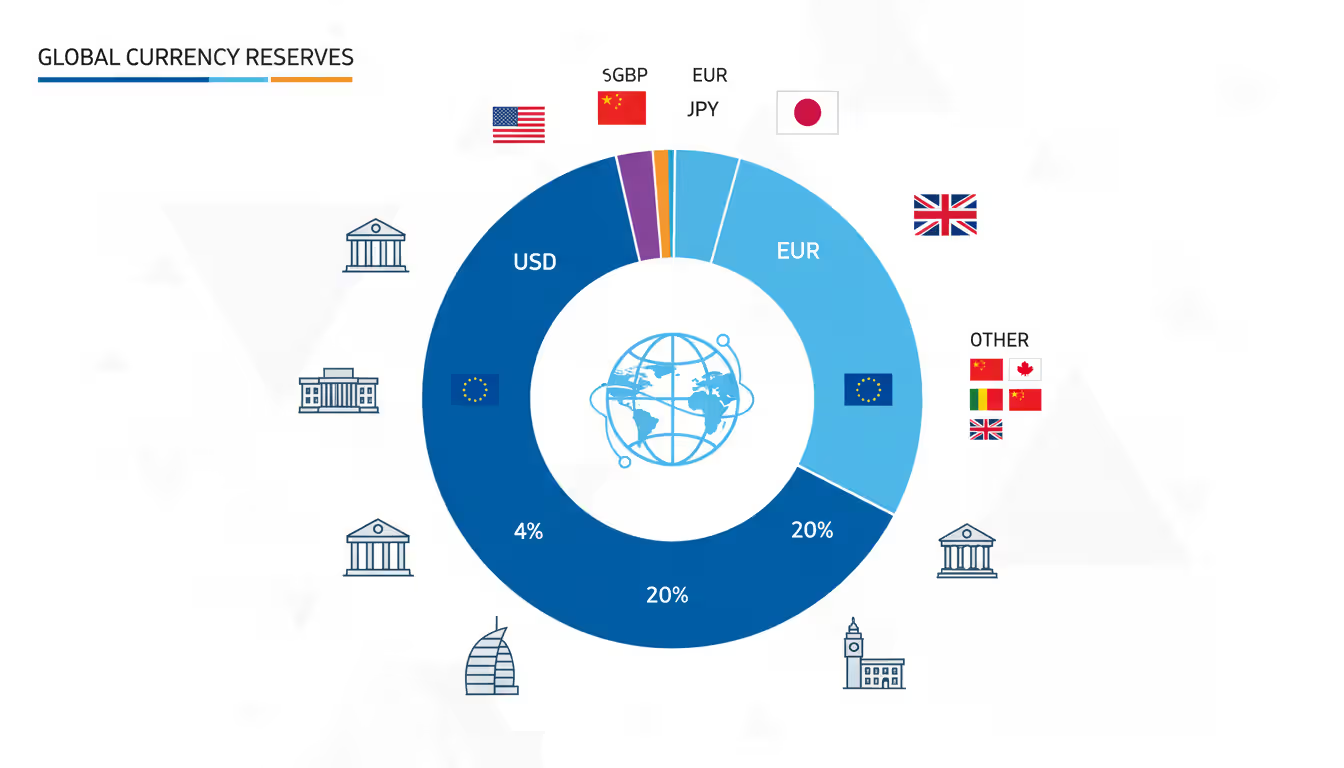
Reserve currency status for both the dollar and euro means central banks globally hold enormous quantities of each. When a country rebalances reserves from dollars toward euros (or vice versa), those transactions flow through EUR/USD markets, adding to volume. The euro represents roughly 20% of global foreign exchange reserves, trailing only the dollar's 58% share.
Derivative markets constructed around EUR/USD generate self-perpetuating liquidity. Options, futures, and swaps on this pair exceed $500 billion in daily notional value. Dealers hedging these derivatives must trade the spot market, injecting additional volume. This ecosystem makes EUR/USD the automatic choice for institutions managing currency exposure.
The pair's negative correlation with risk assets during market turmoil makes it valuable for portfolio hedging. When equity markets crater, EUR/USD frequently moves sharply, offsetting stock losses. Institutional investors maintain EUR/USD positions specifically for this diversification benefit.
Algorithmic trading systems concentrate on EUR/USD because the combination of tight spreads and deep liquidity allows high-frequency strategies to profit from minuscule price discrepancies. These algorithms execute thousands of trades daily, each contributing to volume totals. The presence of sophisticated algorithms further compresses spreads, attracting more participants in a self-reinforcing cycle.
Political stability in both regions—despite occasional challenges—keeps EUR/USD relatively predictable versus emerging market pairs. Traders don't lose sleep worrying about sudden capital controls, currency pegs breaking, or sovereign defaults. This reliability matters enormously for risk-averse institutional capital.
The Federal Reserve and European Central Bank maintain transparent, data-dependent monetary policies. Both publish detailed meeting minutes, economic projections, and forward guidance. This transparency lets traders model likely policy trajectories and position accordingly, reducing reliance on pure speculation.
Time zone coverage delivers round-the-clock liquidity. Asian traders can execute EUR/USD during Tokyo morning hours with acceptable spreads. European traders find deep markets throughout their entire business day. American traders enjoy peak liquidity during New York sessions. No other pair offers this consistent access across all major financial centers.
Here's an underappreciated factor: EUR/USD serves as the benchmark for overall forex market health. When liquidity evaporates across all pairs during crises, EUR/USD typically maintains tighter spreads than alternatives. Traders flee toward this pair during uncertainty, confident they can exit positions if conditions deteriorate. This flight-to-liquidity behavior reinforces EUR/USD's dominance during precisely the moments when market structure matters most.
Frequently Asked Questions About Forex Currency Pairs
What is the most traded forex pair?
EUR/USD dominates with roughly 24% of worldwide forex volume—approximately $1.8 trillion in daily transactions. This leadership stems from the combined economic output of the United States and eurozone, extensive bilateral trade requiring constant currency conversion, and the pair's role as a global liquidity benchmark. USD/JPY captures second place at 13.5% of volume, while GBP/USD takes 9.8%.
Why is EUR/USD so popular with traders?
EUR/USD provides the forex market's tightest spreads (frequently 0.1-0.3 pips), extraordinary liquidity enabling instant execution of massive orders, and comprehensive analytical coverage from institutions worldwide. The pair demonstrates predictable responses to economic data releases and central bank policy shifts, making it suitable for both technical and fundamental analysis approaches. These characteristics minimize trading costs and improve strategy reliability compared to less liquid alternatives.
What's the difference between major and minor pairs?
Major pairs always include the US dollar matched with another heavily-traded currency—EUR, JPY, GBP, CHF, CAD, AUD, or NZD. Minor pairs (also called crosses) combine two major currencies while excluding the dollar, such as EUR/GBP or AUD/JPY. Majors generally deliver tighter spreads (0.1-1.0 pips) and superior liquidity. Minors show wider spreads (1.0-3.0 pips) and somewhat reduced volume. Both categories work well for most trading strategies, though majors involve lower transaction costs.
How do I read a currency pair quote?
Consider a quote displaying EUR/USD 1.0850/1.0851. This shows the bid (1.0850) where dealers purchase the base currency, and the ask (1.0851) where they sell it. EUR on the left represents the base currency; USD on the right is the quote currency. The bid of 1.0850 means dealers pay $1.0850 per euro if you're selling. Buying euros costs you the 1.0851 ask. Going long EUR/USD at 1.0851 generates profit if the pair climbs to 1.0900 because each euro now converts to more dollars. The 0.0001 difference (0.1 pips) represents your transaction cost.
Are exotic pairs good for beginners?
No. Exotic pairs pairing major currencies with emerging market currencies (like USD/TRY or EUR/ZAR) involve spreads of 20-50+ pips, unpredictable volatility, and liquidity gaps causing severe slippage. Political instability and abrupt policy changes in emerging economies create risks even experienced traders find challenging. Beginners benefit from focusing on major pairs where tight spreads and more predictable behavior allow skill development without punishing costs.
Which forex pairs have the tightest spreads?
EUR/USD consistently delivers the market's tightest spreads, often 0.1-0.3 pips during peak London-New York trading overlap. USD/JPY follows closely with 0.2-0.5 pips. GBP/USD, despite higher volatility, maintains 0.3-0.8 pip spreads with quality brokers. These three pairs provide your best options for minimizing transaction costs. Remember that spreads widen during low-liquidity periods (late Friday afternoons, major holidays) and news events, so timing execution matters as much as pair selection.
The concentration of forex trading volume within a small group of pairs—especially EUR/USD, USD/JPY, and GBP/USD—reflects fundamental economic realities rather than random market preference. These pairs deliver the liquidity, competitive spreads, and predictable behavior that make consistent trading actually achievable.
Starting with major pairs lets you develop skills in forex's most forgiving environment. The 0.1-0.3 pip spreads on EUR/USD mean your strategy doesn't need to overcome massive transaction costs before generating profits. Deep liquidity ensures your orders execute at displayed prices instead of slipping unpredictably.
As experience accumulates, minor pairs offer diversification without exotic pairs' extreme risks. EUR/GBP or AUD/JPY introduce new market dynamics while maintaining reasonable spreads and adequate analytical coverage. Exotic pairs remain appropriate only for traders with specific emerging market expertise and tolerance for dramatic volatility.
Understanding what drives pair popularity—volume, liquidity, economic significance—helps you select instruments matching your strategy and risk tolerance. A scalper needs EUR/USD's minimal spreads and constant movement. A swing trader might prefer GBP/USD's larger daily ranges. A macro investor could use AUD/USD to express views on global commodity demand.
The forex market's structure rewards matching your approach to pair characteristics rather than chasing exotic opportunities or ignoring transaction costs. Master the majors initially. The skills you build trading EUR/USD transfer directly to other pairs when you're ready for expansion.
The purchasing power of the US dollar has declined roughly 98% since 1913. While gradual erosion differs from collapse, understanding which assets retain value during currency crises provides practical preparation for scenarios that have played out repeatedly throughout monetary history
Volatility determines profit potential and risk in forex trading. Some currency pairs swing hundreds of pips daily while others barely move. This guide examines which pairs exhibit the highest price fluctuations, why certain currencies are more volatile, and how to trade them effectively with proper risk management
Major currencies represent the backbone of global foreign exchange markets. These monetary units from economically stable nations account for over 90% of daily forex turnover. Understanding which currencies dominate trading, how they're classified, and why they matter helps traders and investors navigate international markets
Discover the full scope of world currencies in 2026—from the 180+ recognized legal tenders to the major players in forex markets. Learn currency names by country, understand fiat vs. digital money, and get actionable advice for travel and international business
The content on this website is provided for general informational and educational purposes only. It is intended to explain concepts related to Forex (FX) trading, currency markets, leverage, hedging, and risk management.
All information on this website, including articles, guides, and examples, is presented for general educational purposes. Forex trading carries significant risk, and outcomes may vary depending on market conditions, leverage, and individual decisions.
This website does not provide financial, investment, or trading advice, and the information presented should not be used as a substitute for consultation with qualified financial professionals.
The website and its authors are not responsible for any errors or omissions, or for any outcomes resulting from decisions made based on the information provided on this website.