Global map highlighting commodity currency countries Australia Canada Norway Russia with natural resource icons and currency symbols on dark blue financial background
Author: Marcus Ellington;Source: martinskikulis.com
When the price of iron ore surges, the Australian dollar often strengthens. When crude oil crashes, the Canadian dollar typically follows it down. This isn't coincidence—it's the fundamental nature of commodity currencies at work.
Commodity currencies represent a distinct category of national money whose value moves in tandem with the prices of natural resources their countries export. Unlike reserve currencies backed by economic diversity and global trust, these currencies rise and fall with the fortune of mines, oil fields, and agricultural output. Understanding this relationship matters whether you're trading forex, managing international business exposure, or simply trying to grasp why some economies boom while others struggle when commodity markets shift.
Understanding Commodity Currencies
A commodity currency is a national currency whose value correlates strongly with the price of one or more natural resources that dominate the country's export revenue. The mechanism is straightforward: when commodity prices rise, foreign buyers need more of that currency to purchase the resources, increasing demand and pushing up the exchange rate. When prices fall, demand for the currency weakens, and its value declines.
This relationship creates commodity-linked exchange rates that behave differently from currencies backed by diversified economies. A country heavily dependent on copper exports will see its currency strengthen when global copper demand increases—typically during periods of industrial expansion—and weaken when construction slows worldwide and copper stockpiles grow.
The correlation isn't perfect or instant. Central bank policies, interest rate differentials, political stability, and broader market sentiment all influence exchange rates. But over medium to long timeframes, the statistical relationship between commodity prices and these currencies remains robust. Research consistently shows correlation coefficients between 0.6 and 0.8 for major commodity currencies and their primary export commodities—strong enough to make this relationship a cornerstone of forex trading strategies.
Resource-rich countries develop commodity currencies when natural resource exports constitute a substantial portion of GDP and government revenue. The threshold isn't fixed, but typically when a single commodity or commodity group exceeds 30-40% of total exports, the currency begins exhibiting commodity-linked behavior. This dependence creates both opportunities and vulnerabilities that define these nations' economic cycles.
Major Commodity Currency Examples
Five currencies dominate discussions of commodity-linked exchange rates: the Australian dollar, Canadian dollar, New Zealand dollar, Norwegian krone, and Russian ruble. Each derives its commodity currency status from different natural resources, creating distinct patterns of correlation and risk.
Currency
Country
Primary Commodity Export
% of Export Revenue
Correlation Strength with Commodity Price
AUD
Australia
Iron ore, coal, gold
58%
0.72
CAD
Canada
Crude oil, natural gas
43%
0.68
NZD
New Zealand
Dairy products, meat
47%
0.61
NOK
Norway
Crude oil, natural gas
67%
0.74
RUB
Russia
Crude oil, natural gas, metals
62%
0.79
Why the Australian Dollar Is a Commodity Currency
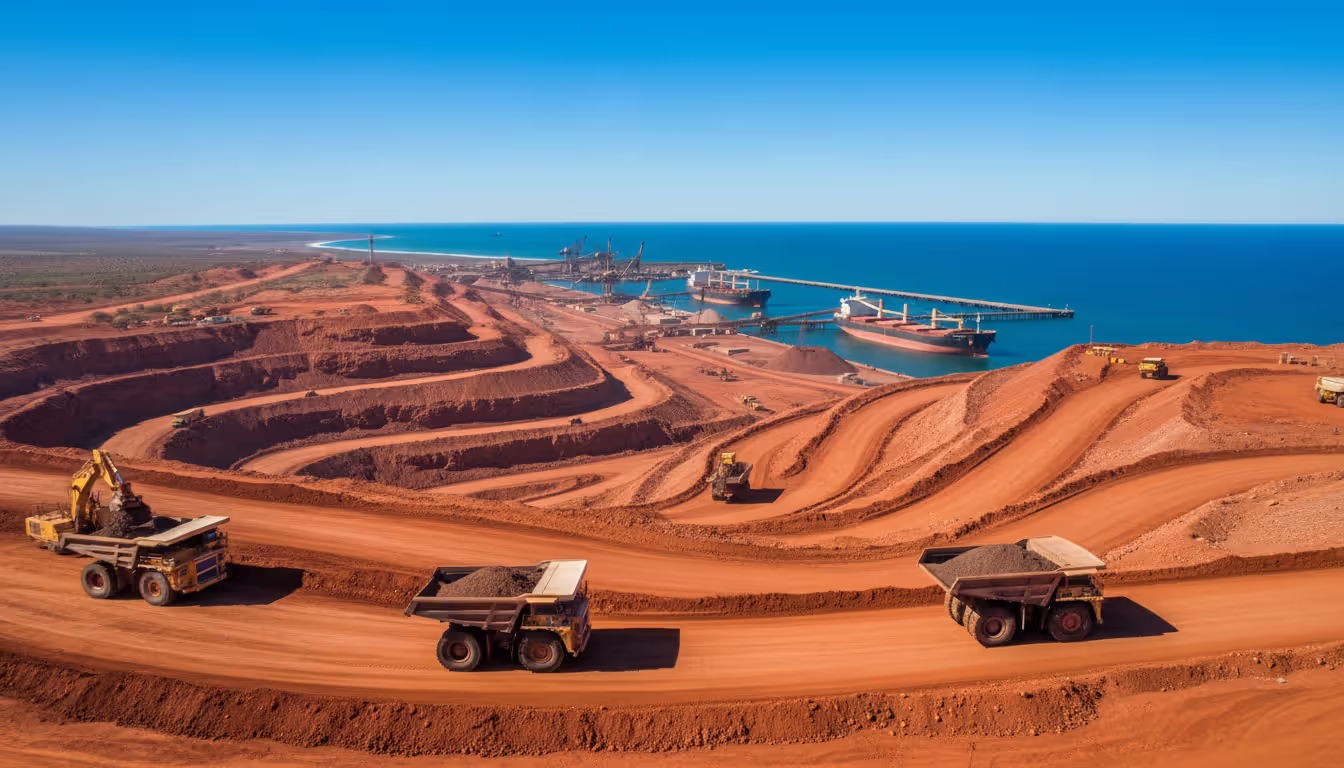
The Australian dollar serves as the textbook example of a commodity currency. Australia exports massive quantities of iron ore primarily to China, along with coal, liquefied natural gas, and gold. When Chinese steel mills ramp up production, iron ore demand spikes, and the AUD typically strengthens within weeks.
This relationship became particularly visible during China's infrastructure boom in the 2000s and early 2010s. The AUD reached parity with the USD in 2011 as iron ore prices peaked above $180 per ton. When commodity prices collapsed in 2015-2016, the AUD fell to $0.68 USD. More recently, China's economic slowdown and property sector troubles have kept pressure on iron ore demand and the AUD, despite occasional rallies when Chinese stimulus measures are announced.
The Reserve Bank of Australia acknowledges this relationship explicitly in policy statements, noting that commodity price swings affect national income, employment in mining regions, and overall economic growth. Traders watch iron ore futures on the Dalian and Singapore exchanges as leading indicators for AUD movements.
Author: Marcus Ellington;
Source: martinskikulis.com
The Canadian Dollar and Oil Dependency
The Canadian dollar—often called the "loonie" after the bird on the one-dollar coin—tracks crude oil prices more closely than almost any other relationship in forex markets. Canada's oil sands in Alberta contain the world's third-largest proven oil reserves, and energy exports to the United States dominate the trade relationship.
When West Texas Intermediate (WTI) crude trades above $80 per barrel, the Canadian economy hums, government budgets balance, and the CAD strengthens. When oil drops below $50, Alberta faces recession, federal revenues shrink, and the loonie weakens. This pattern repeated during the 2014-2016 oil crash when WTI fell from $105 to $26 and the CAD dropped from $0.95 to $0.68 USD.
The correlation isn't one-to-one because Canada has a more diversified economy than some commodity exporters, with significant manufacturing, technology, and service sectors. But energy still represents over 40% of exports, enough to make oil prices the dominant driver of CAD valuation over quarterly and annual timeframes.
Other Resource-Rich Countries and Their Currencies
New Zealand's dollar moves with dairy prices, particularly whole milk powder prices set in twice-monthly auctions. As the world's largest dairy exporter, New Zealand sees its currency strengthen when global milk demand rises—often driven by Asian consumer trends—and weaken during dairy gluts. The correlation is less pronounced than oil-currency relationships but remains statistically significant.
Norway's krone exhibits perhaps the strongest commodity correlation of any developed-market currency. Oil and gas represent two-thirds of Norwegian exports, and the country's sovereign wealth fund—the world's largest—exists specifically to manage petroleum revenues. When Brent crude rises, the NOK strengthens; when it falls, the krone weakens, though Norway's economic stability and wealth fund provide some cushioning.
Russia's ruble shows extreme sensitivity to oil prices combined with heightened volatility from geopolitical factors. During the 2022-2023 period, sanctions and energy market disruptions created unusual ruble movements, but the underlying oil correlation reasserted itself by 2025-2026 as markets adjusted to new trade patterns.
How Commodity Prices Affect Currency Values
The transmission mechanism from commodity prices to currency values operates through several channels. The most direct is the trade balance: higher commodity prices mean more foreign currency flowing into the exporting country to purchase resources, increasing demand for the local currency. Exporters convert their foreign earnings into domestic currency to pay workers and suppliers, creating sustained buying pressure.
The second channel runs through interest rates. When commodity prices rise, resource-exporting countries experience higher inflation as wealth flows into the economy. Central banks typically respond by raising interest rates to prevent overheating, which attracts foreign capital seeking higher yields and further strengthens the currency. The reverse occurs when commodity prices fall—central banks cut rates to stimulate growth, reducing the currency's appeal.
Author: Marcus Ellington;
Source: martinskikulis.com
Oil and currency correlation provides the clearest examples. When crude oil rallied from $70 to $95 per barrel during 2021-2022, the Canadian dollar strengthened from $0.78 to $0.83 USD over the same period. The Norwegian krone and Russian ruble showed similar patterns. When oil prices moderated to the $75-85 range in 2023-2024, these currencies gave back some gains.
The correlation works in both directions but isn't always symmetrical. Currencies often fall faster when commodity prices drop than they rise when prices increase, a pattern called "asymmetric correlation." This happens because commodity price crashes often coincide with broader risk-off sentiment in markets, amplifying the currency weakness, while commodity rallies may occur during mixed market conditions.
Petrocurrencies—currencies of oil-exporting nations—show the strongest and most consistent correlations. The CAD, NOK, and RUB all exhibit correlations above 0.65 with crude oil prices over rolling five-year periods. The Mexican peso and Colombian peso also qualify as petrocurrencies, though with weaker correlations due to more diversified economies.
One common mistake traders make is assuming the correlation remains constant across all time periods. During financial crises or major geopolitical events, traditional correlations can break down temporarily as investors prioritize safety over fundamentals. The CAD actually strengthened briefly during the early 2020 pandemic despite oil prices collapsing, as investors sought North American dollar exposure over emerging market currencies.
Commodity Currencies vs Reserve Currencies
Reserve currencies serve fundamentally different purposes than commodity currencies, leading to distinct characteristics that matter for both governments and investors.
Feature
Commodity Currencies
Reserve Currencies
Volatility
High (10-20% annual swings common)
Low (5-10% typical range)
Global Demand
Limited to trade and speculation
Constant for reserves and trade invoicing
Backing
Natural resource exports
Economic diversity, military power, institutions
Use in Trade
Regional or commodity-specific
Global trade invoicing standard
Central Bank Holdings
Minimal (<5% of global reserves)
Dominant (USD 58%, EUR 20%, JPY 6%)
The US dollar exemplifies a reserve currency. Central banks worldwide hold dollars as reserves, international trade invoices in dollars regardless of the countries involved, and dollar demand remains robust even when US export performance weakens. This creates self-reinforcing stability—the dollar's reserve status increases demand, which maintains its value, which reinforces its reserve status.
Commodity currencies lack this self-reinforcing loop. The Australian dollar's value depends on whether the world needs Australian iron ore, not on the AUD's role in the international monetary system. No country holds significant AUD reserves except for trade-related balances. When iron ore demand falls, nothing prevents the AUD from declining except eventual valuation levels that make Australian exports competitive again.
This difference creates a fundamental trade-off. Reserve currencies offer stability and liquidity but often remain overvalued relative to economic fundamentals—the so-called "exorbitant privilege" that allows reserve currency countries to run persistent trade deficits. Commodity currencies offer more direct exposure to global growth cycles and commodity super-cycles but with significantly higher volatility and crash risk during commodity busts.
For investors, this means commodity currencies work better for tactical positions tied to commodity views rather than long-term store of value. A trader bullish on global infrastructure spending might buy AUD to gain exposure to iron ore demand, but would typically hedge or exit the position rather than hold indefinitely.
Trading Commodity Currencies
Commodity currency trading requires understanding both forex mechanics and commodity market fundamentals—a combination that separates successful traders from those who rely on correlation alone.
The most straightforward strategy involves directional trades based on commodity price forecasts. If analysis suggests crude oil will rise from $75 to $90 over the next six months, buying CAD against USD or EUR offers leveraged exposure to that view. The currency pair will likely move 5-10% if oil follows the expected path, providing significant returns relative to the oil move itself.
Correlation trading pairs commodity currencies against each other or against non-commodity currencies. A classic trade involves buying CAD and selling AUD when oil prices are rising but iron ore prices are falling, capturing the relative performance of two commodity currencies. This reduces exposure to general risk sentiment while maintaining commodity-specific exposure.
Author: Marcus Ellington;
Source: martinskikulis.com
Timing matters enormously. Commodity currencies tend to lead commodity prices by days or weeks at major turning points, as currency markets process information about supply and demand before it fully affects physical commodity prices. Traders who wait for commodity price confirmation often enter positions after much of the currency move has already occurred.
Risk management becomes critical because commodity currencies can gap sharply on unexpected news. OPEC production decisions, Chinese economic data, or natural disasters affecting supply chains can move these currencies 2-3% in hours. Stop-loss orders help but don't eliminate gap risk, particularly over weekends when commodity markets close but geopolitical events continue.
Seasonal patterns exist but aren't reliable enough for mechanical trading. The AUD tends to strengthen during Northern Hemisphere winter when Australian iron ore shipments peak, and the CAD sometimes weakens during spring refinery maintenance season when oil demand dips. These patterns work until they don't—2023 saw the opposite seasonal pattern for AUD due to Chinese demand concerns overriding seasonal factors.
Interest rate differentials complicate commodity currency trades. A trader might correctly predict rising oil prices but still lose money on a long CAD position if the Bank of Canada cuts rates while the Federal Reserve holds steady, offsetting the commodity benefit with interest rate disadvantage. Successful commodity currency trading requires monitoring central bank policies alongside commodity fundamentals.
Petrocurrencies Explained
Petrocurrencies represent a subset of commodity currencies specifically linked to petroleum exports. The category includes obvious examples like the Canadian dollar, Norwegian krone, and Russian ruble, but also encompasses currencies of smaller oil exporters like the Mexican peso, Colombian peso, and currencies of Gulf Cooperation Council countries.
Commodity currencies tend to appreciate when global growth accelerates and commodity prices rise, making them procyclical in nature
— Dr. Michael Melvin
What distinguishes petrocurrencies from other commodity currencies is oil's unique role in the global economy. Petroleum serves as both an essential input for virtually all economic activity and a geopolitically strategic resource. This dual nature creates stronger correlations and higher volatility than currencies linked to metals or agricultural products.
OPEC influence adds another layer of complexity. When OPEC+ announces production cuts, oil prices typically rise, strengthening petrocurrencies. But the relationship isn't always straightforward—if production cuts signal weak demand rather than supply management, the currency impact may be muted or even negative as markets price in global economic weakness.
The Norwegian krone demonstrates the advantages of petrocurrency status combined with strong institutions. Norway's Government Pension Fund Global, funded entirely by oil revenues, now exceeds $1.6 trillion, providing a massive buffer against oil price volatility. The fund's spending rule—allowing the government to spend only about 3% of fund value annually—prevents the boom-bust cycles that plague other petrocurrencies. Despite this prudent management, the NOK still exhibits strong correlation with oil prices, though with less downside volatility than the Russian ruble or Mexican peso.
Vulnerabilities emerge during energy transitions. As the world gradually shifts toward renewable energy and electric vehicles, long-term demand for petroleum faces structural headwinds. Petrocurrencies must navigate this transition, with some like Norway actively preparing through economic diversification while others remain heavily dependent on oil revenues. The 2025-2026 period has shown increased volatility in petrocurrencies as markets debate the pace of energy transition against near-term oil demand resilience.
The Canadian dollar occupies a middle position—strongly correlated with oil but backed by a diversified developed economy. When oil crashed to $20 in early 2020, the CAD fell sharply but recovered faster than emerging market petrocurrencies because investors trusted Canada's broader economic stability and institutions.
Author: Marcus Ellington;
Source: martinskikulis.com
Frequently Asked Questions About Commodity Currencies
What makes a currency a commodity currency?
A currency becomes a commodity currency when natural resource exports dominate the country's foreign exchange earnings, typically exceeding 30-40% of total exports. The currency's exchange rate then exhibits strong statistical correlation with the prices of those commodities, usually above 0.6 correlation coefficient. The relationship must persist over multiple economic cycles, not just temporarily during a commodity boom.
Which commodity currency is the most stable?
The Norwegian krone ranks as the most stable commodity currency due to Norway's sovereign wealth fund, strong institutions, and prudent fiscal management. The Canadian dollar comes second, backed by a diversified developed economy despite significant oil exposure. The Australian dollar shows moderate stability, while the Russian ruble exhibits high volatility due to both commodity dependence and geopolitical factors.
How does oil price affect the Canadian dollar?
Oil prices affect the CAD through multiple channels. Higher oil prices increase export revenues, strengthening the trade balance and increasing demand for Canadian dollars. They also boost Canadian GDP growth, employment in energy sectors, and government revenues, leading to higher interest rates that attract foreign capital. The correlation coefficient between WTI crude and CAD/USD typically ranges from 0.65 to 0.75 over rolling annual periods.
Are commodity currencies good for long-term investment?
Commodity currencies work better for tactical positions than long-term investments due to high volatility and lack of reserve currency status. They perform well during commodity super-cycles lasting 10-15 years but can lose significant value during extended commodity bear markets. Long-term investors typically prefer reserve currencies for stability or maintain only small commodity currency allocations for diversification.
What is the difference between a petrocurrency and a commodity currency?
Petrocurrencies are commodity currencies specifically linked to petroleum exports, representing a subset of the broader category. All petrocurrencies are commodity currencies, but not all commodity currencies are petrocurrencies—the AUD depends on metals rather than oil, making it a commodity currency but not a petrocurrency. Petrocurrencies often show stronger correlations and higher volatility than other commodity currencies because oil plays a more central role in the global economy than other commodities.
Can the US dollar be considered a commodity currency?
No, despite the United States producing significant oil and natural gas, the USD functions as a reserve currency rather than a commodity currency. US exports are highly diversified, with energy representing less than 10% of total exports, far below the threshold for commodity currency status. The dollar's value correlates more strongly with interest rate differentials, safe-haven flows, and global risk sentiment than with commodity prices. Its reserve currency status creates demand independent of US export performance.
Commodity currencies offer a window into the fundamental relationship between natural resources and national wealth. Their value rises and falls with the fortunes of mines, oil fields, and farms, creating opportunities for traders and challenges for policymakers in resource-dependent economies.
Understanding these currencies requires looking beyond exchange rate charts to the commodity markets, shipping data, and demand patterns that ultimately drive valuation. The Australian dollar's fate ties to Chinese steel production. The Canadian dollar moves with drilling rig counts in the Permian Basin and OPEC meeting outcomes. The Norwegian krone reflects both North Sea production and global energy transition debates.
For traders, commodity currencies provide leveraged exposure to commodity views with higher liquidity than futures markets. For businesses operating in resource-rich countries, they create currency risk that demands hedging strategies. For economists and policymakers, they illustrate the double-edged nature of resource wealth—providing prosperity during booms but requiring careful management to avoid the "resource curse" of economic dependence and volatility.
The fundamental patterns persist even as specific circumstances evolve. As long as countries depend heavily on exporting natural resources, their currencies will dance to the rhythm of commodity markets, creating the distinctive behavior that defines commodity currencies in the global financial system.
The purchasing power of the US dollar has declined roughly 98% since 1913. While gradual erosion differs from collapse, understanding which assets retain value during currency crises provides practical preparation for scenarios that have played out repeatedly throughout monetary history
Volatility determines profit potential and risk in forex trading. Some currency pairs swing hundreds of pips daily while others barely move. This guide examines which pairs exhibit the highest price fluctuations, why certain currencies are more volatile, and how to trade them effectively with proper risk management
The forex market processes $7.5+ trillion daily, yet a handful of pairs dominate volume. Learn which currency pairs traders prefer, why EUR/USD captures 24% of global transactions, and how liquidity, spreads, and volatility shape pair selection for different trading strategies
Major currencies represent the backbone of global foreign exchange markets. These monetary units from economically stable nations account for over 90% of daily forex turnover. Understanding which currencies dominate trading, how they're classified, and why they matter helps traders and investors navigate international markets
The content on this website is provided for general informational and educational purposes only. It is intended to explain concepts related to Forex (FX) trading, currency markets, leverage, hedging, and risk management.
All information on this website, including articles, guides, and examples, is presented for general educational purposes. Forex trading carries significant risk, and outcomes may vary depending on market conditions, leverage, and individual decisions.
This website does not provide financial, investment, or trading advice, and the information presented should not be used as a substitute for consultation with qualified financial professionals.
The website and its authors are not responsible for any errors or omissions, or for any outcomes resulting from decisions made based on the information provided on this website.