Currency values never stand still. The exchange rate between the euro and dollar shifts minute by minute, the British pound gains strength against the yen one week and loses it the next, and emerging market currencies can swing dramatically within a single trading session. Understanding these movements matters whether you're a business owner importing goods, an investor with international holdings, or simply planning a vacation abroad.
Exchange rates respond to a complex web of forces: central bank decisions, economic data releases, political upheaval, and the collective psychology of millions of market participants. A single inflation report can trigger billions of dollars in currency trades. A presidential election can send a currency soaring or plummeting. Even rumors and speculation move markets before any actual economic change occurs.
This guide breaks down the mechanisms behind currency movements, examining both the fundamental drivers and the human factors that create volatility in foreign exchange markets.
How Currency Values Are Determined
Currency prices emerge from the same basic principle that governs any market: supply and demand. When more traders want to buy dollars than sell them, the dollar strengthens. When sellers outnumber buyers, it weakens. But unlike stocks or commodities, currencies always trade in pairs—you're simultaneously buying one currency and selling another.
The foreign exchange market operates 24 hours a day across global financial centers, with roughly $7.5 trillion changing hands daily in 2026. This massive liquidity means that prices adjust continuously as new information arrives. A bank in Tokyo selling euros for dollars at 3 AM affects the rate available to a corporation in New York at 10 AM, even though they never interact directly.
Several types of participants drive currency demand. Commercial banks execute trades for clients and manage their own positions. Multinational corporations convert revenues from foreign operations back into their home currency. Central banks intervene to influence their currency's value. Hedge funds and proprietary trading firms speculate on future movements. Even tourists exchanging cash at airports contribute to overall demand, though their impact barely registers in such a vast market.
How supply and demand affect currency values depends on what's driving the buying or selling pressure. A country running large trade surpluses naturally creates demand for its currency as foreign buyers need it to pay for exports. Higher interest rates attract capital seeking better returns, increasing demand. Political instability triggers selling as investors move money to safer jurisdictions.
The exchange rate at any moment represents the market's collective assessment of a currency's relative value—not its absolute worth, but its price compared to another currency based on current and expected future conditions.
Economic Factors That Drive Currency Movement
Economic fundamentals provide the foundation for long-term currency trends. While short-term noise can obscure these factors for days or weeks, economic drivers of currency values ultimately determine whether a currency strengthens or weakens over months and years.
Interest Rates and Central Bank Policy
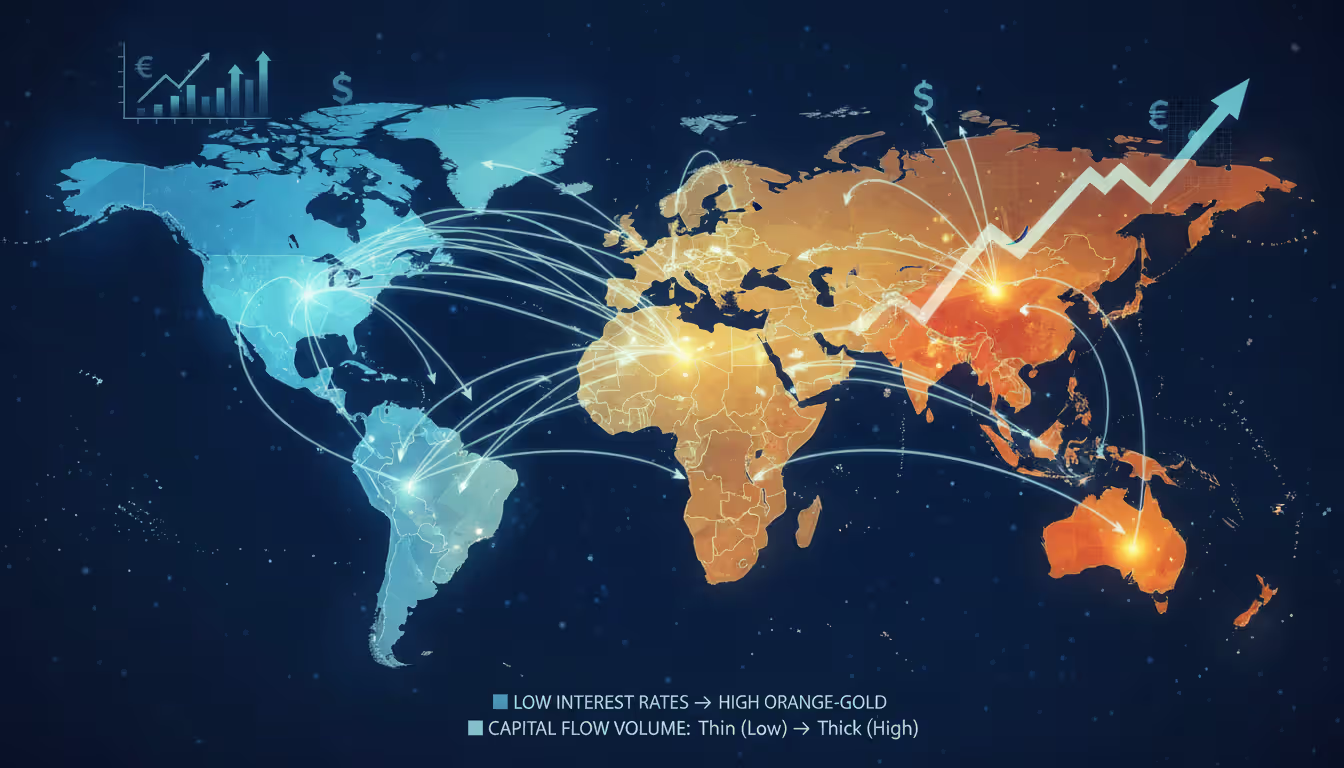
Interest rate differentials between countries create one of the most powerful forces in currency markets. When the Federal Reserve raises rates while the European Central Bank holds steady, dollar-denominated bonds and deposits offer better returns than euro-denominated alternatives. Capital flows toward higher yields, increasing demand for dollars and pushing the exchange rate higher.
Central banks influence rates through multiple channels. The most visible is the benchmark rate—the federal funds rate in the United States, the deposit facility rate in the eurozone. But central banks also use quantitative easing (buying bonds to inject money into the economy) or quantitative tightening (selling bonds to remove money). These policies affect currency values by changing the relative supply of money and influencing expectations about future rates.
A 2025 example illustrates this dynamic: when the Reserve Bank of Australia raised rates by 50 basis points in response to persistent inflation while the Bank of Japan maintained negative rates, the Australian dollar gained 8% against the yen over three months. The interest rate gap made Australian assets more attractive, driving demand for the currency.
Author: Ethan Blackwell;
Source: martinskikulis.com
Markets react not just to current rates but to expected future policy. If traders believe the Fed will cut rates in six months, the dollar may weaken immediately even though rates haven't changed yet. This forward-looking behavior means that currency values reflect both present conditions and anticipated shifts.
Inflation and Purchasing Power
Inflation erodes a currency's purchasing power, affecting exchange rates through multiple mechanisms. High inflation typically weakens a currency because each unit buys less than before. If U.S. inflation runs at 5% annually while Japanese inflation stays at 1%, goods priced in dollars become relatively more expensive, reducing demand for dollar-denominated products and the currency itself.
The relationship between inflation and exchange rates isn't always straightforward. Moderate inflation in a growing economy may coincide with currency strength if rising prices reflect strong demand and economic expansion. Central banks often respond to inflation by raising interest rates, which can strengthen the currency even as prices rise. The key is relative inflation—how one country's price increases compare to its trading partners.
Real interest rates (nominal rates minus inflation) matter more than nominal rates alone. A 5% interest rate with 4% inflation offers a real return of just 1%. A 3% rate with 0% inflation provides a 3% real return, making the second option more attractive despite the lower nominal rate. Currency traders constantly recalculate these real yields as new inflation data arrives.
Countries experiencing hyperinflation see their currencies collapse as confidence evaporates. Venezuela's bolivar and Zimbabwe's dollar serve as extreme examples where inflation exceeded 1,000% annually, making the currencies nearly worthless in international markets. Such cases demonstrate how inflation, when uncontrolled, can override all other currency value drivers.
Political and Geopolitical Influences on Exchange Rates
Political risk and currency values maintain a tight connection because government actions shape economic policy, legal frameworks, and international relationships. A stable political environment supports currency strength by providing predictability for investors and businesses. Instability introduces uncertainty, triggering capital flight and currency weakness.
Elections create natural inflection points. When a country faces a contested election with candidates proposing dramatically different economic policies, currency volatility typically increases in the weeks before voting. The British pound's behavior around the 2024 general election demonstrated this pattern, with the currency trading in a wider range as polls shifted and markets priced in different policy scenarios.
Government policy changes affect currencies through multiple channels. Tax reform that makes a country more attractive for foreign investment can strengthen its currency. New regulations that restrict capital flows or impose currency controls typically weaken it. Fiscal policy matters too—large budget deficits may undermine confidence in a currency if markets worry about long-term sustainability or potential monetization through inflation.
Geopolitical tensions create immediate currency movements. When Russia faced expanded sanctions in 2025, the ruble weakened sharply as international transactions became more difficult and foreign investors reduced exposure. Conversely, the Swiss franc and U.S. dollar tend to strengthen during global crises as investors seek safe havens.
International relations influence trade flows and capital movements that drive currency demand. A trade dispute between major economies can redirect billions in commerce, changing the relative demand for different currencies. Diplomatic breakthroughs that open new markets or resolve conflicts often boost currencies of the affected nations.
The predictability of political institutions matters as much as specific policies. Countries with strong rule of law, independent central banks, and smooth transitions of power typically maintain more stable currencies than those where political processes are opaque or prone to sudden changes.
Author: Ethan Blackwell;
Source: martinskikulis.com
Market Sentiment and Speculation
Beyond measurable economic data and political events lies the realm of market psychology—the collective mood, expectations, and risk appetite of currency traders. These subjective factors create currency volatility causes that can overwhelm fundamental analysis in the short term.
Risk sentiment drives significant currency flows. When global economic conditions look favorable and investors feel confident, money flows toward higher-yielding currencies in emerging markets and commodity-exporting nations. When uncertainty rises—whether from financial crises, pandemic fears, or geopolitical threats—capital rushes to safe-haven currencies like the U.S. dollar, Swiss franc, and Japanese yen.
The dollar's role as the primary safe-haven currency creates a consistent pattern: during market stress, the dollar strengthens regardless of U.S.-specific economic conditions. This happened repeatedly during the 2025 banking sector concerns, when the dollar gained even as some analysts questioned U.S. financial stability. The flight-to-safety instinct overrode other considerations.
Currency speculation amplifies movements in both directions. Hedge funds and proprietary trading desks take leveraged positions based on expected trends, and their buying or selling can become self-fulfilling. If enough traders believe the euro will weaken and take short positions, their selling pressure helps drive the currency down, validating their initial thesis.
Technical analysis—studying price charts, trends, and patterns—influences many traders' decisions. When a currency breaks through a widely-watched support or resistance level, algorithmic trading systems and technical traders may trigger additional buying or selling, accelerating the move. These technical factors operate independently of economic fundamentals but create real price changes.
Carry trades represent a specific form of speculation that can dominate currency flows. Traders borrow in low-interest-rate currencies (historically the yen or Swiss franc) and invest in higher-yielding currencies, profiting from the interest differential. These positions can grow to hundreds of billions of dollars, and their unwinding during market stress creates violent currency swings. The 2025 yen carry trade unwind, triggered by unexpected Bank of Japan policy shifts, caused the yen to appreciate 12% in just two weeks.
Market positioning creates its own momentum. When the majority of traders hold positions in one direction, the market becomes vulnerable to sharp reversals if new information challenges the consensus view. Currency markets regularly experience these "positioning squeezes" where crowded trades unwind rapidly.
How Currency Fluctuation Affects International Trade
Author: Ethan Blackwell;
Source: martinskikulis.com
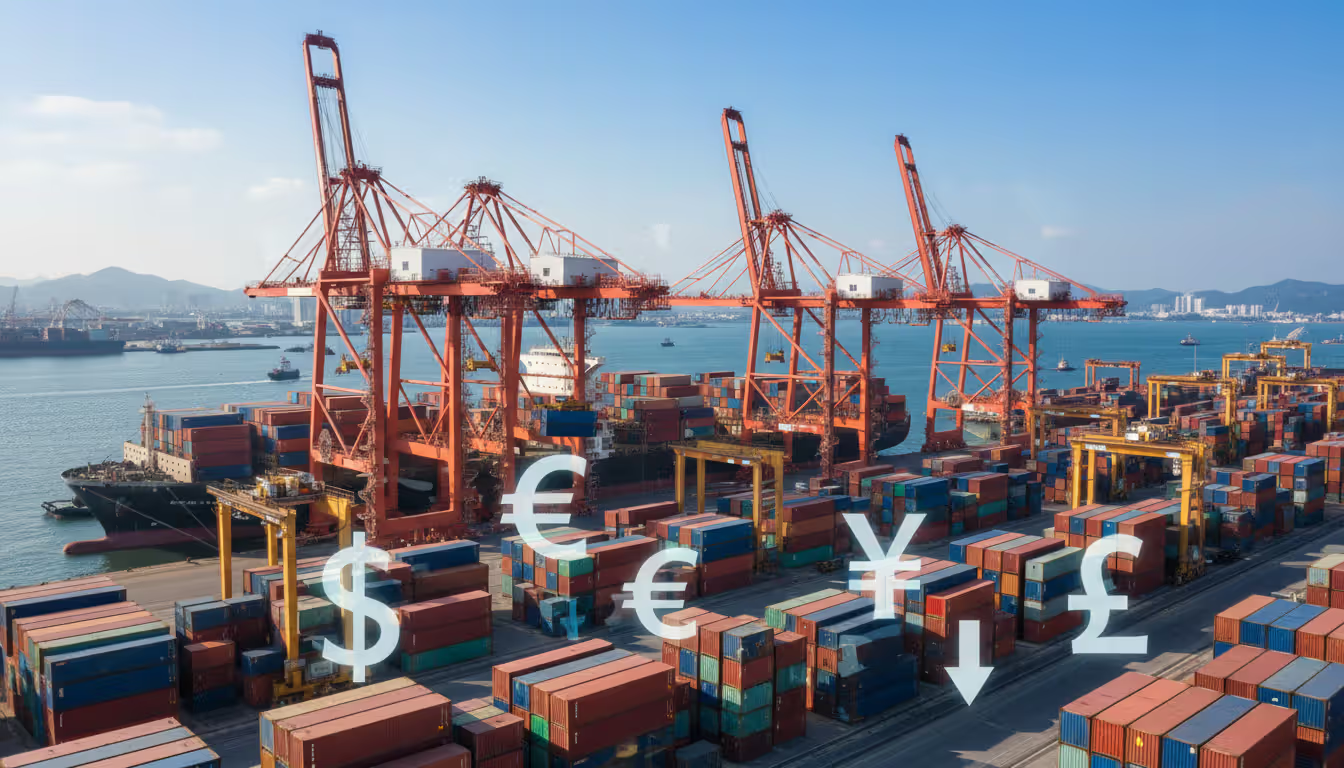
Currency fluctuation effects on trade ripple through the global economy, influencing everything from corporate profits to national competitiveness. A stronger currency makes imports cheaper but exports more expensive for foreign buyers. A weaker currency does the opposite, helping exporters while raising import costs.
Consider a German manufacturer selling machinery to U.S. customers. If the euro strengthens from $1.10 to $1.20, a €100,000 machine that previously cost $110,000 now costs $120,000. American buyers may reduce orders or seek alternative suppliers, hurting the German company's sales. Conversely, if the euro weakens to $1.00, the same machine costs just $100,000, making it more competitive and potentially increasing demand.
Import costs directly affect businesses that rely on foreign supplies. A U.S. retailer importing clothing from Vietnam sees profit margins shrink when the dollar weakens against the dong, as each dollar buys fewer dong to pay suppliers. Some companies can pass these costs to consumers through higher prices, but competitive pressures often force them to absorb some impact.
Currency volatility creates planning challenges beyond the direction of movement. When exchange rates swing unpredictably, businesses struggle to forecast costs and revenues. A contract signed when the euro trades at $1.15 may become unprofitable if the rate moves to $1.25 by the time payment is due. This uncertainty complicates budgeting, pricing decisions, and investment planning.
Hedging strategies help manage currency risk but come with costs and trade-offs. Forward contracts lock in an exchange rate for future transactions, providing certainty but eliminating the possibility of benefiting from favorable moves. Options provide insurance against adverse movements while preserving upside potential, but premiums reduce profitability. Many mid-sized companies lack the expertise or resources for sophisticated hedging, leaving them exposed to currency swings.
National competitiveness shifts with exchange rates. Japan's export sector benefits when the yen weakens, making Japanese cars, electronics, and machinery more affordable globally. Tourism flows respond to currency values too—a weak pound makes Britain a bargain destination for foreign visitors, boosting hospitality and retail sectors.
Common Currency Movement Patterns
Exchange rates are influenced by a multitude of factors, including monetary policy, fiscal policy, and economic growth prospects. But perhaps most importantly, they reflect market expectations about future economic conditions rather than just current reality. This forward-looking nature makes currency markets particularly sensitive to changes in outlook and policy direction
— Janet Yellen
Currency movement patterns help traders and analysts anticipate behavior, though no pattern guarantees future results. Understanding these tendencies provides context for interpreting exchange rate changes.
Trending versus ranging markets represent the most basic distinction. During trends, a currency moves consistently in one direction over weeks or months, driven by sustained fundamental factors like interest rate differentials or economic growth divergence. Ranging markets see currencies oscillate within a defined band, lacking clear directional momentum. The euro-dollar pair spent much of early 2025 ranging between $1.08 and $1.12 before breaking higher in response to Fed policy shifts.
Seasonal patterns appear in some currencies, particularly those of commodity-exporting nations. The Canadian dollar often shows strength in late spring and summer when energy demand peaks and oil prices typically rise. The Australian dollar sometimes exhibits patterns tied to agricultural export cycles, though these effects have weakened as financial flows increasingly dominate trade flows.
Commodity correlations remain significant for resource-dependent economies. The Norwegian krone moves closely with oil prices, the Australian dollar with iron ore and coal, the Canadian dollar with crude oil. When oil prices surged 40% during the 2025 Middle East supply disruptions, the Norwegian krone appreciated 8% against the euro within three months. These relationships aren't perfect—other factors matter too—but the correlations persist.
End-of-month and end-of-quarter flows create predictable volatility spikes. Portfolio managers rebalancing international holdings, corporations settling cross-border transactions, and derivatives contracts expiring all concentrate trading volume at period ends. Currency pairs often see increased volatility in the final hours of the month as these flows execute.
Author: Ethan Blackwell;
Source: martinskikulis.com
Crisis patterns show remarkable consistency. During financial stress, safe-haven currencies strengthen while emerging market and commodity currencies weaken. The dollar, yen, and Swiss franc gain. The Brazilian real, South African rand, and Turkish lira decline. This pattern has repeated across multiple crises, from the 2020 pandemic to the 2025 banking concerns.
Historical precedent offers lessons but not precise predictions. The dollar's multi-year strengthening from 2014 to 2017 paralleled the Fed's rate-hiking cycle. The euro's weakness from 2021 to 2023 coincided with energy crises and economic stagnation in Europe. These episodes show how sustained fundamental factors drive extended trends, but timing and magnitude vary.
Major Factors Affecting Currency Fluctuation
Factor Category
Primary Drivers
Impact Level
Typical Timeframe
Example
Economic
Interest rates, inflation, GDP growth, trade balance
High
Medium to long-term (months to years)
Fed rate hikes strengthening USD in 2025
Political
Elections, policy changes, government stability, sanctions
Frequently Asked Questions About Currency Fluctuation
What is the main reason currencies fluctuate?
No single factor dominates—currencies fluctuate due to the constant interplay between supply and demand driven by interest rate differentials, economic growth rates, inflation, political developments, and market sentiment. Interest rate gaps between countries create one of the strongest sustained pressures, as capital flows toward higher yields. However, any significant change in economic conditions, policy expectations, or risk perception can shift currency values.
How do interest rates affect currency values?
Higher interest rates typically strengthen a currency by attracting foreign capital seeking better returns on bonds and deposits. When the Federal Reserve raises rates while other central banks hold steady, investors buy dollars to access higher-yielding U.S. assets, increasing dollar demand and pushing its value higher. The relationship works in reverse too—rate cuts generally weaken a currency as capital seeks better returns elsewhere. Markets also react to expected future rate changes, not just current levels.
Can political events cause sudden currency changes?
Yes, political events frequently trigger sharp currency movements, especially when they're unexpected or involve major policy shifts. A surprising election result, sudden government collapse, or unexpected policy announcement can move a currency several percentage points within hours. The British pound dropped over 10% overnight following the 2016 Brexit referendum result. Political stability and predictability support currency strength, while uncertainty and instability typically cause weakness.
Why is the US dollar considered a safe-haven currency?
The dollar serves as the world's primary reserve currency, with central banks holding roughly 58% of their foreign exchange reserves in dollars as of 2026. The depth and liquidity of U.S. financial markets, the stability of American institutions, and the dollar's role in international trade make it the default choice during crises. When uncertainty rises, investors worldwide buy dollars and dollar-denominated assets, knowing they can easily sell them later. This self-reinforcing pattern means the dollar strengthens during most global stress events regardless of whether the crisis originates in the United States.
How does inflation impact exchange rates?
Higher inflation typically weakens a currency over time by eroding its purchasing power—each unit buys less than before, reducing its value relative to currencies with lower inflation. However, the relationship isn't always direct. Central banks often respond to inflation by raising interest rates, which can strengthen the currency even as prices rise. What matters most is relative inflation compared to trading partners and whether inflation appears temporary or sustained. Moderate inflation in a growing economy may coincide with currency strength, while runaway inflation destroys currency value.
Do currencies fluctuate on weekends?
The major foreign exchange market closes from Friday evening New York time until Sunday evening Sydney time, so most currency pairs show no price movement during weekends. However, some brokers offer limited weekend trading, and cryptocurrency markets operate continuously. When markets reopen Sunday evening, prices often "gap" higher or lower from Friday's close if significant news occurred over the weekend. Major geopolitical events or unexpected announcements during weekends can cause substantial gaps when trading resumes.
Currency fluctuation reflects the constant reassessment of relative value between economies. No currency moves in isolation—exchange rates represent the market's collective judgment about which economy offers better growth prospects, returns, stability, and safety at any given moment.
The factors driving these judgments span measurable economic data, political developments, and subjective market psychology. Interest rate differentials create sustained pressure over months and years. Inflation shapes long-term purchasing power. Political stability influences confidence and capital flows. Market sentiment amplifies movements in both directions, sometimes overriding fundamentals temporarily.
For businesses engaged in international trade, currency movements create both risks and opportunities. Exporters benefit from a weaker home currency but face challenges when it strengthens. Importers experience the opposite effects. Managing this exposure through hedging strategies, diversified sourcing, or pricing adjustments becomes essential for maintaining stable margins.
Investors with international holdings face similar dynamics. A strong dollar boosts the value of foreign assets when converted back to dollars, while a weak dollar reduces returns from overseas investments. Currency movements can either enhance or erase gains from foreign stocks, bonds, or real estate.
The foreign exchange market's 24-hour nature and massive liquidity mean that new information gets incorporated into prices almost instantly. An unexpected employment report, surprise central bank decision, or geopolitical development can move major currency pairs one or two percent within minutes. These rapid adjustments reflect millions of participants constantly updating their assessments based on the latest data.
Predicting currency movements with precision remains impossible—too many variables interact in complex ways, and unexpected events regularly surprise markets. However, understanding the key drivers helps interpret why currencies move and anticipate potential scenarios. When central banks diverge on policy, currencies typically follow interest rate differentials. When risk sentiment shifts, safe havens strengthen and higher-risk currencies weaken. When economic data surprises, currencies adjust to reflect changed growth or inflation expectations.
The patterns and relationships described here provide a framework for understanding currency markets, but they offer no guarantees. Exchange rates have surprised experts countless times, moving in unexpected directions or remaining stable when volatility seemed inevitable. Markets incorporate information faster and more thoroughly than any individual analysis can match.
What remains constant is that currencies will continue fluctuating as long as economies grow at different rates, central banks pursue different policies, and market participants reassess relative value. These fluctuations create challenges for international business and investment, but they also reflect the dynamic nature of the global economy—capital flowing toward opportunity, adjusting to new information, and constantly seeking optimal returns adjusted for risk.
The purchasing power of the US dollar has declined roughly 98% since 1913. While gradual erosion differs from collapse, understanding which assets retain value during currency crises provides practical preparation for scenarios that have played out repeatedly throughout monetary history
Volatility determines profit potential and risk in forex trading. Some currency pairs swing hundreds of pips daily while others barely move. This guide examines which pairs exhibit the highest price fluctuations, why certain currencies are more volatile, and how to trade them effectively with proper risk management
The forex market processes $7.5+ trillion daily, yet a handful of pairs dominate volume. Learn which currency pairs traders prefer, why EUR/USD captures 24% of global transactions, and how liquidity, spreads, and volatility shape pair selection for different trading strategies
Major currencies represent the backbone of global foreign exchange markets. These monetary units from economically stable nations account for over 90% of daily forex turnover. Understanding which currencies dominate trading, how they're classified, and why they matter helps traders and investors navigate international markets
The content on this website is provided for general informational and educational purposes only. It is intended to explain concepts related to Forex (FX) trading, currency markets, leverage, hedging, and risk management.
All information on this website, including articles, guides, and examples, is presented for general educational purposes. Forex trading carries significant risk, and outcomes may vary depending on market conditions, leverage, and individual decisions.
This website does not provide financial, investment, or trading advice, and the information presented should not be used as a substitute for consultation with qualified financial professionals.
The website and its authors are not responsible for any errors or omissions, or for any outcomes resulting from decisions made based on the information provided on this website.