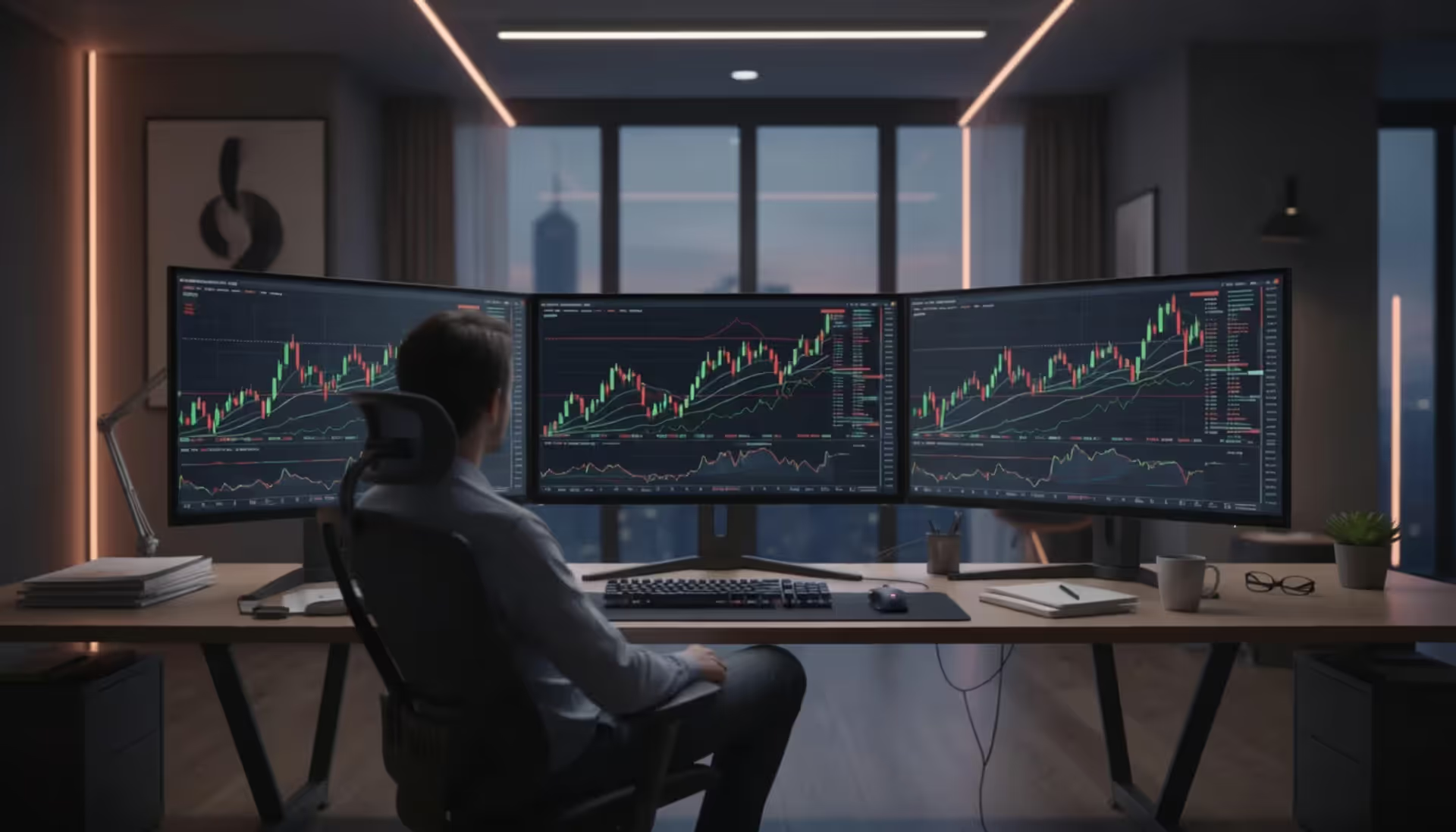
Currency markets look nothing like they did twenty years ago. Back then, human traders made nearly every decision. Today, computers handle the bulk of forex transactions—some estimates put it at 70-80% of daily volume in major pairs like EUR/USD and GBP/USD.
Retail traders now access the same automation that institutional desks pioneered. Computer programs can watch dozens of currency pairs at once, execute trades in milliseconds, and follow strategies without second-guessing or emotional interference.
But here's the thing: automation doesn't equal easy money. Plenty of algorithmic systems drain accounts faster than manual trading ever could. The difference between a working algo and an expensive mistake comes down to design, testing, and realistic expectations about what code can and cannot do in live markets.
What Is Algorithmic Forex Trading?
Picture a trading system that never sleeps. It monitors EUR/USD, USD/JPY, and fifteen other pairs simultaneously. When specific conditions appear—maybe a moving average crossover or a breakout above resistance—the system fires off buy or sell orders instantly. You might be asleep, at work, or on vacation. The algorithm keeps running.
That's algorithmic forex trading in practice. Computer programs execute currency trades based on mathematical rules, technical patterns, or statistical models. No manual button-clicking required at the moment of order placement.
Here's where it differs from discretionary trading. Manual traders analyze charts, interpret news, read price action, then decide whether to buy or sell. Their judgment drives every trade. Algorithms flip that script. A developer writes explicit rules upfront: "Enter long when RSI drops below 30 and price bounces off the lower Bollinger Band." The code watches for those exact conditions, then acts.
This separation of logic from execution matters more than it sounds. Remove the human from the decision loop and you eliminate panic selling, revenge trading after losses, and the hesitation that kills good setups. You also enable strategies impossible for manual traders—like monitoring 50 currency pairs across multiple timeframes or executing trades within 100 milliseconds of economic data releases.
Investment banks started this trend in the early 2000s. Hedge funds followed. Now retail platforms like MetaTrader and cTrader put algorithmic tools in the hands of individual traders. The barrier to entry dropped from millions in infrastructure to a laptop and internet connection.
Does automation guarantee profits? Absolutely not. A flawed algorithm just executes bad ideas faster and more consistently than a struggling manual trader. The edge comes from disciplined execution of sound logic, not from using computers instead of hands.
How Forex Algorithms Work
Every forex algorithm runs through the same basic cycle, though complexity varies wildly between a simple moving average crossover and a machine learning system processing terabytes of tick data.
Step one: data collection. The algorithm pulls price information—bid, ask, open, high, low, close—from broker feeds or data vendors. Some strategies need only daily closing prices. High-frequency systems consume every tick. More sophisticated algos add sentiment indicators, economic calendar events, or order book data.
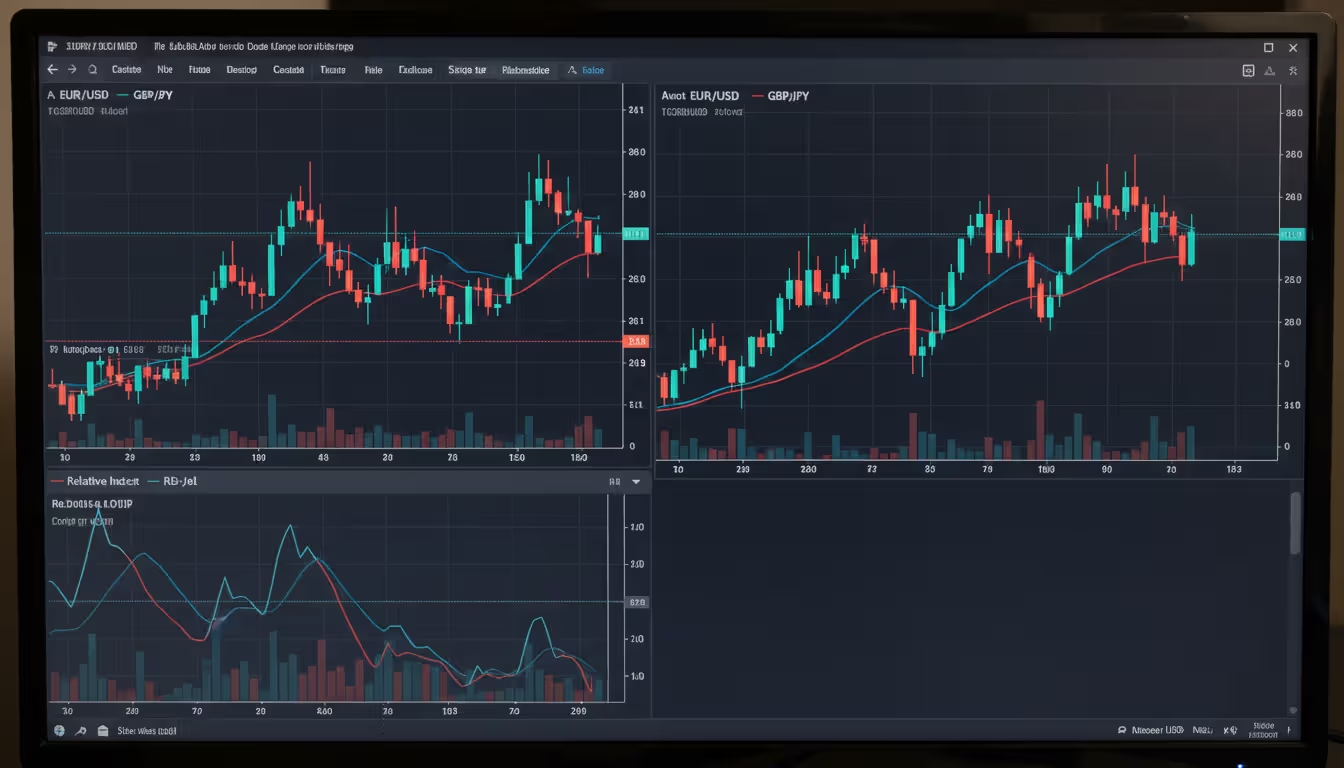
Step two: signal generation. The algorithm applies its rules to incoming data. A trend-following system might calculate whether the 20-day exponential moving average crossed above the 50-day EMA. A mean-reversion strategy might measure how many standard deviations price sits from its 100-period average. Statistical arbitrage models compare the spread between correlated pairs like EUR/USD and GBP/USD, looking for temporary divergences.
Author: Vanessa Cole;
Source: martinskikulis.com
Step three: risk checks and position sizing. Before placing any order, the algo verifies risk parameters. Is the maximum position limit already reached? Would this trade exceed the daily loss threshold? Does account equity support the calculated position size? These safeguards prevent runaway losses during system malfunctions or extreme market moves.
Step four: order execution. The algorithm submits orders to the market through broker APIs. Choice of order type matters here. Market orders guarantee fills but accept whatever price the market offers—sometimes 2-3 pips worse than expected during volatile periods. Limit orders specify "execute at this price or better," which avoids slippage but risks missing trades entirely if price never reaches the limit.
Step five: position management. Once the trade is live, the algorithm monitors for exit conditions. Maybe it trails a stop-loss below recent price action. Maybe it targets a fixed profit level. Maybe it exits when an indicator gives an opposite signal. The cycle continues: collect data, check exit rules, adjust orders if needed.
Here's a concrete example. An algorithm tracks EUR/USD on 15-minute bars. At 2:45 PM, a new bar closes. The algo calculates that the 9-period EMA crossed above the 21-period EMA. It checks position limits—no other EUR/USD trade is open. It sizes the trade to risk 1% of account equity. It submits a market order to buy 10,000 units at 1.0842. The broker fills at 1.0844 due to slippage. The algo immediately places a stop-loss at 1.0824 (20 pips below entry) and a take-profit at 1.0884 (40 pips above entry). Now it waits, checking every new 15-minute bar for exit conditions.
Algorithmic Execution in FX Markets
Execution quality determines whether a theoretically profitable strategy makes money in practice. Forex markets have no central exchange. Instead, multiple liquidity providers—banks like Citi and JP Morgan, market makers, electronic communication networks—all quote their own prices. An algorithm must navigate this fragmented landscape.
Consider slippage. Your algo targets entry at 1.1000 in EUR/USD. The market is moving fast. By the time the order reaches the liquidity provider, the best available price is 1.1003. That three-pip difference might seem trivial, but it compounds. A strategy that trades 50 times per week and suffers average slippage of 1.5 pips per trade bleeds 75 pips weekly—enough to turn a winning backtest into a losing live account.
Order type selection addresses this. Market orders prioritize speed: "fill me now at whatever price." They make sense for breakout strategies that chase momentum—missing the trade costs more than a few pips of slippage. Limit orders prioritize price: "only fill me at 1.1000 or better." Mean-reversion strategies use these because the entire premise assumes price returns to a specific level. No point chasing price away from that level.
Sophisticated execution algorithms split large orders into smaller pieces. Instead of buying 500,000 EUR/USD at once and moving the market, a time-weighted average price (TWAP) algorithm buys 10,000 units every minute over 50 minutes. Volume-weighted average price (VWAP) algorithms adjust chunk sizes based on typical hourly volume patterns, executing more during liquid periods.
Latency becomes critical as trading frequency increases. A retail algo running on a home computer in Ohio, connected to a broker server in New York, might experience 80-150 milliseconds between signal generation and order confirmation. For a daily strategy, that's irrelevant. For a scalping strategy that profits from 2-3 pip moves, those milliseconds can mean the difference between catching the move and missing it entirely.
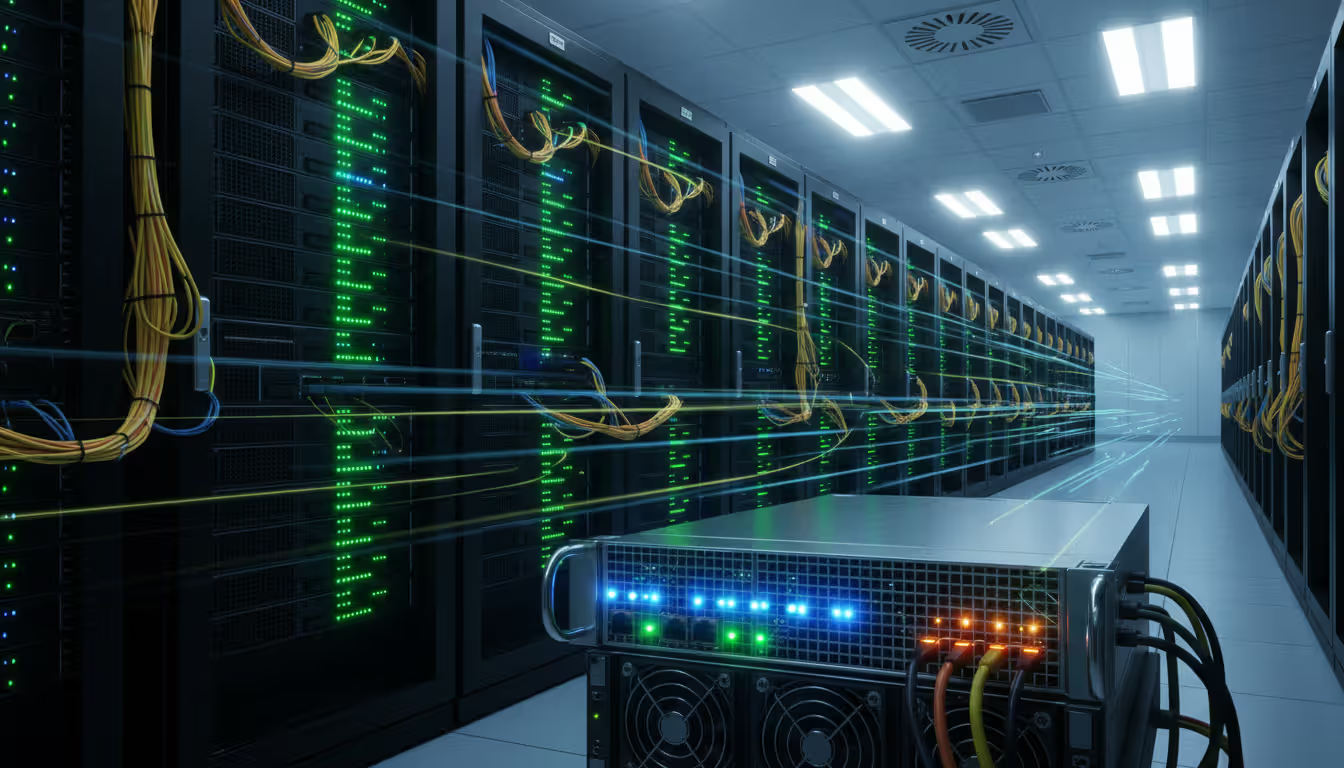
Institutional high-frequency traders colocate their servers inside the same data centers as liquidity providers. Latency drops to under one millisecond. Retail traders can't compete at that speed, which is why most individual algo traders focus on slower timeframes where a few hundred milliseconds don't matter.
Author: Vanessa Cole;
Source: martinskikulis.com
Types of Automated Forex Strategies
Algorithmic strategies fall into distinct categories, each suited to different market environments and risk profiles.
Trend-following systems ride momentum. They enter when price breaks above resistance or when faster moving averages cross above slower ones. The famous "Turtle Traders" system from the 1980s—buying 20-day highs and selling 10-day lows—is a classic trend-follower that's been adapted to algorithmic form. These strategies shine during sustained directional moves, like the USD rally from 2014-2016 or the EUR collapse in 2022. They struggle during choppy, range-bound periods when every breakout proves false and stops get hit repeatedly.
Mean-reversion approaches bet that price deviations from average are temporary. When EUR/USD touches the lower Bollinger Band and RSI drops below 30, a mean-reversion algo might buy, expecting a bounce back toward the middle band. These work beautifully in stable range markets—think EUR/USD trading between 1.05 and 1.10 for months. They fail catastrophically when a genuine trend develops and price never "reverts." The algo keeps buying a falling currency, stacking losses.
Arbitrage strategies exploit price differences across brokers or related instruments. Triangular arbitrage spots when the implied cross rate between three currency pairs differs from the actual quoted rate. For instance, if you can buy EUR/USD at 1.1000, sell EUR/GBP at 0.8500, and buy GBP/USD at 1.2941, you've locked in a tiny profit because the math doesn't align (1.1000 ÷ 0.8500 = 1.2941, so any difference creates opportunity). These opportunities exist for milliseconds. Retail traders lack the speed to capture them profitably once you account for spreads and commissions.
News-driven systems react to economic releases or central bank announcements. When US non-farm payroll data hits the wires, these algos parse the number, compare it to forecasts, and execute trades within milliseconds based on whether it beat or missed expectations. They need direct data feeds from services like Bloomberg or Reuters—waiting for free news sites introduces fatal delays. Volatility spikes around major news create wild slippage and spread widening, making these strategies risky even when directional calls are correct.
High-Frequency Forex Trading Explained
High-frequency trading represents the extreme end of algorithmic execution. These systems hold positions for seconds—sometimes microseconds—making thousands or tens of thousands of trades daily. Profit per trade might be a fraction of a pip. Scale makes the strategy viable.
HFT operations require infrastructure that retail traders simply cannot access. Servers sit inside data center racks mere feet from exchange matching engines—called colocation—reducing network latency to under 500 microseconds. Specialized hardware like field-programmable gate arrays (FPGAs) process market data faster than standard CPUs. Direct connections to liquidity providers bypass retail broker platforms entirely.
The edge comes from speed. An HFT system spots a price discrepancy between two liquidity venues and simultaneously buys at the cheaper price and sells at the higher price before anyone else reacts. Or it identifies the first microseconds of a large institutional order beginning to execute and positions ahead of the anticipated price move. These are razor-thin margins extracted from temporary inefficiencies.
Risks scale with speed. A software bug that triggers thousands of erroneous orders in 10 seconds can generate millions in losses before a human notices. Knight Capital famously lost $440 million in 45 minutes during 2012 due to a deployment error in their trading software. Competition is relentless—the fastest systems win, and speed advantages measured in microseconds cost millions to develop.
Regulators have taken notice. Some jurisdictions now require minimum order resting times to prevent quote stuffing. Transaction taxes in certain markets make ultra-short holding periods unprofitable. The European Markets in Financial Instruments Directive (MiFID II) imposes algorithmic trading registration and testing requirements.
For retail traders, HFT is a spectator sport. The capital requirement to build competitive infrastructure starts around $5 million and climbs from there. Latency from home internet makes HFT strategies mathematically impossible—by the time your order reaches the broker, institutional systems have already moved the market.
Systematic Trading vs Discretionary Trading
Traders endlessly debate whether rules-based algorithms beat human judgment. The honest answer: each excels in different areas.
Aspect
Systematic Trading
Discretionary Trading
Decision-making process
Pre-coded rules execute automatically when conditions match
Real-time judgment interpreting charts, news, and context
Heavy upfront (development/testing), minimal during live operation
Continuous—requires active screen time and focus
Adaptability to market changes
Slow—needs redesign and retesting when conditions shift
Fast—experienced traders adjust tactics based on current observations
Systematic approaches eliminate the psychological demons that plague discretionary traders. No more freezing when a perfect setup appears because the last three trades lost. No more moving stops to avoid taking a loss. The algorithm executes its logic without hesitation or second-guessing.
Scalability represents another major advantage. A single algo can monitor EUR/USD, GBP/USD, USD/JPY, AUD/USD, and a dozen other pairs across three timeframes—45 different chart combinations—simultaneously. A human watching that many screens would miss trades or make errors from information overload.
But algorithms struggle with context. A discretionary trader notices that price action looks "different" this week—maybe volatility dropped, or the usual London session patterns aren't appearing. They adjust. An algorithm coded for typical conditions keeps executing the same logic until results deteriorate enough for the developer to notice and intervene.
Market regime changes kill unprepared algos. A trend-following system developed during 2022 when inflation drove huge directional moves in USD pairs might have crushed it. That same system in 2024's choppier, range-bound environment? Likely bleeding money. Discretionary traders adapt their approach week to week. Algos need manual recoding.
Many professional traders blend both methods. They identify setups discretionally but use algos for consistent execution. Or they run multiple algos designed for different regimes and manually select which one trades based on current conditions. Pure systematic or pure discretionary are two ends of a spectrum—most successful approaches land somewhere in between.
How to Develop and Backtest a Forex Algorithm
Building an algo that doesn't blow up your account requires structured steps and honest self-assessment about what you're seeing in test results.
Start with strategy design. Don't begin by coding. Begin with a hypothesis rooted in market behavior. Example: "Currency pairs that break above multi-month consolidation ranges often continue trending for weeks." Define specific entry conditions: price closes above the highest high of the past 120 days, and average true range is above its 50-day average (confirming volatility expansion). Define exits: trail a stop at 3× ATR below the highest high since entry. Define position sizing: risk 2% of account equity per trade. Define filters: skip trades during the week of major central bank meetings.
Choose your platform. MetaTrader 4 and 5 dominate retail algo trading. They use MQL, a proprietary language similar to C++, with massive community support and thousands of code examples. Python offers more flexibility and powerful libraries like pandas for data analysis and scikit-learn for machine learning, but requires more infrastructure setup—connecting to broker APIs, managing data feeds, handling execution. cTrader uses C#, which some programmers find cleaner than MQL. TradeStation and NinjaTrader offer proprietary languages with drag-and-drop strategy builders for non-programmers.
Gather quality historical data. Garbage in, garbage out. Tick data provides the most precision but requires gigabytes of storage and slows backtests. Minute bars work for most retail strategies. Daily bars suffice for swing trading systems. Critical point: your data must include realistic bid-ask spreads. Backtesting on mid-prices without accounting for the 1-2 pip spread cost inflates results dramatically. If possible, use data from your actual broker to match the prices you'll encounter live.
Run initial backtests. Code your strategy and unleash it on historical data. The platform simulates every trade the algo would have taken. You'll get a report: 250 trades, 58% win rate, 15% total return, maximum drawdown of 12%, average trade duration 3.2 days, profit factor of 1.4 (gross profit divided by gross loss).
Watch for overfitting. This is where most developers fool themselves. You tweak parameters to maximize backtest results. "What if I use a 23-period moving average instead of 20? Oh, that boosts returns to 22%!" You keep optimizing until the equity curve looks beautiful. Then you trade it live and it collapses immediately. Why? You've fit the strategy to the noise in that specific historical data sample, not to genuine market patterns that persist into the future.
Combat overfitting by limiting parameters. Strategies with 2-3 adjustable variables are more robust than those with 10. Use out-of-sample testing: develop your strategy on data from 2018-2021, then test it on 2022-2023 data it never saw during development. Walk-forward analysis simulates realistic adaptation by repeatedly optimizing on a rolling window and testing on the next period forward.
Evaluate performance metrics honestly. A backtest showing 150% annual returns with 3% maximum drawdown screams overfitting or unrealistic assumptions about execution. Institutional algo traders often target 12-18% annual returns with drawdowns kept under 20%. Sharpe ratio above 1.5 is solid (that's risk-adjusted return—higher values mean more return per unit of risk taken). Profit factor above 1.5 indicates winning trades are sufficiently larger than losing trades. Win rate matters less than you'd think—plenty of profitable trend-followers win only 40% of trades but cut losses fast and let winners run.
Account for transaction costs. Each trade costs the spread plus any commission. If your backtest shows 500 trades per year averaging 3 pips profit each, that's 1,500 pips annually. Sounds great. But if average spread is 1.5 pips, you're really paying 750 pips in transaction costs, cutting your returns in half. Slippage adds another layer—assume at least 0.5 pips per trade for market orders on major pairs, more for exotic pairs or during news events.
Common mistakes that invalidate backtests: using future data (look-ahead bias, like calculating an indicator using prices that wouldn't be known yet), assuming perfect fills at historical prices (ignoring spread and slippage), testing on too short a timeframe (six months of data can't validate a strategy across different market regimes), and ignoring regime changes (testing through 2020's COVID volatility and 2024's calmer conditions as if they're identical environments).
Author: Vanessa Cole;
Source: martinskikulis.com
Machine Learning in Forex Trading
Machine learning sounds like the future of trading. Neural networks that predict price movements! Reinforcement learning agents that maximize profits! Adaptive systems that improve themselves!
Reality is more mundane. ML has legitimate applications in forex algo trading, but it's not a magic solution and comes with unique pitfalls.
Supervised learning models like random forests, gradient boosting machines, or neural networks can predict short-term price direction. You feed them features—past returns, technical indicators like RSI and MACD, volatility measures, even macroeconomic variables. The model learns patterns: "When these input combinations occur, price usually rises in the next hour." You use those predictions to generate trade signals.
Reinforcement learning takes a different approach. An agent explores trading actions—buy, sell, hold, adjust position size—and receives rewards (profit) or penalties (loss). Over millions of simulated trades, the agent learns a policy that maximizes cumulative reward. In theory, this discovers non-obvious strategies humans wouldn't think to code.
Time-series models like LSTMs (long short-term memory networks) or transformer architectures process sequential price data, attempting to capture temporal dependencies and long-range patterns that simpler models miss.
Here's the problem: forex markets are incredibly noisy. The ratio of signal to noise is brutally low. ML models need massive amounts of quality data to learn meaningful patterns instead of fitting to randomness. They're prone to overfitting—a neural network with 10,000 parameters can memorize historical data perfectly but fail miserably on new data.
Academic research consistently shows that ML provides marginal improvements over simpler baseline methods, not revolutionary gains. A 2019 study in the Journal of Financial Data Science found that ML models beat simple moving average strategies by 2-3% annually on average, but half the tested models actually underperformed.
Practical applications work best when ML enhances specific components rather than running the whole show. Use ML for regime detection—classifying current market conditions as trending vs. ranging, then switching between appropriate strategies. Use it for volatility forecasting to improve position sizing. Use it to optimize execution—predicting short-term price impact to time order placement.
Beware the hype. Vendors sell "AI trading bots" with vague claims about "deep learning algorithms" and zero disclosure of methodology, training data, or live performance. A black box that won't show you how it works or validate its results independently? That's a red flag, not an edge.
If you pursue ML in forex trading, start simple. A logistic regression predicting next-bar direction outperforms a poorly-implemented deep learning model. Understand the basics of feature engineering, cross-validation, and out-of-sample testing. Expect incremental improvements, not 200% returns.
How Forex Bots Work in Practice
The term "forex bot" usually refers to retail algorithmic trading software, often called Expert Advisors (EAs) in MetaTrader terminology. Understanding their practical operation helps separate realistic expectations from marketing hype.
Author: Vanessa Cole;
Source: martinskikulis.com
Platform integration is straightforward. MetaTrader 4 or 5 users download an EA file (extension .ex4 or .ex5), copy it into the platform's "Experts" folder, restart the platform, drag the EA onto a chart, and enable the "AutoTrading" button. The EA connects to the broker's price feed through the platform's API and executes trades automatically when its coded conditions trigger.
VPS hosting solves reliability problems. Running a bot on your home computer creates vulnerabilities. Power outages stop the bot. Internet disruptions disconnect it from broker servers. Windows decides to update and restart at 3 AM, right when a trade needs management. Virtual private servers—remote computers hosted in data centers—eliminate these issues. The bot runs 24/7 on stable power and internet. Most forex brokers offer VPS services optimized for low latency to their trading servers, typically $20-30 monthly.
Monitoring remains essential. Bots aren't "set and forget" systems. Markets change. A strategy that worked in January might fail in July. Brokers adjust spreads—your bot was backtested on 1.2 pip spreads but now the broker is quoting 2.5 pips during your trading hours. Software bugs emerge. You need to check performance daily: Are open trades managed correctly? Does live performance align with backtest expectations? Is slippage higher than anticipated?
Track key metrics: average slippage per trade, actual spread paid vs. expected, drawdown relative to backtest drawdown, win rate compared to historical win rate. Significant deviations signal problems.
Common pitfalls wreck accounts. Over-optimization creates bots that worked perfectly on historical data but collapse live. Inadequate capitalization means normal drawdowns trigger margin calls before the strategy can recover. Ignoring broker restrictions—some brokers prohibit certain scalping strategies or impose minimum trade durations—leads to account closure and forfeited profits.
The biggest trap? Buying commercial EAs from unverified vendors. Forex bot marketplaces overflow with systems showing incredible backtests that somehow never work when you pay for them. Vendors fabricate backtest results, cherry-pick time periods, or use hindsight bias. The $99 bot that claims 300% annual returns with 2% drawdowns? If it worked that well, the developer would trade it with institutional money, not sell it to retail traders for pocket change.
Successful bot users treat them as tools requiring oversight, not autonomous profit machines. They understand the underlying strategy—why it should work, what market conditions favor it, what conditions kill it. They monitor performance, adjust parameters when needed, and stop the bot when conditions deteriorate beyond its design parameters.
The goal of algorithmic trading is not to eliminate risk, but to understand and manage it systematically. Traders who expect algorithms to remove uncertainty are setting themselves up for disappointment
— Dr. Ernest Chan
Frequently Asked Questions About Forex Algorithmic Trading
Is algorithmic forex trading legal in the US?
Absolutely—US traders can legally use automated forex strategies. The regulatory framework permits algo trading on platforms run by brokers registered with the CFTC (Commodity Futures Trading Commission) and holding membership in the National Futures Association. These requirements ensure brokers maintain adequate capital reserves and follow client protection rules. Before deploying any algo, verify your broker's regulatory standing. Unregulated offshore brokers pose risks beyond poor execution—they may freeze accounts or refuse withdrawals.
How much money do I need to start algo trading forex?
A realistic minimum sits around $1,000-$2,500 for initial testing of a single strategy on micro lots. This allows proper position sizing while absorbing normal drawdown periods. Professional algo traders typically start with $25,000 or more, enabling diversification across multiple strategies and currency pairs. Remember that most algos lose money during early live testing as you debug issues invisible in backtests. Only risk capital you're comfortable losing completely.
Do I need to know how to code to use forex algorithms?
Not mandatory, but highly beneficial. MetaTrader's marketplace offers thousands of pre-built bots you can purchase and run immediately. Platforms like TradeStation provide visual strategy builders—drag-and-drop blocks representing conditions and actions without writing code.
The drawback: you're dependent on someone else's logic. Can't customize behavior for your risk tolerance. Can't fix bugs or adapt when market conditions change. Can't evaluate whether the underlying strategy makes sense or is overfitted nonsense.
Learning basic programming—MQL for MetaTrader, or Python for more flexibility—unlocks independence. You can build custom strategies, modify purchased EAs, and troubleshoot issues without waiting for vendor support. The learning curve is manageable. MQL especially has extensive documentation and community forums. Even basic coding knowledge puts you ahead of traders blindly running black-box systems they don't understand.
Can forex trading bots guarantee profits?
Anyone claiming guaranteed profits from a forex bot is lying or selling something—usually both. Forex markets shift constantly based on central bank policies, geopolitical events, and changing trader behavior patterns. A bot that crushed it during 2022's inflation-driven trends might bleed during 2024's range-bound chop.
Drawdown periods are inevitable. Even the best institutional algo trading systems experience months of losses. The goal is positive mathematical expectancy over hundreds of trades, not zero-loss perfection. A bot might win 55% of trades with average winners 1.5× larger than average losers—that yields profit long-term but includes plenty of individual losing trades and losing weeks.
Treat any "guarantee" claim with maximum skepticism. Legitimate algo developers discuss historical performance, maximum drawdown periods, and risk parameters—not guarantees.
What are the main risks of algorithmic forex trading?
Technical failures top the list. Software bugs execute unintended orders—buying when you meant to sell, or sizing positions 10× larger than planned. Connectivity loss during critical moments prevents the algo from managing open trades. Server crashes stop execution entirely.
Over-optimization causes live failure despite stellar backtests. The algo learned patterns specific to historical data that don't repeat in future markets. Market risk persists regardless of automation—algorithms can't predict currency interventions, surprise rate hikes, or geopolitical shocks that gap markets beyond stop-loss levels.
Execution risk includes slippage that erodes profitability and requotes during fast markets that prevent fills at expected prices. Broker risk matters too—some brokers have poor execution quality or manipulate pricing against algo traders they identify.
Psychological risk sneaks in. Traders either trust the bot blindly, ignoring red flags until drawdown becomes catastrophic, or panic during normal drawdowns and shut it off prematurely, preventing recovery. Finding the balance between appropriate oversight and counterproductive interference takes experience.
How do I know if my backtested strategy will work in live markets?
Short answer: you don't, with certainty. Backtests provide historical evidence of what would have happened, not guarantees about what will happen.
Increase confidence through rigorous testing. Use out-of-sample data the strategy never saw during development—if you built the algo on 2018-2021 data, test it on 2022-2023. Conduct walk-forward analysis that simulates realistic parameter adaptation over time. Test across different market regimes: trending periods, ranging periods, high volatility (like March 2020), low volatility (like summer 2024).
Start live trading with minimal risk. Paper trading (demo accounts) reveals execution issues but doesn't perfectly match live conditions—brokers sometimes provide better pricing on demos than real accounts. Micro lots on a real account with tiny position sizes bridges that gap. Trade the smallest size your broker allows for 1-2 months. Compare live results to backtest expectations.
Even then, continuous monitoring remains essential. Be prepared to stop strategies that underperform beyond reasonable deviation from backtest results. Markets evolve. Strategies that worked for years can stop working. Successful algo traders maintain multiple strategies, retire failing ones, and continuously develop new approaches. It's active portfolio management, not passive income.
Algorithmic forex trading delivers genuine advantages: consistent execution without emotional interference, capacity to monitor dozens of markets simultaneously, and the ability to implement complex strategies impossible for manual traders. These benefits explain why institutional players moved almost entirely to automated systems over the past fifteen years.
But algorithms aren't shortcuts to effortless wealth. Building robust strategies demands programming ability, statistical knowledge, and disciplined testing methodology. Market conditions change. Overfitting creates beautiful backtests that collapse live. Execution issues invisible during testing eat away profitability.
Retail bots marketed as turnkey solutions rarely deliver. Most show fabricated results or reflect outdated logic. The $99 bot claiming 200% returns probably cost you $99 to learn an expensive lesson.
Success requires realistic expectations and continuous learning. Treat backtests as rough guides, never guarantees. Monitor live performance closely against expectations. Understand that drawdowns will occur—the question is whether they fall within historical parameters or signal fundamental strategy failure. Accept that no strategy works forever as market regimes shift.
For traders willing to invest time in education, rigorous testing, and ongoing iteration, algorithmic approaches provide powerful tools. They enforce discipline that discretionary trading struggles to maintain. They enable strategies beyond human execution capability. They complement manual trading skills rather than replacing them.
Whether you develop custom algorithms, purchase and modify commercial bots, or blend systematic signals with discretionary execution, core principles remain constant: test thoroughly across multiple market conditions, manage risk conservatively, and adapt as markets evolve. Computers execute faster and more consistently than humans, but they still need good logic to execute. That part remains your job.
The spread is the difference between bid and ask prices in forex trading—your cost to enter every position. Understanding how spreads work, when they widen, and how to minimize these costs can dramatically improve your trading profitability over time
A pip represents the smallest standardized price movement in forex trading. Understanding pip calculations is essential for position sizing, risk management, and profit calculation. This guide explains pip definitions, calculation methods for different currency pairs, and how to avoid common mistakes
Spread betting allows you to speculate on price movements without owning assets. This leveraged derivative offers access to thousands of markets but carries substantial risks. Learn how spread betting works, profit/loss mechanics, tax implications, and critical mistakes to avoid
The forex market moves $7.5 trillion daily, yet most retail traders lose money. Regulatory data shows only 15-25% maintain profitable accounts. This guide examines real statistics, common failure causes, and what actually makes traders profitable based on 2026 data
The content on this website is provided for general informational and educational purposes only. It is intended to explain concepts related to Forex (FX) trading, currency markets, leverage, hedging, and risk management.
All information on this website, including articles, guides, and examples, is presented for general educational purposes. Forex trading carries significant risk, and outcomes may vary depending on market conditions, leverage, and individual decisions.
This website does not provide financial, investment, or trading advice, and the information presented should not be used as a substitute for consultation with qualified financial professionals.
The website and its authors are not responsible for any errors or omissions, or for any outcomes resulting from decisions made based on the information provided on this website.