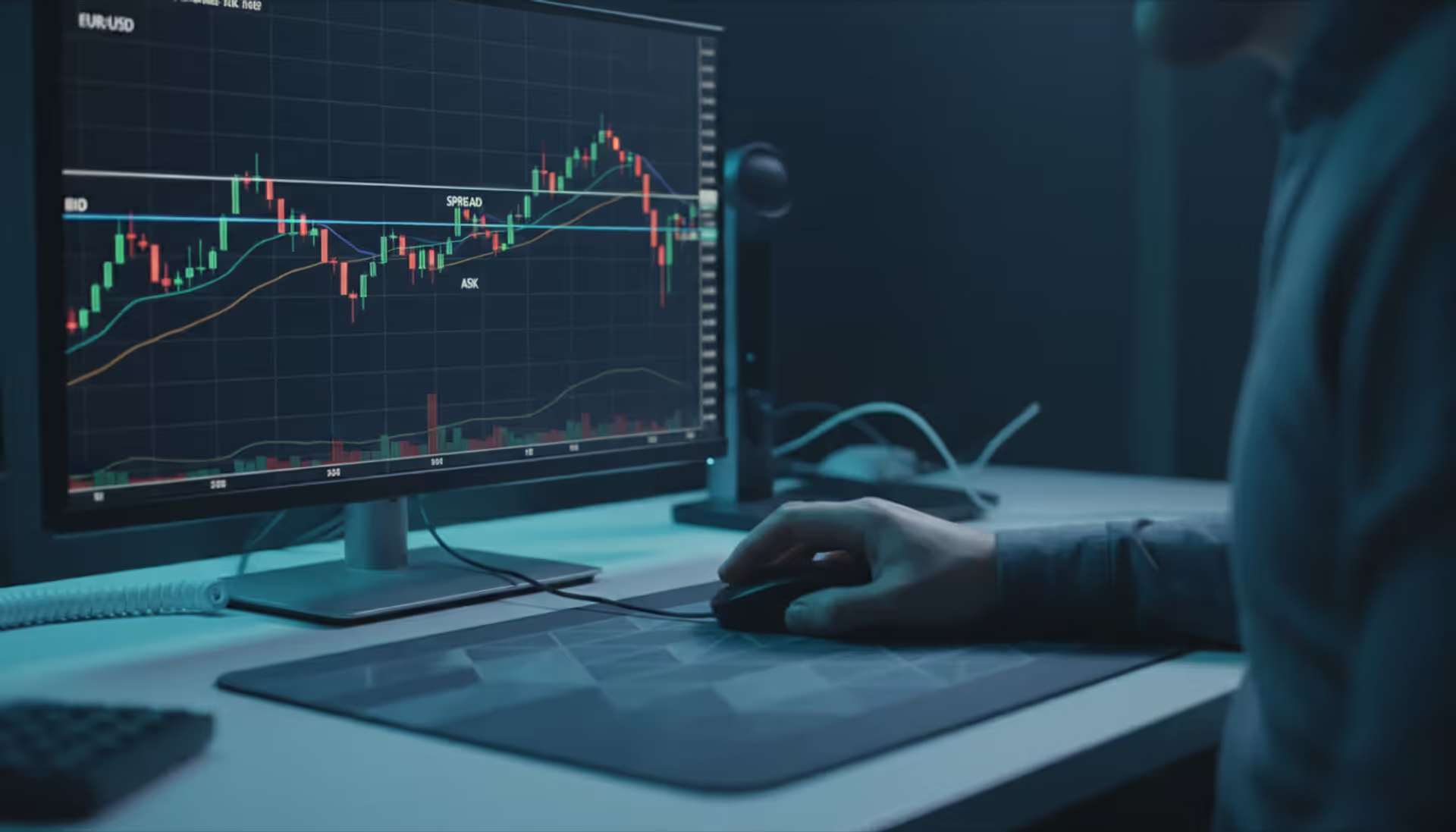
Professional forex day trader workspace with multiple monitors showing candlestick charts of currency pairs, coffee cup on desk, early morning city skyline through window
Want to trade currencies without holding anything overnight? That's day trading in the forex market—you're in before breakfast and out before dinner, squaring every position before 5 PM Eastern when the New York session wraps up. You'll never face the anxiety of waking up to find geopolitical news has blown through your stop-loss while you slept.
Here's what makes currency day trading distinct: the market never sleeps during weekdays. Tokyo hands off to London, London overlaps New York, then we're back to Asia. A Chicago trader can wake up at 2 AM to catch London's opening fireworks, while someone in Singapore targets the Asian morning. You pick your window instead of watching everything at once—because nobody can monitor charts for 24 straight hours without losing their mind.
Quick decisions matter more than perfect analysis. That support level you marked yesterday? You've got maybe 15 minutes to decide if it's holding or breaking before the moment passes. Beginners often crater because they fixate on finding the "perfect" setup while ignoring practical realities: spreads eat 30% of small gains, leverage turns tiny mistakes into account-killers, and session transitions can whipsaw prices without warning.
The profitable day traders I've watched all share one trait: they treat this like a business with systems, not a casino with hunches. Technical skill matters, sure. But so does knowing when your brain is too fried to make another decision, or recognizing that sick feeling in your stomach that means you're risking money you can't actually afford to lose.
What Is Forex Day Trading?
Here's the core concept: you're buying one currency while simultaneously selling another (they always trade in pairs), and you're closing that entire position before the 5 PM EST cutoff that marks the daily settlement. Your holding time might be 90 seconds or four hours, but extending past that cutoff exposes you to rollover fees and the dreaded liquidity desert between New York's close and Tokyo's open.
Let's say you think the euro will gain strength against the dollar during London's morning rush. You buy EUR/USD at 1.0850. Three hours later, the pair hits 1.0890, and you close out with a 40-pip gain. The entire cycle happened while most Americans were still asleep. That's the appeal—catch the move and get out clean.
Your holding time depends entirely on which style fits your personality. Scalpers are adrenaline junkies who might hold for 45 seconds, grabbing 3-7 pips before the next tick reverses. Traditional day traders have more patience, holding two to three hours while targeting 30-60 pip moves on majors. Both types have one rule: everything closes before that 5 PM bell, no exceptions.
Author: Olivia Kensington;
Source: martinskikulis.com
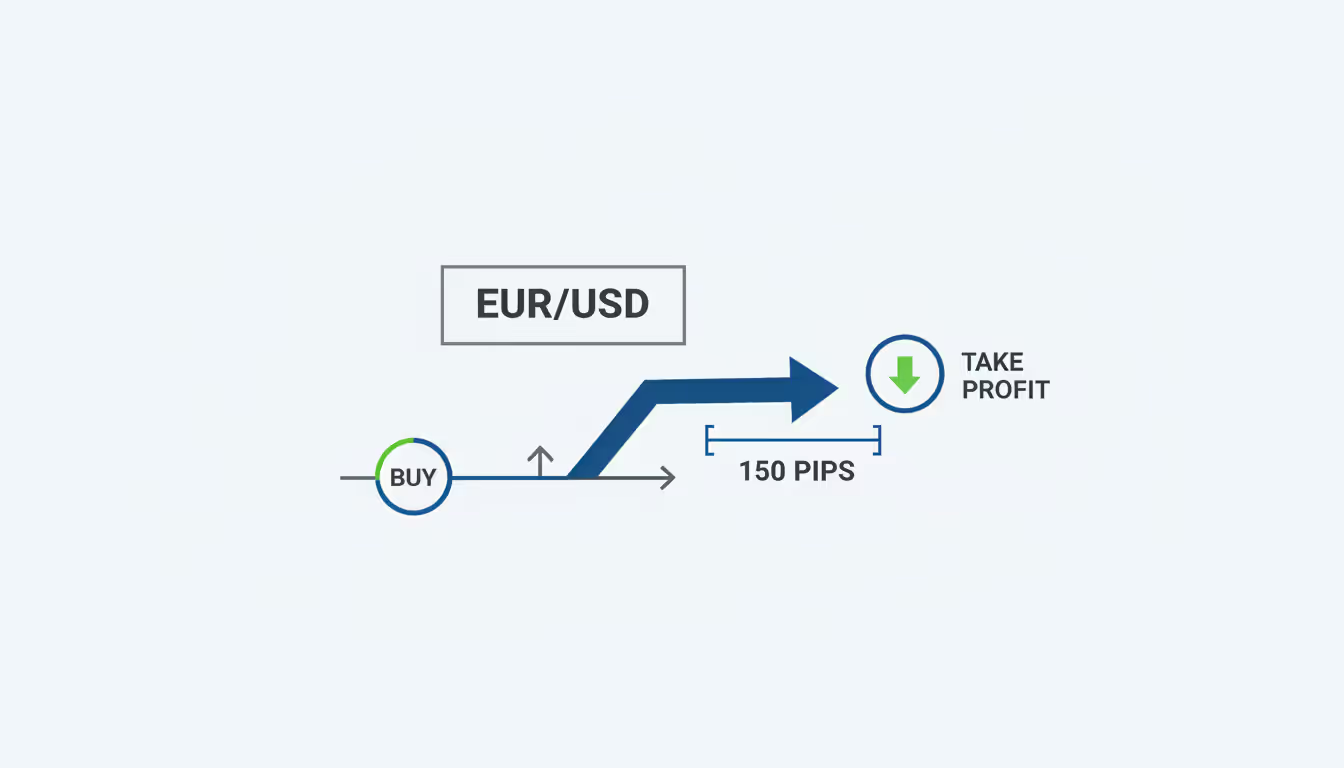
Compare this to swing trading, where you'd hold EUR/USD for maybe a week to catch a 150-pip trend. Position traders? They might sit in USD/JPY for three months based on central bank policy divergence. You're sacrificing those monster moves in exchange for sleeping soundly—no gap risk, no weekend worry, no checking your phone at 3 AM because Chinese GDP data just printed.
The mechanics need a forex brokerage account, charting software that doesn't lag, and understanding that pip values change based on position size. Open one mini lot (10,000 units) on EUR/USD, watch it climb 35 pips, and you've banked roughly $35 before the broker takes their cut. Day traders stack these smaller gains repeatedly while keeping losses even tighter through stops that actually make sense.
How to Day Trade Currencies Step by Step
Your first move: finding a broker regulated by the CFTC who's registered with the NFA if you're trading from US soil. These agencies cap leverage at 50:1 for major pairs and 20:1 for exotics—annoying restrictions that actually prevent you from nuking your account on a single impulse trade. Fund it with money that won't trigger a panic attack if it disappears. I'd suggest $3,000 minimum because anything less forces you into position sizes so small that spreads consume half your gains.
Pair selection matters more than most guides admit. Sure, everyone talks about EUR/USD because it's liquid. But during the Asian session? That pair often crawls sideways for hours, wasting your time. Better to match pairs to sessions: trade EUR/GBP during London, USD/CAD when New York opens, AUD/JPY during Tokyo hours. Spreads on these major pairs typically run 0.2 to 0.5 pips on decent ECN accounts—low enough that you're not buried in costs before your trade even moves.
Platform mastery separates amateurs from pros. You need to execute market orders (fills immediately at whatever price is available) versus limit orders (sits there waiting for your specific price to appear). Stop-loss orders cut losing trades automatically at your predetermined pain threshold—the difference between a $40 loss and a $400 disaster when news hits. Most traders use MetaTrader 4 or 5, though some brokers built proprietary platforms. Enable one-click trading or you'll miss fast-moving setups while fumbling through order menus.
Trade execution demands confirmation, not hope. Your strategy says buy breakouts above resistance? Then wait for that candle to actually close above the level with volume surging before you click anything. Drop your stop-loss underneath the breakout candle's low—forcing the market to prove your thesis wrong by reclaiming that level. Set your profit target using your risk-reward minimum (I use 1:2 on day trades, so a 20-pip risk aims for 40 pips profit).
Closing everything by 4:30 PM Eastern is non-negotiable. Some traders who've been burned learn to exit by 3 PM when New York afternoon trading turns choppy and unpredictable. You're hunting clean moves during high-volume windows, not gambling on what Asian data releases might do to your position at midnight.
Forex Day Trading Strategies That Work
Different market conditions need different approaches, and forcing one strategy onto the wrong environment kills accounts. Breakout trading shines when major news drops and price explodes through established ranges. Range trading works beautifully during the dull Asian afternoon when pairs bounce between the same levels for five hours straight. News trading captures volatility spikes from Fed announcements or payroll surprises—but you need fast reflexes and nerves that don't rattle.
Scalping means you're targeting tiny profits repeatedly throughout a session, holding positions anywhere from 20 seconds to maybe three minutes. This demands laser focus, platforms that fill orders without slippage, and spreads tight enough that you're not starting every trade 3 pips underwater. A scalper might grab 4-6 pips on EUR/USD during the 8:30 AM London-New York overlap, doing this 25 times before lunch. Your win rate needs to hit 65% because costs eat a bigger percentage of these tiny gains.
Author: Olivia Kensington;
Source: martinskikulis.com
Forex Scalping Explained
Scalping boils down to this: jump in, grab your pips, jump out before market noise reverses your gain. You're glued to 1-minute or 5-minute charts, watching for momentum bursts that follow data releases or when price breaks technical levels everyone's watching. The EUR/USD pair between 8 and 9 AM Eastern (peak overlap volume) creates perfect conditions—massive liquidity, minimal spread widening, directional moves that actually follow through.
Where scalpers wreck themselves: trading during thin volume when spreads balloon from 0.3 pips to 2.0 pips (killing your edge instantly), or refusing to cut losses at 4 pips because they're "sure" it'll reverse. Successful scalpers have ice-cold discipline—stop out at 4 pips, let winners stretch to 7-9 pips, never negotiate with the market. They also go flat five minutes before major news when spreads can spike to 8 pips in a blink, making your usual edge evaporate.
Recognizing Intraday Forex Patterns
Intraday patterns pop up repeatedly if you watch long enough: double tops and bottoms at session highs/lows, flag formations after sharp breakout moves, engulfing candles that telegraph reversals. Spot a bullish engulfing candle on the 15-minute EUR/USD chart right when London opens? That often kicks off a 35-50 pip climb over the next two hours. Flag patterns—those tight sideways consolidations following vertical moves—usually break in the same direction once price escapes the flag boundaries.
There's one pattern every London trader learns the hard way: the "fake-out" spike at the 3 AM session open. Price rockets up or down for maybe 20 pips, triggers a bunch of stop-losses, then completely reverses and runs 50 pips the opposite direction. Smart traders wait 20-30 minutes after major session opens for this nonsense to clear before entering real positions. You'll learn which patterns actually work for your style through painful trial and error—journal every trade to spot what setups print money versus which ones just feel good but lose.
Session Timing and Market Hours for Day Traders
Which session you trade determines everything about your opportunities and which pairs actually move. The Asian session (7 PM through 4 AM Eastern) brings moderate volatility to JPY, AUD, and NZD crosses, though ranges usually stay tighter than London or New York. If you're targeting USD/JPY or AUD/USD, Tokyo hours can be productive, but don't expect the explosive breakouts you'd see during London.
London's opening (3 AM to noon Eastern) generates more volume than any other single session, with EUR, GBP, and CHF pairs making aggressive moves. Major trends often birth during the 3-5 AM window, making it critical for breakout traders willing to sacrifice sleep. GBP/USD regularly travels 80-120 pips during this stretch on ordinary days—double that when the Bank of England surprises markets.
New York (8 AM to 5 PM Eastern) overlaps with London from 8 AM to noon, creating the single most liquid period globally. EUR/USD, GBP/USD, and USD/CAD enjoy their tightest spreads here, with technical patterns behaving most reliably. After London traders leave for lunch around noon, New York trading frequently degrades into choppy range-bound mess unless US economic data injects fresh volatility.
Session overlaps offer your highest-probability setups because institutional order flow concentrates during these windows. That London-New York overlap stacks European bank flows with US hedge fund activity, producing cleaner trends and breakouts that actually follow through. Contrast this with the dead zone between New York's close and Tokyo's open (5-7 PM Eastern)—liquidity evaporates and small orders can cause erratic spikes. Most profitable traders avoid this window entirely.
Matching pairs to sessions prevents frustration. Trade EUR/USD and GBP/USD when London and New York are active—that's when European and American economic calendars drive real price action. Shift to AUD/USD or NZD/USD during Asian hours when Australian employment or Chinese trade data moves those pairs. Trading EUR/USD at 11 PM Eastern? You're fighting tiny ranges and wide spreads for no reason.
The goal of a successful trader is to make the best trades. Money is secondary
— Alexander Elder
Risk Management for Forex Day Traders
Position sizing starts with your account balance and stop-loss distance, not gut feeling. Here's a standard approach: never risk beyond 1% of your total account on any single trade. Got $4,000 to trade? Maximum risk per position is $40. If your stop sits 30 pips away, you can trade roughly 1.3 mini lots (13,000 units) where each pip costs about $1.30. Hit your stop and you lose $39, surviving to trade another day.
Stop-loss placement needs technical logic behind it, not arbitrary distances plucked from thin air. A stop placed 12 pips away because that's "two ATRs" or whatever indicator said so will get shredded by normal intraday noise. Instead, position stops 3-5 pips below recent swing lows when buying, or above swing highs when shorting. Force the market to actually break structure before taking you out—if price reclaims that support level, your thesis was wrong and you should be stopped out.
Risk-reward ratios dictate long-term survival more than win percentage ever will. You can win 38% of trades and still make money with 1:3 risk-reward. Someone winning 62% of trades at 1:1 risk-reward is barely breaking even after costs. Day traders should hunt for minimum 1:1.5 setups—risking 25 pips to make 38 pips or better. This cushion absorbs spreads and commissions while keeping math on your side across dozens of trades.
Overleveraging destroys more accounts than bad strategy. US forex accounts allow 50:1 on majors, which sounds conservative next to offshore brokers offering 400:1. But even 50:1 lets you take dangerously oversized positions. If your $5,000 account uses full leverage, you could control $250,000 in currency—meaning a 2% adverse move costs you everything. Most professionals use 10:1 to 15:1 effective leverage, keeping positions small enough that three straight losses don't trigger emotional meltdowns.
Daily loss limits act as circuit breakers during rough stretches. Set a maximum daily loss around 2-3% of your account—when you hit it, close the platform and walk away. Trading with $6,000? Maybe your kill switch is $150 in losses for the day. After losing three trades at $50 each, you're done regardless of how "sure" you are about that next setup. This single rule prevents catastrophic drawdown spirals where you double position sizes trying to recover losses.
Elder's insight cuts through the noise: obsessing over your account balance while trades are open clouds judgment and encourages desperate position size increases to recover faster. Focus on executing your process—proper entry confirmation, logical stop placement, disciplined exits—and profits follow naturally.
Psychology and Discipline in Forex Day Trading
The mental game separates traders who survive from those who flame out spectacularly. You're riding an emotional rollercoaster when executing five trades in 90 minutes—two winners, three losers—and somehow maintaining equilibrium throughout. Day trading condenses the psychological pressure that swing traders experience over weeks into a few intense hours.
Emotional control starts with accepting losses as cost of doing business, not personal attacks from the market. When your GBP/USD long gets stopped out for a $55 loss, the market isn't punishing you—it's providing feedback that your timing was off or the setup wasn't as solid as you thought. Profitable traders dissect losing trades clinically: Was my entry confirmation valid? Did I execute at the right price? Was the stop placement logical? This analytical approach prevents the emotional death spiral into revenge trading.
Author: Olivia Kensington;
Source: martinskikulis.com
Handling losses requires pre-trade acceptance of the worst-case scenario. Before you click buy or sell, acknowledge this specific trade might hit your stop and you're genuinely okay with that outcome. This mental framing blunts the shock when stops trigger and eliminates that desperate urge to immediately jump into another trade to "win back" what you just lost. The smartest trade after a loser is often no trade at all—waiting patiently for your next high-probability setup.
Revenge trading after losses is how accounts die. You take two quick stops, losing $80, and suddenly you're itching to double your position size on the next trade to get it all back in one shot. Professional traders implement hard rules: after two losing trades, take a 20-minute walk. After three losses, or any time you hit your daily loss limit, shut down your platform completely. The market opens again tomorrow—your capital might not if you keep forcing trades.
Maintaining focus during trading hours means ruthlessly eliminating distractions. Close every browser tab, silence your phone, tell your family you're unavailable during your chosen window. Day trading demands simultaneous monitoring of multiple timeframes, watching for setup confirmation on three different pairs, and managing open positions while new setups appear—split attention guarantees missed exits or late entries that cost you money.
Building a consistent routine creates the foundation for improvement. Wake at the same time daily, spend 20 minutes reviewing overnight price action, check the economic calendar for data releases that might spike volatility, identify key support and resistance levels before you take any trades. This preparation puts you miles ahead of reactive traders who open their charts at random times and start clicking based on FOMO. My routine includes trading only 8-11 AM Eastern during peak overlap, then mandatory journaling every trade before closing the platform.
Forex Day Trading vs Stock Day Trading
Trading forex versus stocks involves fundamentally different market structures, capital requirements, and regulatory frameworks. Currency markets run 24 hours on weekdays across decentralized global networks of banks and brokers, while stock markets operate fixed hours (9:30 AM to 4 PM Eastern for US equities). This means forex traders pick sessions matching their schedule instead of being forced into New York market hours regardless of where they live.
Feature
Forex Day Trading
Stock Day Trading
Market hours
Available 24/5 across all time zones
9:30 AM - 4 PM EST only
Leverage limits
Up to 50:1 on majors, 20:1 minors (US)
Capped at 4:1 intraday (Reg T)
Liquidity depth
$7.5 trillion daily global volume
Varies dramatically by ticker
Capital to start
$500-$2,000 practical minimum
$25,000 required (PDT rule)
Typical volatility
Moderate, pair-dependent moves
High, stock-specific gaps common
Regulatory bodies
CFTC and NFA oversight
SEC, FINRA, strict PDT rules
Leverage differences change everything about position sizing and risk tolerance. Forex brokers offer 50:1 on major pairs, letting a $3,000 account control $150,000 in currency. Stock day traders face 4:1 intraday leverage and must maintain $25,000 minimum equity to avoid Pattern Day Trader restrictions that freeze their account. This capital barrier makes forex more accessible to smaller accounts, though that higher leverage becomes dangerous if you don't respect position sizing rules.
Liquidity in currency markets dwarfs individual stocks by several orders of magnitude. EUR/USD alone processes over $1 trillion daily, ensuring razor-thin spreads and instant fills on retail order sizes. Even mega-cap stocks like Microsoft or Amazon have lower liquidity that can cause slippage when you're moving larger size. Forex traders almost never worry about moving the market—stock day traders must check average daily volume and be careful with limit orders on less liquid names.
Market hours flexibility lets West Coast forex traders catch London's opening around midnight Pacific or trade New York session starting at 5 AM, all without destroying their sleep schedule. Stock day traders must be available during East Coast business hours regardless of their location. This flexibility attracts traders with full-time jobs who can trade Asian or early European sessions before heading to work.
Volatility patterns differ significantly between asset classes. Forex pairs often trend more smoothly during their active sessions, with major moves concentrated around scheduled economic data releases. Individual stocks can gap violently on surprise earnings or FDA approvals, creating both massive opportunity and catastrophic risk. Forex gaps are rarer due to 24-hour trading, though Sunday evening reopening occasionally creates gaps when weekend news hits.
Regulatory frameworks affect your trading freedom dramatically. The Pattern Day Trader rule forces stock traders to maintain $25,000 minimum equity if executing four or more day trades within five business days in a margin account. Forex accounts face no such restriction—you can make 50 intraday round-trips with a $1,000 account if you want. However, CFTC leverage caps protect forex traders from the insane 200:1 or higher leverage that offshore brokers dangle like a loaded gun.
Frequently Asked Questions About Forex Day Trading
How much money do I need to start forex day trading?
You can technically open accounts with $100 at some brokers, but $2,500 to $5,000 gives you realistic position sizing that respects risk management principles. Using a $3,000 account with the standard 1% risk rule means you're risking $30 per trade—enough room to set meaningful stops at logical technical levels while maintaining small positions. Accounts below $1,000 force you into uncomfortably tight stops that get picked off by normal market noise, or excessive risk percentages that blow up your account on three consecutive losses.
Can you make a living from forex day trading?
It's possible but demands substantial capital, a provably profitable strategy, and at least six months of consistent wins before quitting your day job. Need $5,000 monthly income? With a conservative 4% monthly return, you'd need a $125,000 account. Most successful traders recommend seeing 8-12 consecutive profitable months in live trading (not demo) before considering this full-time. Reality check: various studies suggest 75-85% of retail forex traders lose money in their first year, so plan accordingly.
What are the best currency pairs for day trading?
EUR/USD, GBP/USD, and USD/JPY dominate because they offer microscopic spreads and massive liquidity during their active sessions. EUR/USD spreads average 0.1-0.4 pips on ECN accounts during London-New York overlap, making it perfect for scalping and frequent entries. GBP/USD provides bigger intraday ranges for traders hunting larger moves (80-150 pips on active days), while USD/JPY delivers clean technical patterns during Asian and New York hours. Exotic pairs like USD/TRY or EUR/HUF carry 10-30 pip spreads that destroy day trading edge.
How many trades should a forex day trader make per day?
Depends entirely on your strategy and what the market offers. Scalpers might execute 30-60 trades per session chasing 5-pip moves, while methodical day traders might take just 2-4 high-conviction setups. Quality always trumps quantity—three well-planned trades with solid risk-reward beats twenty impulse trades any day. Most consistently profitable day traders I've tracked average 4-10 trades daily, focusing exclusively on their best setups during peak liquidity windows rather than forcing trades during choppy periods.
Is forex day trading legal in the United States?
Completely legal when done through CFTC-regulated brokers who maintain NFA registration. US regulations impose 50:1 maximum leverage on major pairs and 20:1 on exotics—lower than international brokers but still plenty for day trading. US residents must use domestic brokers or approved offshore brokers with proper US registration. Trading through unregulated offshore brokers violates CFTC rules, voids any legal recourse when disputes arise, and exposes you to potential fraud with zero protection.
What is the difference between scalping and day trading in forex?
Scalping is a specialized subset of day trading that focuses on ultra-short holding periods (seconds to maybe two minutes) and tiny profit targets (3-8 pips per trade). Day trading encompasses all intraday approaches, including scalping but also trades held for multiple hours targeting much larger moves (30-70 pips). Both strategies close all positions before the 5 PM Eastern cutoff, but scalpers execute far more trades with tighter stops and accept lower per-trade profits. Scalping demands more screen time, faster execution, and higher win rates to overcome the larger percentage cost of spreads on small gains.
Forex day trading offers a legitimate entry point into financial markets with lower capital barriers than stock trading and flexible hours that fit any schedule. But success requires far more than opening an account and clicking buttons—you need technical analysis competence, deep understanding of session-based volatility, and ironclad risk management on every single trade you take. The 24-hour currency market creates opportunities across every time zone while also demanding discipline to trade only your chosen sessions and pairs instead of chasing everything that moves.
The learning curve extends well beyond chart patterns and indicators into psychological resilience and emotional control that most beginners don't anticipate. Consecutive losses trigger revenge trading impulses faster than you'd expect—that desperate feeling to "get it all back" on the next trade kills accounts. Start with demo trading or micro lots in a funded account, letting you develop real skills without risking serious capital. Journal every trade obsessively, noting not just entry and exit prices but your emotional state and whether you actually followed your plan.
Risk management isn't negotiable if you plan to survive long enough to become profitable. Cap risk at 1% per trade, always use stop-losses positioned at logical technical levels, and maintain strict daily loss limits that force you to stop trading before catastrophic drawdowns. These rules feel painfully restrictive when you're starting out, but they're the foundation that allows compounding modest gains into meaningful returns across months and years.
Your path to consistent profitability probably takes 8-15 months of focused practice, strategy refinement through painful losses, and psychological development that only comes from real-money trading. Treat your first year as expensive education, keeping positions tiny while you discover what actually works for your personality and schedule. The traders who make it view currency day trading as a skill-based profession requiring continuous improvement—not a lottery ticket or gambling substitute that promises quick riches.
The spread is the difference between bid and ask prices in forex trading—your cost to enter every position. Understanding how spreads work, when they widen, and how to minimize these costs can dramatically improve your trading profitability over time
A pip represents the smallest standardized price movement in forex trading. Understanding pip calculations is essential for position sizing, risk management, and profit calculation. This guide explains pip definitions, calculation methods for different currency pairs, and how to avoid common mistakes
Spread betting allows you to speculate on price movements without owning assets. This leveraged derivative offers access to thousands of markets but carries substantial risks. Learn how spread betting works, profit/loss mechanics, tax implications, and critical mistakes to avoid
The forex market moves $7.5 trillion daily, yet most retail traders lose money. Regulatory data shows only 15-25% maintain profitable accounts. This guide examines real statistics, common failure causes, and what actually makes traders profitable based on 2026 data
The content on this website is provided for general informational and educational purposes only. It is intended to explain concepts related to Forex (FX) trading, currency markets, leverage, hedging, and risk management.
All information on this website, including articles, guides, and examples, is presented for general educational purposes. Forex trading carries significant risk, and outcomes may vary depending on market conditions, leverage, and individual decisions.
This website does not provide financial, investment, or trading advice, and the information presented should not be used as a substitute for consultation with qualified financial professionals.
The website and its authors are not responsible for any errors or omissions, or for any outcomes resulting from decisions made based on the information provided on this website.