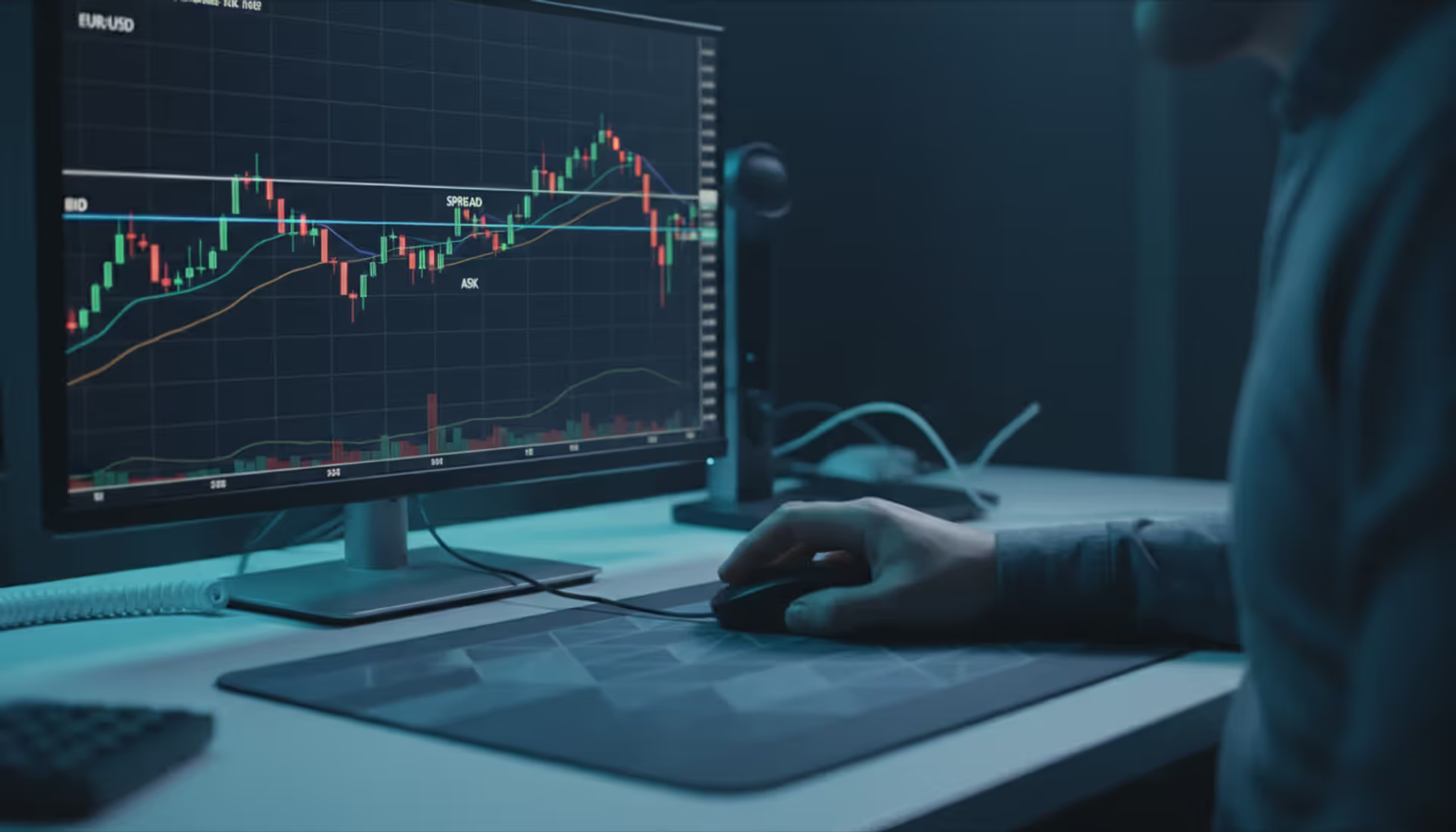
Modern forex trading floor with multiple monitors showing candlestick charts of currency pairs, trader silhouettes, and illuminated world map highlighting major financial centers
Six currency pairs dominate the $7.5 trillion daily forex market. Traders call them "the majors," and they share one critical feature: every single one pairs the US dollar against another powerhouse economy's currency.
Together, these six account for roughly 68% of worldwide currency trading. That's not coincidence—it's a reflection of where global commerce actually happens.
Here's how pair pricing works in practice. Take EUR/USD quoted at 1.0850. The euro (listed first) serves as your base currency. The dollar (second position) functions as the quote currency. That 1.0850 figure tells you exactly how many dollars you'll need to purchase one euro. If you're buying this pair, you're simultaneously purchasing euros while selling an equivalent dollar amount.
Why should you care about these specific six pairs? They track real economic relationships between the world's financial giants. EUR/USD movements reflect monetary policy differences between the European Central Bank and the Federal Reserve. USD/JPY captures the economic power dynamic between American growth and Japanese fiscal conditions. Trillions change hands daily across these pairs, which creates legitimate profit opportunities—but only if you understand what actually moves them.
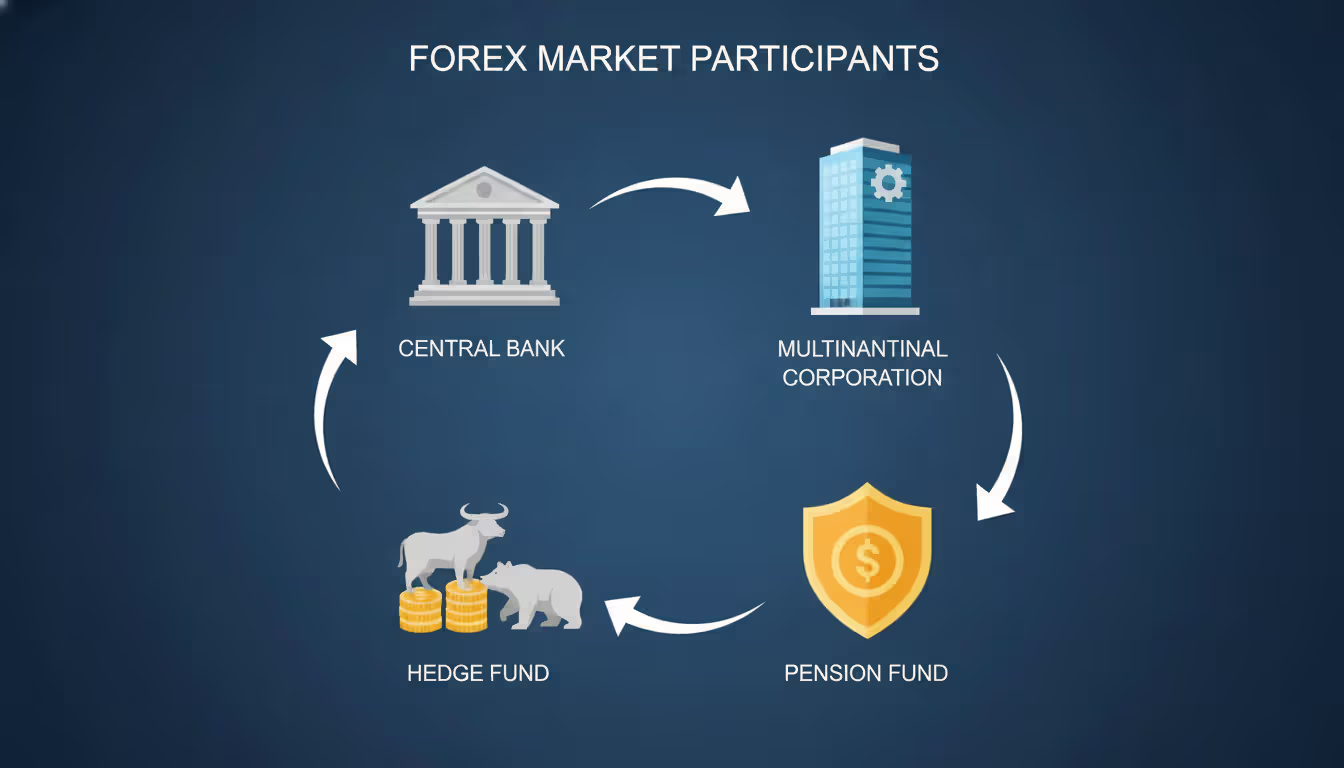
The participant list reads like a who's-who of global finance. Central banks managing national reserves trade majors. Multinational corporations converting international revenues focus on majors. Hedge funds deploying billions concentrate on majors. Consider a European automaker receiving $500 million from US sales—they'll need to convert that back to euros. Or picture a Japanese pension fund purchasing $2 billion in US Treasury securities—they'll exchange yen first. This never-ending commercial necessity, layered with speculative positioning, creates the exceptional liquidity that defines these six pairs.
Author: Vanessa Cole;
Source: martinskikulis.com
Complete List of Forex Major Pairs
Exactly six pairs earn "major" status. Each one matches the greenback against another G7 nation's currency:
EUR/USD – Euro / US Dollar
GBP/USD – British Pound / US Dollar
USD/JPY – US Dollar / Japanese Yen
USD/CHF – US Dollar / Swiss Franc
USD/CAD – US Dollar / Canadian Dollar
AUD/USD – Australian Dollar / US Dollar
You'll notice Australia didn't make the G7 cut. Yet AUD/USD earned major pair classification anyway because Australian dollar trading volume rivals—and sometimes exceeds—several official G7 currencies. Market reality trumps political designations.
Major Pair
Nickname
Typical Spread (pips)
Daily Volume (% of total)
Primary Trading Session
EUR/USD
Fiber
0.1–0.3
~24%
London/New York overlap
USD/JPY
Ninja (or Gopher)
0.1–0.4
~13%
Tokyo/London sessions
GBP/USD
Cable
0.3–0.8
~11%
London session
USD/CHF
Swissie
0.4–0.9
~5%
London session
USD/CAD
Loonie
0.4–0.9
~5%
New York session
AUD/USD
Aussie
0.2–0.6
~6%
Asian/Sydney sessions
Combined, these six represent approximately 64% of all forex transactions worldwide. EUR/USD alone captures nearly one-quarter of global currency trading—a staggering dominance that hasn't budged in decades.
Why Major Pairs Are the Most Liquid in Forex
Liquidity measures how quickly you can enter or exit without your own order disrupting the price. The majors dominate here because they connect economies worth tens of trillions in GDP. Europe's economy exceeds $15 trillion. America tops $28 trillion. Japan approaches $5 trillion. When these economic behemoths conduct cross-border business, someone's converting currency.
Volume drives everything. An average 2026 trading day processes roughly $7.5 trillion in forex transactions. Major pairs handle about $4.8 trillion of that flow. Those numbers create practical advantages—when you're ready to buy 100,000 units of EUR/USD, thousands of counterparties will sell to you at virtually identical prices within milliseconds.
Institutional participation amplifies this effect dramatically. Central banks executing policy interventions exclusively use majors. Investment banks hedging client exposure concentrate positions in majors. Algorithmic trading firms running high-frequency strategies need the tight spreads and deep order books that only majors provide.
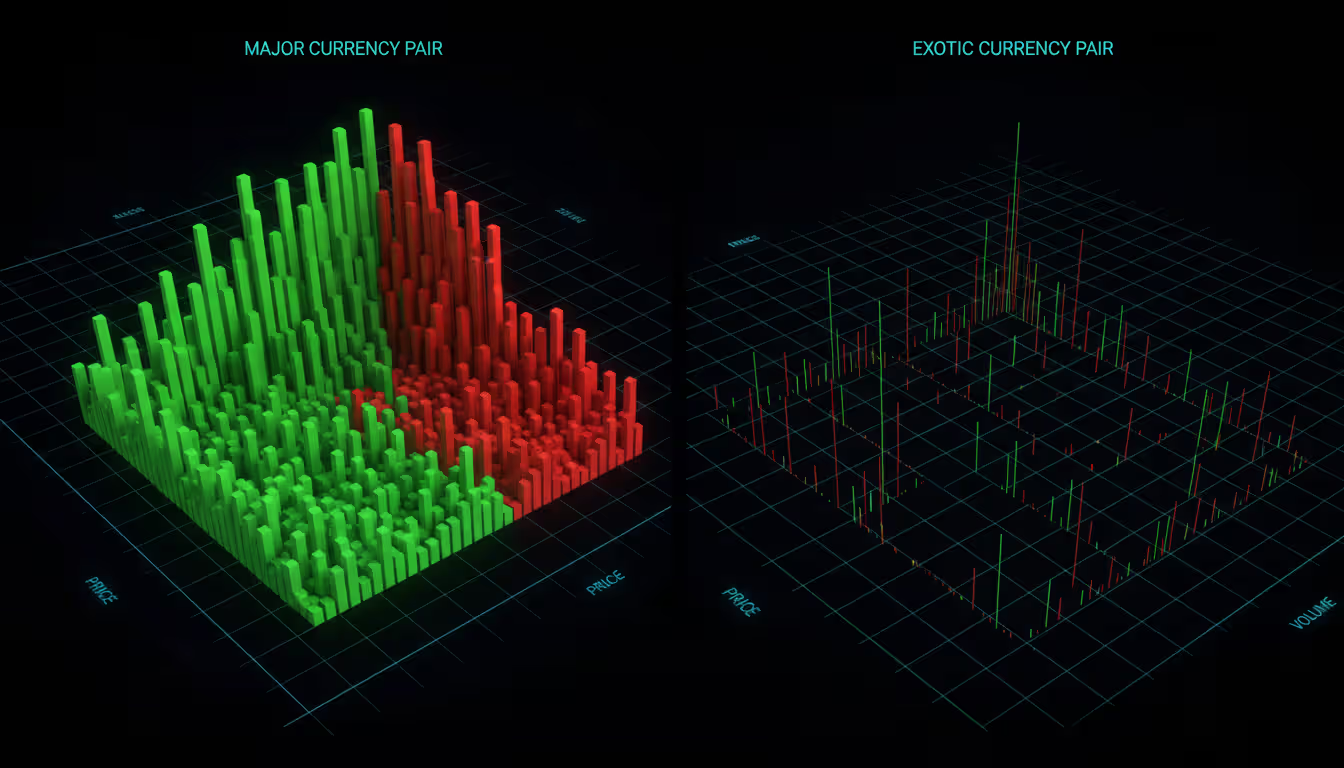
Check the spreads yourself—they reveal liquidity instantly. During active London hours, EUR/USD might display just 0.1 pips between bid and ask. Meanwhile, an exotic like USD/TRY could show 15 pips of spread. That 150-times difference directly impacts your bottom line and demonstrates the liquidity gulf between majors and everything else.
Market depth extends well beyond the visible best bid and ask. Major pairs maintain substantial volume waiting at multiple price levels. Place a larger order and the market absorbs it smoothly. Try the same with an exotic pair and you'll see price gap several pips just from moderate-sized trades—there simply isn't enough depth sitting behind the current quote.
Author: Vanessa Cole;
Source: martinskikulis.com
How Liquidity Benefits Retail Traders
Transaction costs make or break retail trading careers. Pay 0.2 pips on EUR/USD versus 5 pips on some exotic alternative, and you've saved 4.8 pips per complete trade cycle. On a standard 100,000-unit lot, that's $48 saved. Execute 100 trades yearly? You've just banked $4,800 that would otherwise vanish into spread costs.
Execution speed matters most during volatility spikes. Picture the Federal Reserve announcing an unexpected rate decision—major pairs might swing 100 pips within minutes. Your broker fills your order almost instantaneously because massive liquidity exists at every price level. With thinly traded pairs, you're waiting for fills, receiving partial executions, or missing your intended entry entirely while watching the move happen without you.
Slippage protection keeps your strategy viable. Your system generates a buy signal at 1.0850 on EUR/USD? You'll likely get filled within 0.1 pips of that level. Try the same on an illiquid pair and you might see 3-5 pips of slippage, which transforms a potentially profitable setup into an immediate loser before the trade even begins.
Characteristics of Each Major Currency Pair
EUR/USD: The World's Most Traded Pair
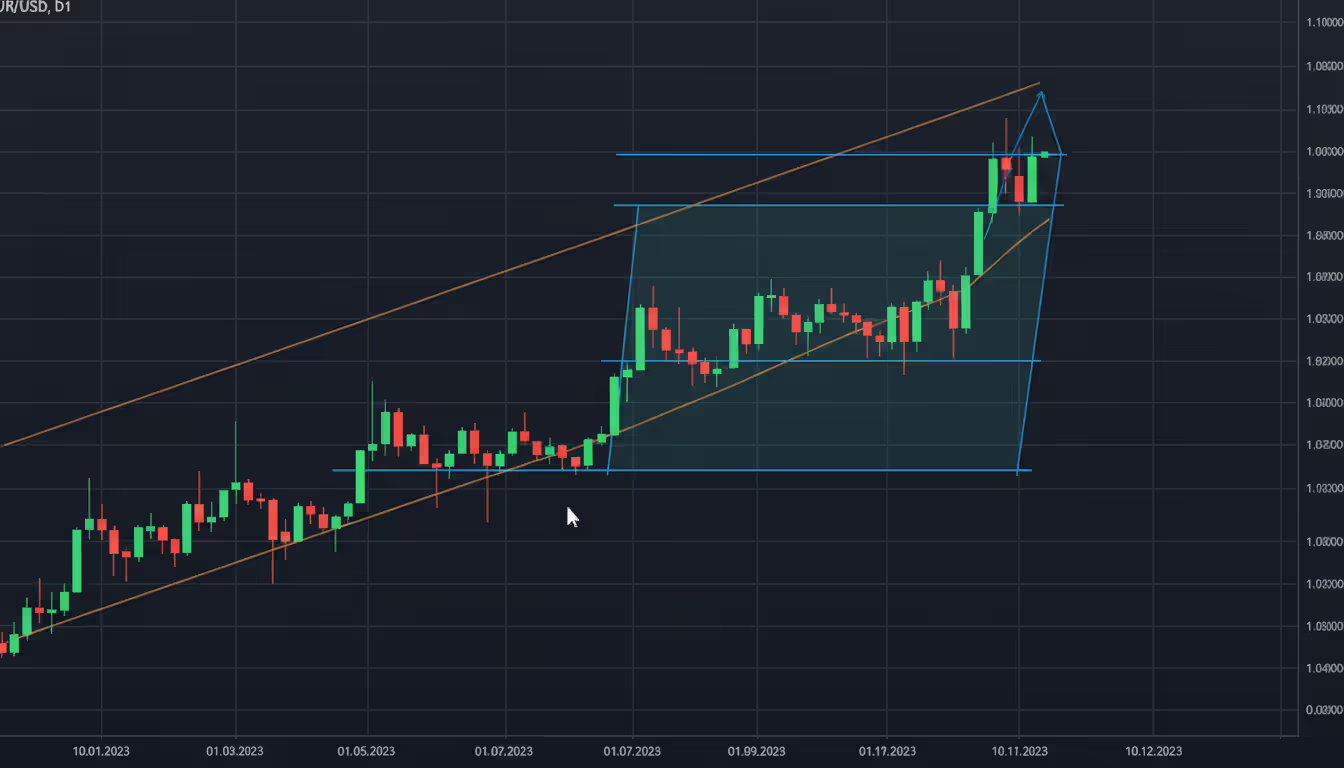
EUR/USD processes approximately $1.8 trillion daily—it's the undisputed heavyweight champion. The pair responds primarily to monetary policy divergence between Frankfurt and Washington. When the ECB maintains easy money while the Fed tightens? Dollar strength dominates. Reverse that policy gap and watch euros rally.
European economic releases drive half the equation. German manufacturing PMI carries outsized weight because Germany accounts for roughly 30% of eurozone GDP. Eurozone inflation reports matter tremendously given the ECB's price stability mandate. Employment data from major member states creates movement.
American data carries equal importance. Nonfarm payrolls can generate 80-pip swings in minutes. CPI releases move the pair 50-100 pips regularly. GDP beats or misses shift sentiment for weeks. Retail sales surprises create intraday opportunities.
The pair typically delivers moderate volatility—expect 60-80 pips of daily range during calm periods. That expands to 100-150 pips when major data drops or policy divergence increases.
Watch the London/New York overlap carefully (8:00 AM to noon Eastern). This four-hour window accounts for roughly 40% of EUR/USD's entire daily volume. European traders positioning ahead of US data releases create additional flow during London morning hours.
EUR/USD trends exceptionally well over medium timeframes because it reflects genuine economic shifts between two massive economic blocs. When the eurozone slides into recession while America expands, the resulting directional move can persist for months. This makes the pair suitable whether you're day trading intraday swings or position trading longer-term fundamental themes.
Author: Vanessa Cole;
Source: martinskikulis.com
GBP/USD: The Cable's Volatility Profile
Traders nicknamed this pair "Cable" back in the 1850s when a transatlantic telegraph cable transmitted exchange rates between London and New York. That historical quirk stuck.
What hasn't stuck is calm price action. GBP/USD exhibits notably higher volatility than its eurozone cousin, frequently delivering 90-120 pip daily ranges. Sometimes you'll see 150-200 pip days on major UK data releases. This amplified movement creates larger profit potential but demands wider stop-losses and stronger risk tolerance.
Bank of England policy decisions heavily influence sterling. The UK economy's smaller size relative to the eurozone or US means individual data releases generate outsized reactions. A disappointing retail sales print might move Cable 50 pips, whereas similar eurozone data might budge EUR/USD just 25 pips.
Brexit's economic aftermath continues creating periodic volatility in 2026. Trade relationship adjustments between the UK and EU spark intermittent price swings. Scottish independence movement politics add another uncertainty layer that traders must monitor.
Strongest activity concentrates during London hours, particularly morning sessions when UK economic releases hit. GBP/USD can gap dramatically on unexpected news because speculative traders maintain large positions that unwind violently when fundamentals shift unexpectedly.
USD/JPY: The Safe Haven Pair
USD/JPY uniquely reflects global risk appetite. When equity markets crater and investors scramble for safety, the yen typically strengthens as Japanese investors repatriate foreign capital. During risk-on environments when stocks rally, the yen weakens as that capital flows back out chasing higher returns abroad.
The Bank of Japan's yield curve control policy—which targets 10-year JGB yields—creates technical levels that USD/JPY respects with unusual consistency. When the pair approaches intervention zones (historically around 150.00 or 155.00), traders anticipate potential BOJ action, which creates natural support or resistance.
Carry trade dynamics influence longer-term direction. When US interest rates significantly exceed Japanese rates, traders borrow yen cheaply to invest in higher-yielding dollar assets. This flow supports the dollar. When rate differentials compress, those carry trades unwind rapidly, which strengthens the yen.
Activity spans Asian, European, and American sessions, though Tokyo trading hours (7:00 PM to 4:00 AM Eastern) generate substantial volume. Japanese corporate hedging activity during Tokyo morning creates distinct price patterns that technical traders exploit.
USD/CHF: The Swiss Franc Relationship
Switzerland's political neutrality, banking secrecy traditions, and fiscal stability give the franc safe-haven status. USD/CHF typically moves inversely to EUR/USD because the franc and euro maintain high correlation—when euros weaken against dollars, francs often follow suit.
The Swiss National Bank actively intervenes to prevent excessive franc strength that would devastate Swiss exports. Past interventions created sudden 300+ pip moves without warning. Traders monitor SNB commentary obsessively because officials sometimes signal intervention thresholds through carefully worded public statements.
USD/CHF spreads widen compared to EUR/USD due to lower overall volume. During volatile periods, expect 1.5-2.0 pip spreads versus EUR/USD's 0.3-0.5 pips. This cost difference matters significantly for scalpers and day traders executing multiple daily positions.
Trending proves less reliable than with EUR/USD or GBP/USD because SNB intervention can abruptly reverse established moves. A three-month downtrend might end instantly if the central bank decides franc appreciation has gone too far. This intervention risk makes USD/CHF better suited for shorter-term trading approaches.
USD/CAD: The Commodity Currency
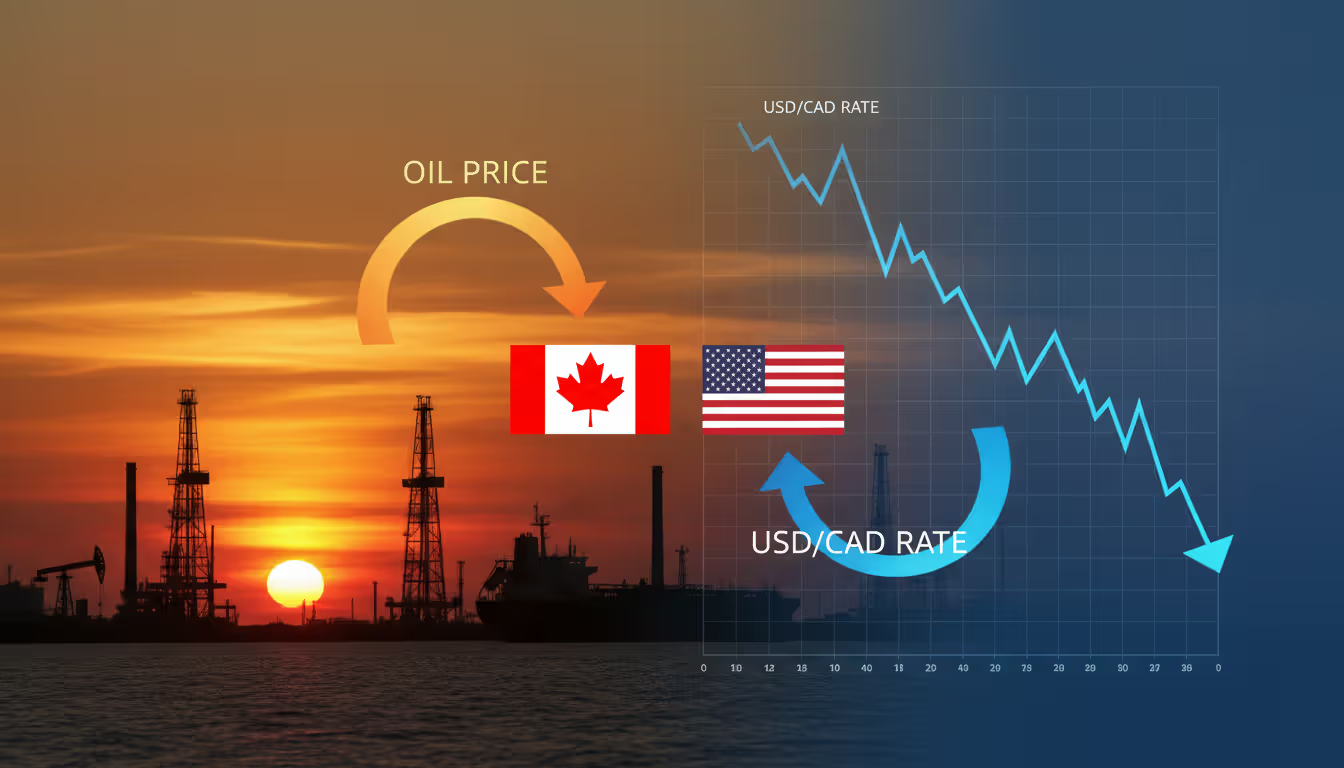
Crude oil prices drive USD/CAD more directly than virtually any other factor. Canada ships approximately 4 million barrels daily to the United States, making petroleum the dominant bilateral trade relationship. When crude rallies, the Canadian dollar typically strengthens (pushing USD/CAD lower). When oil collapses, the loonie weakens (driving USD/CAD higher).
The correlation isn't perfect—Canadian monetary policy, US economic data, and broader risk sentiment all influence the pair—but oil provides the primary fundamental driver. Smart traders monitor WTI crude charts alongside USD/CAD to identify divergences signaling potential reversals.
Bank of Canada policy decisions reflect commodity price trends directly. When oil prices strengthen, inflation pressures build, potentially prompting rate hikes supporting the loonie. When oil weakens, the BOC might ease policy supporting the economy, which weakens the Canadian dollar.
USD/CAD shows peak activity during New York sessions when both US and Canadian economic releases occur. Volatility sits between EUR/USD's moderate movement and GBP/USD's wider ranges, typically averaging 70-90 pips daily.
Author: Vanessa Cole;
Source: martinskikulis.com
AUD/USD: The Risk Appetite Indicator
Australia's economy depends heavily on commodity exports to China—iron ore, coal, natural gas, agricultural products. Chinese economic performance directly impacts Australian dollar strength. When China's manufacturing PMI expands, the Aussie typically rallies. When Chinese growth slows, AUD/USD falls.
Reserve Bank of Australia interest rate policy influences the pair significantly. Australia historically maintained higher rates than many developed economies, making the Aussie attractive for carry trades. Rate differentials between the RBA and Federal Reserve create directional bias persisting for quarters.
AUD/USD serves as a reliable risk appetite barometer. During periods when investors embrace risk—buying stocks, selling bonds, purchasing emerging market assets—the Australian dollar tends to strengthen. When risk aversion dominates, capital flows toward the US dollar, weakening AUD/USD.
Strong activity concentrates during Asian trading hours, particularly Sydney and Tokyo sessions. Australian economic data releasing during Asian evening hours (US time) can generate 50+ pip moves. The pair frequently gaps Sunday evening when Asian markets open following weekend news that shifted sentiment.
How Major Pairs Differ from Minor and Exotic Pairs
Minor pairs—sometimes called crosses—exclude the US dollar entirely. EUR/GBP, EUR/JPY, and GBP/JPY serve as examples. These exhibit lower liquidity than majors because executing them requires two conversions. To complete EUR/GBP, your broker typically converts EUR to USD, then USD to GBP, which widens the effective spread you pay.
Exotic pairs match a major currency against an emerging market currency. Think USD/TRY (Turkish lira), USD/ZAR (South African rand), or EUR/PLN (Polish zloty). These feature dramatically wider spreads—frequently 10-50 pips—and limited liquidity. A 5,000-unit trade might visibly move an exotic pair's price, whereas that same order wouldn't register on EUR/USD.
Volatility differs substantially across these categories. Major pairs typically swing 60-100 pips daily under normal conditions. Exotic pairs might move 200-500 pips on routine news simply because thinner liquidity amplifies every price movement. This creates profit potential but demands larger account sizes to withstand drawdowns.
Trading costs accumulate rapidly with minors and especially exotics. If EUR/USD charges 0.2 pips per spread, EUR/GBP might charge 1.5 pips, while USD/TRY could demand 25 pips. Over 100 trades, you'd pay $20 in EUR/USD spreads versus $150 for EUR/GBP and $2,500 for USD/TRY (calculating standard lots). These costs directly reduce profitability before considering win rate or risk-reward.
New traders consistently underestimate the advantage that major pair liquidity provides. The difference between a 0.2 pip and 2.0 pip spread seems trivial until you realize it represents a 10-fold increase in the distance price must move for you to break even. Over hundreds of trades, that cost differential determines whether most retail traders survive their first year
— Michael Chen
Market accessibility varies dramatically by pair type. Every forex broker offers competitive pricing on majors because intense interbank competition keeps spreads tight. Minor pairs show wider broker-to-broker variation. Exotic pairs might not appear at retail brokers at all, and those offering them frequently charge spreads significantly wider than institutional clients pay.
Frequently Asked Questions About Forex Majors
Which forex major pair is best for beginners?
EUR/USD offers the strongest starting point for new traders. It combines the tightest spreads (0.1-0.3 pips), deepest liquidity, moderate volatility, and extensive available analysis—perfect for learning without unnecessary handicaps. The pair trends reasonably well, responds predictably to economic data, and trades actively during European and US hours when most Western traders monitor markets. Once you're comfortable with EUR/USD mechanics, expand to USD/JPY or GBP/USD for diversification.
Do all forex majors include the US dollar?
Yes, definitionally. All six recognized major pairs include USD on one side. This reflects the dollar's role as the world's reserve currency and the reality that roughly 88% of forex transactions involve the greenback. Currency pairs excluding the dollar—like EUR/GBP or AUD/JPY—get classified as minor pairs or crosses, even when they involve major global currencies.
What time of day are forex majors most active?
Activity peaks during session overlaps when multiple major financial centers operate simultaneously. The London/New York overlap (8:00 AM to noon Eastern) generates maximum volume for EUR/USD, GBP/USD, and USD/CHF. USD/JPY shows strong activity during Tokyo hours (7:00 PM to 4:00 AM Eastern) and London sessions. AUD/USD and USD/CAD peak during their respective regional trading hours. Trading during high-activity periods typically delivers tighter spreads and superior execution quality.
How much money do I need to trade forex majors?
Minimum account sizes vary by broker—some accept $100 deposits. However, proper risk management suggests starting with at least $1,000-$2,000 for micro lot trading (1,000 units). This allows risking 1-2% per trade ($10-$40) while maintaining position sizes generating meaningful learning experiences. Professional traders frequently recommend $5,000-$10,000 to trade mini lots (10,000 units) comfortably while following sound risk parameters.
Are forex majors less risky than other currency pairs?
Majors carry substantially lower liquidity risk and execution risk thanks to tighter spreads and deeper markets, but they still exhibit considerable price risk. GBP/USD can move 150+ pips on unexpected Bank of England decisions. USD/JPY might gap 100 pips if the BOJ intervenes. The "lower risk" characterization applies primarily to trading costs and execution quality, not directional price movement. Proper position sizing and disciplined stop-loss placement remain essential regardless of which major pair you trade.
What economic reports most affect forex majors?
Central bank interest rate decisions and accompanying policy statements generate the largest immediate moves—often 100-200 pips within minutes. Employment reports (US nonfarm payrolls, UK employment change) rank second in market impact. Inflation data (CPI, PCE) has gained importance as central banks focus intensely on price stability. GDP releases, manufacturing PMI readings, and retail sales also move markets significantly. For commodity currencies like USD/CAD and AUD/USD, oil inventory reports and Chinese economic data add critical fundamental drivers worth monitoring.
The six forex majors dominate global currency trading for straightforward reasons: unmatched liquidity, minimal spreads, reliable price discovery, and direct connection to the world's largest economies. EUR/USD, GBP/USD, USD/JPY, USD/CHF, USD/CAD, and AUD/USD each carry distinct characteristics shaped by underlying economic fundamentals, yet all share advantages stemming from deep institutional participation and constant commercial flow.
Understanding what drives each major pair provides a foundation for developing trading strategies aligned with your risk tolerance and available schedule. EUR/USD's moderate volatility suits traders seeking steady, predictable movement. GBP/USD's wider swings attract those comfortable with larger position risk. USD/JPY's safe-haven behavior provides opportunities during risk-off market events. USD/CAD and AUD/USD offer commodity correlation plays.
The liquidity advantage majors provide isn't merely theoretical—it translates directly into lower costs, better execution, and reduced slippage compounding over dozens or hundreds of trades. Starting your forex journey focused on major pairs lets you learn market mechanics without additional complexity and expense that minor and exotic pairs introduce unnecessarily.
Success in forex trading requires more than understanding major pair characteristics, of course. Risk management, disciplined execution, continuous learning, and psychological control ultimately determine long-term outcomes. But choosing to concentrate on forex majors removes unnecessary obstacles, letting you focus energy on developing skills that actually generate consistent returns.
The spread is the difference between bid and ask prices in forex trading—your cost to enter every position. Understanding how spreads work, when they widen, and how to minimize these costs can dramatically improve your trading profitability over time
A pip represents the smallest standardized price movement in forex trading. Understanding pip calculations is essential for position sizing, risk management, and profit calculation. This guide explains pip definitions, calculation methods for different currency pairs, and how to avoid common mistakes
Spread betting allows you to speculate on price movements without owning assets. This leveraged derivative offers access to thousands of markets but carries substantial risks. Learn how spread betting works, profit/loss mechanics, tax implications, and critical mistakes to avoid
The forex market moves $7.5 trillion daily, yet most retail traders lose money. Regulatory data shows only 15-25% maintain profitable accounts. This guide examines real statistics, common failure causes, and what actually makes traders profitable based on 2026 data
The content on this website is provided for general informational and educational purposes only. It is intended to explain concepts related to Forex (FX) trading, currency markets, leverage, hedging, and risk management.
All information on this website, including articles, guides, and examples, is presented for general educational purposes. Forex trading carries significant risk, and outcomes may vary depending on market conditions, leverage, and individual decisions.
This website does not provide financial, investment, or trading advice, and the information presented should not be used as a substitute for consultation with qualified financial professionals.
The website and its authors are not responsible for any errors or omissions, or for any outcomes resulting from decisions made based on the information provided on this website.