When you trade spread betting, you're making directional bets on market prices—but here's the twist: you never actually own anything. Not stocks, not commodities, not currencies. Instead, you're entering into a contract with a broker where you stake a certain dollar amount per point that a market moves.
Think of it this way: if you bet $5 per point that the S&P 500 will climb, and it jumps 50 points, you pocket $250. If it drops 50 points instead? You're down $250. Your returns scale directly with how right (or wrong) you are.
trading style took root in Britain during the 1970s as a way for everyday people to access financial markets without the hefty capital requirements of traditional investing. Since then, it's evolved into a sophisticated tool that professional traders deploy across everything from currency pairs to commodity futures. The mechanics share DNA with CFDs, but several key differences set spread betting apart—particularly around how positions are structured and what markets you can access.
What Is Spread Betting in Financial Markets?
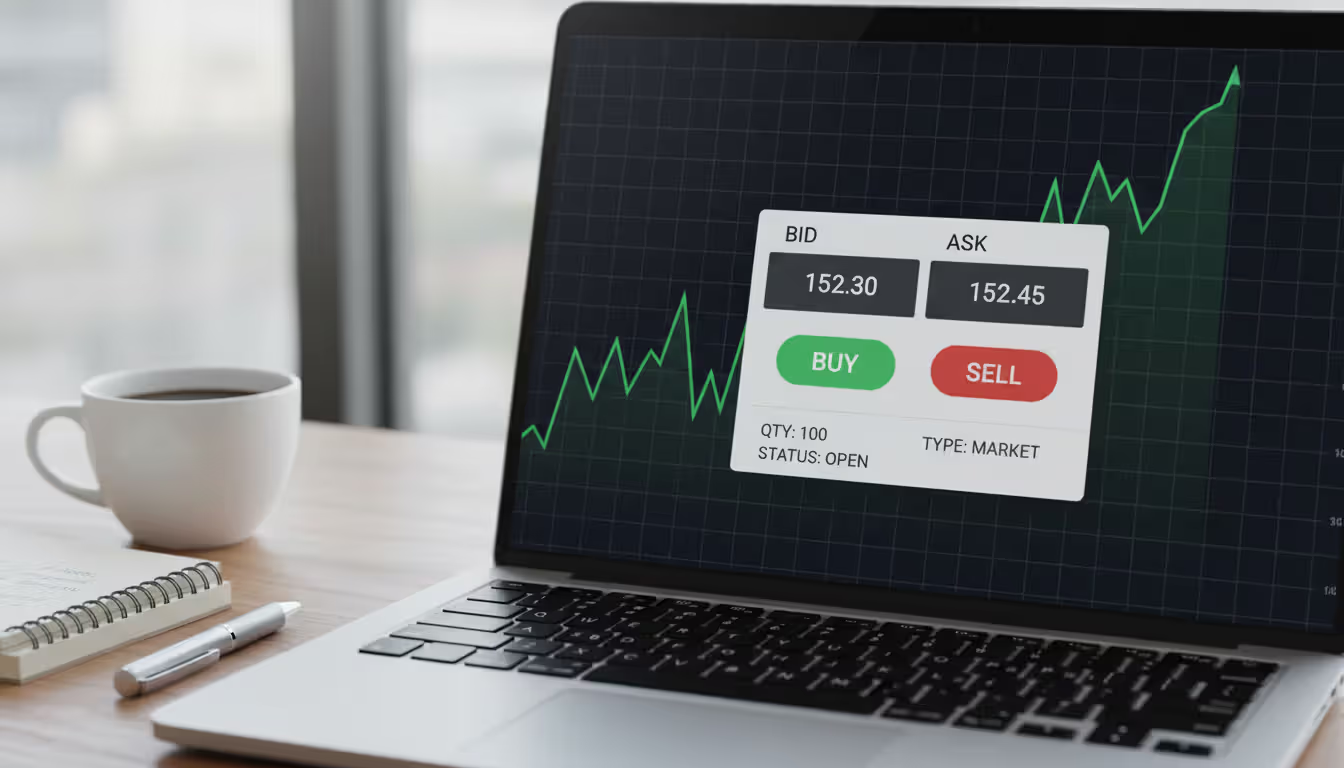
Picture this: you open a trading platform and see gold quoted at two prices—$2,050 to sell, $2,052 to buy. That $2 gap? That's the spread, and it represents how your broker gets paid. When you place a financial spread bet, you're picking one of those prices based on which way you think the market will move, then choosing how much money you want to risk per point of movement.
Here's what makes spread betting in finance fundamentally different from regular investing: ownership doesn't exist in this equation. You're not buying shares of a gold mining company or taking delivery of physical gold bars. You're simply entering into a contract that tracks gold's price.
The spread betting definition boils down to three non-negotiables: zero ownership of underlying assets, leverage that lets you control large positions with minimal upfront cash, and profit or loss calculations based purely on price direction—not dividends, not interest, not voting rights.
Why do traders gravitate toward this approach? Leverage sits at the heart of it. Got $1,000 in your account? Depending on margin rules, you might control a position worth $20,000 or even $50,000. That's a double-edged sword, obviously—wins get multiplied, but so do losses.
Active traders love the flexibility. Day traders who capitalize on hourly price swings, swing traders riding multi-day trends, news traders jumping on economic announcements—they all find something useful here. You can open a position at 9:00 AM and close it at 9:15 AM, or hold it for three weeks. No restrictions.
The platform access is genuinely impressive. From one account, you might bet on Tesla's stock price before lunch, switch to natural gas futures after lunch, then place an evening trade on the British pound. No need for separate commodity accounts, forex brokers, or stock trading platforms.
When you're ready to trade, you'll see two prices staring back at you: bid and ask. Using that S&P 500 example—say it's quoted 5,400/5,402—you'd buy at 5,402 if you're bullish, or sell at 5,400 if you're bearish. The 2-point spread comes out of your pocket immediately; the market needs to move at least 2 points in your direction just to break even.
How Spread Betting Works Step by Step
Let me walk you through an actual trade from start to finish using real numbers that'll make the process click.
You're watching the Dow Jones, and everything you're seeing—technical indicators, market sentiment, news flow—points to an upward move this week. Your broker shows 38,500/38,504. You decide to buy at 38,504, risking $10 for every point the Dow moves.
Position's now live. Every single point the Dow climbs above 38,504 puts $10 in your pocket. Every point it slides below 38,504 takes $10 out. Your broker's going to require margin—call it 10% of your total exposure—sitting in your account as collateral.
Do the math on that $10 stake at 38,504: you're controlling 38,504 points times $10 per point, which equals $385,040 in total exposure. At 10% margin, you need $38,504 available. Some brokers cut you slack on smaller trades, but they'll watch your account like a hawk regardless.
Fast forward three days. The Dow's climbed to 39,100/39,104. Time to cash out. You sell at the current bid—39,100. The market traveled 596 points your direction (39,100 minus 38,504), so you're collecting 596 times $10, which comes to $5,960 profit.
Flip the scenario. What if the Dow tanked to 38,000/38,004 instead? You'd be staring at a 504-point loss times your $10 stake. That's $5,040 gone, deducted straight from your margin balance.
Author: Vanessa Cole;
Source: martinskikulis.com
Understanding the Spread and Stake Size
Every trade starts in the red because of the spread. Go back to that Dow quote at 38,500/38,504. The 4-point gap means your $10-per-point position is already down $40 the second you enter. The market owes you 4 points of movement just to get you back to zero.
Spreads fluctuate wildly depending on what you're trading. Major forex pairs like EUR/USD might only cost you 0.5 to 2 pips during London or New York sessions. Individual stocks? Could be several cents wide. Try trading exotic instruments or catching markets outside regular hours, and watch those spreads balloon.
Your stake determines your risk velocity. Pick $1 per point, and a 50-point move against you costs $50. Pick $100 per point, and that same 50-point move costs $5,000. Beginners consistently underestimate how fast points accumulate, especially when volatility spikes.
Professional money managers operate on strict risk limits—typically 1% to 2% of account value per trade, maximum. Running a $10,000 account with a 1% risk ceiling? You're risking $100 per trade, period. Planning to set your stop-loss 50 points from entry? Then your maximum stake is $2 per point ($100 divided by 50 points). Not $3. Not $2.50. Exactly $2.
Going Long vs Going Short
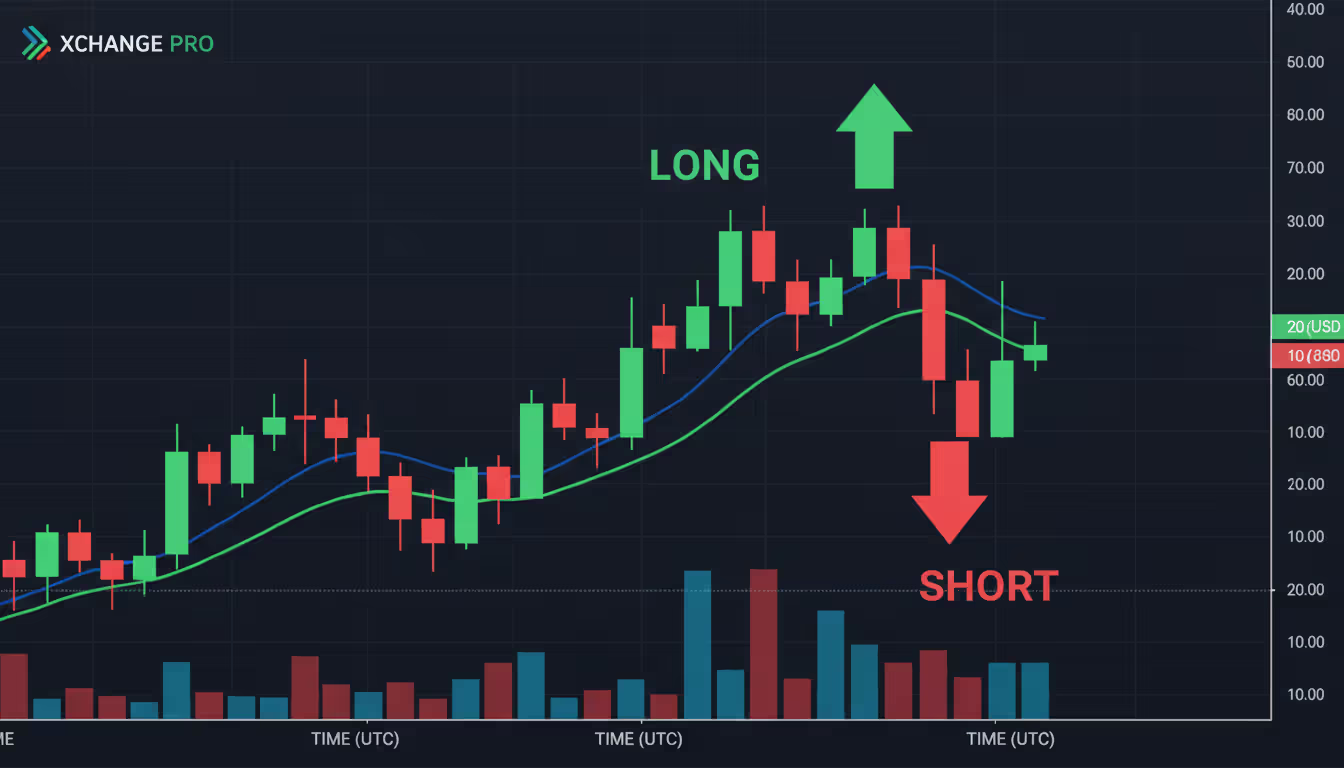
Here's the beautiful simplicity of spread betting explained: markets can make you money going up or down. Going long means buying because you expect prices to rise. Going short means selling because you expect prices to fall.
Shorting through spread betting beats the pants off shorting actual stocks. No share borrowing hassles. No borrowing fees eating into profits. You just sell at the bid price and buy back later at (fingers crossed) a lower price.
Say Tesla's quoted at $280/282, and you're convinced it's heading down. You sell at $280 with a $5 stake. Tesla drops to $265/267 like you predicted. You close by buying at $267. The 13-point drop ($280 minus $267) times your $5 stake nets you $65. Same mechanics as going long, just reversed.
Being able to short effortlessly makes spread betting powerful during market crashes. Throughout the 2025 tech correction, traders shorting the Nasdaq 100 via spread bets banked profits while buy-and-hold investors watched their portfolios bleed.
Author: Vanessa Cole;
Source: martinskikulis.com
Spread Betting vs CFD Trading
The spread betting vs CFD question trips up a lot of traders because these products feel almost identical—both use leverage, neither involves owning assets. But several meaningful differences emerge when you dig deeper.
Feature
Spread Betting
CFD Trading
Ownership of asset
You own nothing
You own nothing
Tax treatment (US)
Ordinary income or capital gains based on trading frequency
Capital gains or ordinary income based on holding duration
Commission structure
Usually hidden in spread
Often explicit commission plus narrower spread
Expiry dates
Daily-funded or quarterly expiry
Typically daily-funded with no expiry
Leverage options
Can reach 20:1 to 100:1
Typically 10:1 to 50:1
Best for
Short-term directional traders
Traders wanting transparent pricing
CFDs track underlying market prices more faithfully. Apple trading at $185.50? Your CFD quote will probably match that exactly, maybe with a 2-cent spread. Spread betting quotes might round to whole numbers or use different point scales for simplicity.
How you pay your broker differs substantially. Spread betting platforms often bundle all costs into the spread—no line items for commission. CFD platforms frequently charge explicit commission (say $10 per $10,000 traded) while keeping spreads tighter.
Traders pick spread betting when they want uncomplicated pricing and don't care about matching exact market quotes. CFD traders prefer seeing exactly what they're paying in commissions, especially on larger positions where tight spreads plus small commissions beat wide spreads with no commission.
Risk-wise? Identical. A 10:1 leveraged position can obliterate your account if the market moves 10% against you. Most traders choose between these products based on tax situations, pricing preferences, and which markets their preferred broker offers.
Markets You Can Trade with Spread Betting
The sheer variety of spread betting markets is staggering—you can access practically anything that has a price and moves. That breadth is a major selling point; diversify across completely different asset classes without juggling multiple specialized accounts.
Indices dominate trading volume. S&P 500, Nasdaq 100, Dow Jones, FTSE 100, DAX, Nikkei 225—all see massive spread betting activity. Index bets let you play broad market moves without picking individual winners. Major indices offer tight spreads, and trading runs almost continuously Monday through Friday.
Forex spans everything from major pairs like EUR/USD and GBP/USD to weird stuff like USD/TRY or EUR/ZAR. Deep forex liquidity means spreads stay tight during London and New York overlap—maybe 0.8 pips on EUR/USD. Exotic pairs? Prepare for 20+ pip spreads.
Individual stocks from exchanges worldwide are fair game. Apple, Microsoft, Amazon, plus thousands of international companies. Spread width depends on how actively a stock trades—Tesla might have a 2-cent spread because millions of shares trade daily, while some small-cap stock could have 10-cent spreads or wider.
Commodities cover gold, silver, crude oil, natural gas, copper, wheat, coffee—the whole spectrum. Gold spreads might run $0.30 per ounce. Crude oil could be 3 to 5 cents per barrel. Keep in mind commodity markets follow specific exchange hours; crude oil spread betting aligns with NYMEX hours, for instance.
Cryptocurrencies became standard offerings around 2020. Bitcoin, Ethereum, and major altcoins are available, though spreads are brutal compared to traditional markets. Bitcoin spreads can hit $50 to $100 during volatile sessions—that's significant on a $60,000 asset.
Here's the catch for Americans: traditional spread betting as UK brokers offer it isn't available. CFTC and SEC regulations block it. US traders get similar functionality through CFDs or futures instead.
Liquidity matters enormously. Betting on the S&P 500 at 2:00 PM Eastern? Tight spreads, instant fills. Betting on some obscure Australian mining stock at 11:00 PM Eastern? Wide spreads, slow execution, possible requotes.
Author: Vanessa Cole;
Source: martinskikulis.com
Calculating Profits and Losses in Spread Betting
Spread betting profits and losses follow simple arithmetic: take your closing price, subtract your opening price, multiply by your stake per point. Where traders get demolished is underestimating how quickly leverage makes that arithmetic violent.
Let me show you multiple scenarios with actual numbers:
Scenario
Entry Price
Exit Price
Stake per Point
Movement
Profit/Loss
Long gold trade
$2,050
$2,075
$20
+25 points
+$500
Short EUR/USD (losing)
1.0850
1.0920
$10 per pip
-70 pips
-$700
Long S&P 500 (stopped out)
5,200
5,150
$25
-50 points
-$1,250
Short crude oil
$85
$81
$50
+4 points
+$200
Scenario 1: Long gold trade—You buy gold at $2,050 per ounce, staking $20 per point. Gold rallies to $2,075. Your profit calculation: (2,075 - 2,050) times $20 equals $500. But you held three days and paid $15 total in overnight financing. Net profit drops to $485.
Scenario 2: Short EUR/USD disaster—You sell EUR/USD at 1.0850 with a $10-per-pip stake, betting the euro weakens. Instead it strengthens to 1.0920. Each pip in forex represents 0.0001, so you moved 70 pips in the wrong direction. At $10 per pip, that's $700 gone.
Scenario 3: S&P 500 with stop-loss protection—You buy the S&P at 5,200, staking $25 per point. Smart move: you place a stop-loss at 5,150. Market drops, stop triggers. Loss calculation: (5,150 - 5,200) times $25 equals negative $1,250. Painful, but your stop prevented a potentially catastrophic loss if the market kept falling.
Scenario 4: Profitable crude short—You sell crude at $85 per barrel, staking $50 per point. Oil drops to $81. Profit: (85 - 81) times $50 equals $200. That 4-point move generated a 20% return on your margin (assuming $1,000 was required).
Margin creates leverage that amplifies everything. That S&P 500 trade in Scenario 3 controlled $130,000 in exposure (5,200 points times $25). If your broker required 10% margin—$13,000—then your $1,250 loss represents a 9.6% hit to your margin from just a 50-point market move.
Losses can—and do—exceed deposits. Imagine having $3,000 in your account when that S&P 500 trade moved 150 points against you before you could react. You'd owe $3,750 (150 times $25). Your $3,000 account gets wiped out, and you still owe the broker $750.
Brokers have automatic liquidation systems that trigger when margin gets too low, but during market chaos, you might get closed out at prices far worse than the margin threshold. That creates negative balances you're legally obligated to pay.
Spread betting's greatest advantage—leverage—is also its greatest danger. I've seen traders turn $5,000 into $50,000 in a month, and I've seen them lose everything in a day. The math is unforgiving: if you risk 20% per trade, you only need five consecutive losses to be wiped out, and five consecutive losses happen more often than most traders expect
— Michael Patterson
Spread Betting Tax Treatment in the US
Spread betting tax treatment gets complicated fast in the United States because—unlike the UK where spread betting profits often escape taxation entirely—American tax law doesn't carve out special exceptions.
The IRS lumps spread betting under existing rules for speculative trading. Whether your profits get taxed as capital gains or ordinary income depends on how often you trade, how long you hold positions, and whether you can legitimately claim trader status.
Capital gains path: Trade occasionally with varied holding periods? You're probably looking at capital gains treatment. Hold positions under one year and you pay short-term capital gains, which the IRS taxes at your regular income rate—anywhere from 10% to 37% depending on your 2026 tax bracket. Hold over one year and you get long-term capital gains rates: 0%, 15%, or 20%.
Trader Tax Status qualification: Active traders meeting specific IRS tests can claim Trader Tax Status (TTS). Benefits include deducting trading expenses, sidestepping wash sale headaches, and potentially electing mark-to-market accounting via Section 475(f). To qualify, you need substantial, regular, continuous trading activity aimed at catching short-term price moves rather than long-term growth.
Mark-to-Market election: Traders with TTS can elect Section 475(f), which treats every position as if you sold it December 31st. All gains and losses become ordinary income/loss. This eliminates the $3,000 annual capital loss limitation and nukes the wash sale rule. Catch: you must make this election by your tax filing deadline for the year before it takes effect.
Reporting obligations: Every single spread bet needs reporting on your tax return. Capital gains treatment? Use Form 8949 and Schedule D. Trader Tax Status? Report on Schedule C. Keep meticulous records—entry prices, exit prices, dates, stake sizes, financing charges, everything.
Foreign account complications: Using a non-US broker? FBAR (Foreign Bank Account Report) and FATCA (Foreign Account Tax Compliance Act) filing requirements kick in once account balances cross certain thresholds.
US tax code complexity around derivatives makes professional help non-optional. A CPA who specializes in active trading can determine your optimal classification, ensure you're reporting correctly, and potentially save serious money through strategic elections and deductions.
Don't forget state taxes. Most states tax trading profits as ordinary income regardless of how the federal government classifies them. Living in Florida, Texas, or Nevada? No state income tax means potentially huge savings for high-volume traders.
Risks and Common Mistakes to Avoid
Spread betting has bankrupted more traders than market crashes. Most blow up from leverage misuse and psychological mistakes, not from poor market analysis.
Overleveraging kills accounts faster than anything else. When you can control $100,000 of market exposure with just $5,000 margin, the temptation to max out position sizes becomes irresistible. I've watched traders with $10,000 open five separate $100,000 positions—creating $500,000 in total exposure. A mere 2% adverse move across all positions? Account gone.
Fix this with ironclad position sizing. Never risk more than 1% to 2% of your account per trade. Running $10,000? Risk $100 to $200 per trade, maximum. Stop-loss 50 points away? Your stake can't exceed $2 to $4 per point. Feels ridiculously small when markets are moving hundreds of points, but it's the difference between surviving and exploding.
Skipping stop-losses or placing them absurdly wide creates unlimited downside exposure. Some traders enter positions naked, figuring they'll "watch it closely." Works great until you're in the bathroom when breaking news hits. The 2025 European banking flash crash saw certain shares crater 15% in under five minutes—traders without stops lost multiple times their account balances.
Set stops based on technical logic or volatility metrics, not random percentages. Buying the S&P 500 at support around 5,200? Maybe your stop goes just below support at 5,180. If support sits at 5,100, that's where your stop belongs—and you'd better reduce your stake size to maintain proper risk per trade.
Emotional trading destroys more capital than bad analysis. Lose a trade and the "revenge trade" urge hits hard—you oversize the next position trying to recover losses immediately. Win a few trades and overconfidence kicks in, leading to reckless position sizing. Both roads end at the same destination: blown account.
Maintain a trading journal tracking not just trades but emotional state. Notice patterns—like trading poorly after losses or making mistakes on Mondays—then implement rules. "No trading for 30 minutes after closing a loss" or "maximum two trades on Mondays" might seem arbitrary, but they interrupt destructive behavioral loops.
Margin call ignorance leaves traders confused when brokers suddenly close their positions. Margin requirements aren't suggestions or guidelines—they're contractual obligations. When your account drops below maintenance margin levels, your broker closes positions to restore compliance. No warning, no mercy.
This typically happens at the absolute worst moment. Markets gap against your position during maximum drawdown. Margin call triggers. Broker liquidates at a terrible price. Three hours later the market reverses completely, and you sit there watching the profit you would've captured if you'd maintained adequate margin.
Keep a margin cushion. Broker requires $5,000 to hold a position? Keep $7,000 to $8,000 available. This buffer prevents forced liquidation during normal volatility spikes.
Trading unfamiliar markets without understanding their personalities guarantees losses. A trader experienced in forex might assume crude oil behaves similarly. Wrong. Oil gaps 5% overnight on OPEC surprises or geopolitical events. That trader's 2% stop-loss? Gets obliterated, creating a 5% loss—two and a half times the intended risk.
Before trading new markets, study typical volatility patterns, trading hours, major price drivers, and seasonal behavior. Gold trades nothing like soybeans. The Nasdaq 100 has completely different volatility characteristics than the FTSE 100.
Holding through major news without accounting for gap risk invites disaster. Earnings announcements, Federal Reserve decisions, employment reports—these can move markets 5% to 10% in literal seconds. Your stop-loss might sit 2% below entry, but the market gaps 7% past it, handing you a 7% loss instead of the planned 2%.
Either close positions before major scheduled news or accept that stops might not protect you at intended levels. Some traders specifically target news volatility for profits, but they use dramatically smaller position sizes accounting for amplified risk.
Author: Vanessa Cole;
Source: martinskikulis.com
FAQ
Is spread betting legal in the United States?
Traditional spread betting as British brokers structure it isn't available to Americans. CFTC and SEC regulations prohibit this specific product design. US traders can access nearly identical functionality through regulated CFDs, options, or futures contracts—all offering comparable leverage and the ability to profit from rising or falling markets. The mechanics differ slightly, but the core concept of speculating on price movements with leverage remains the same.
Can you lose more than your initial deposit in spread betting?
Absolutely. Leverage means controlling positions larger than your account balance. When markets move violently against you—particularly during gaps or extreme volatility events—losses can punch through your account balance, creating negative equity owed to your broker. Some brokers offer negative balance protection policies, but coverage isn't universal. Stop-losses and adequate margin buffers are your primary defense against this nightmare scenario.
What's the minimum amount needed to start spread betting?
Brokers set minimums ranging from $200 to $1,000 typically. But the realistic minimum for sustainable trading sits much higher—think $2,000 to $5,000 minimum. Here's why: proper risk management means risking 1% to 2% per trade. A $500 account can only risk $5 to $10 per trade, which severely restricts available markets and stake sizes. Undercapitalization ranks among the top reasons trading accounts fail—small accounts can't weather normal losing streaks.
How is spread betting different from traditional stock trading?
Stock trading means buying and owning shares—you get voting rights, dividend payments, and actual ownership of a company slice. Spread betting involves zero ownership; you're speculating on price direction through a derivative contract. Traditional stock purchases typically require full payment upfront (or 50% with margin accounts), while spread betting might only require 5% to 20% margin. Tax treatment differs significantly. Plus you can't hold spread betting positions indefinitely without paying daily financing charges, whereas stocks can sit in your account for decades.
Do I need to pay taxes on spread betting profits in the US?
Yes, every dollar of spread betting profit faces taxation in America. The IRS doesn't grant the tax-free status that UK traders often enjoy. Your profits get taxed as either capital gains or ordinary income depending on trading frequency and your tax classification. Maintain detailed records of every trade—dates, prices, stake sizes, financing charges. Seriously consider hiring a CPA familiar with active trading to ensure proper reporting and potentially optimize tax treatment through elections like mark-to-market accounting if you qualify.
What happens if I can't meet a margin call?
When your account balance drops below required maintenance margin, the broker issues a margin call demanding additional deposit. If you don't deposit funds rapidly—often within hours or even minutes during volatile conditions—the broker automatically liquidates some or all positions to restore account compliance. These forced closures typically execute at horrible prices during peak market stress. In extreme situations where liquidating positions doesn't cover the margin shortfall, you can end up owing the broker money beyond your account balance.
Spread betting delivers a powerful mechanism for speculating on financial markets using leverage, flexibility, and broad access to thousands of instruments from one account. The capacity to profit whether markets climb or tumble, combined with relatively modest capital requirements, makes it appealing to active traders chasing short-term opportunities.
The risks scale directly with leverage employed. Markets can turn against you faster than you can blink, leverage multiplies losses just as enthusiastically as gains, and the psychological pressures of managing volatile positions destroy more accounts than poor market calls ever will.
Succeeding with spread betting requires more than mechanical knowledge. You need rigid risk management protocols, emotional discipline, adequate capitalization, and realistic expectations about both returns and drawdowns. Traders who survive and profit treat this as serious business requiring continuous education, strict rules, and enough humility to accept that losses come with the territory.
For Americans, regulatory barriers block access to traditional spread betting products, but CFDs and other derivatives offer nearly identical functionality. Understanding tax implications and keeping meticulous records becomes critical for both compliance and optimization.
Whether spread betting fits your trading style depends on risk tolerance, available capital, time commitment, and ability to handle the psychological pressures that leverage creates. It's completely unsuitable for passive investors or anyone seeking steady, predictable returns. It works for active traders who understand the risks, can implement disciplined strategies, and have sufficient capital to survive inevitable losing periods.
The spread is the difference between bid and ask prices in forex trading—your cost to enter every position. Understanding how spreads work, when they widen, and how to minimize these costs can dramatically improve your trading profitability over time
A pip represents the smallest standardized price movement in forex trading. Understanding pip calculations is essential for position sizing, risk management, and profit calculation. This guide explains pip definitions, calculation methods for different currency pairs, and how to avoid common mistakes
The forex market moves $7.5 trillion daily, yet most retail traders lose money. Regulatory data shows only 15-25% maintain profitable accounts. This guide examines real statistics, common failure causes, and what actually makes traders profitable based on 2026 data
The forex market processes over $7.5 trillion daily, yet fraud complaints have surged 340% since 2022. This guide explains how legitimate currency trading coexists with widespread scams, details CFTC and NFA oversight, identifies red flags, and provides a step-by-step broker verification process
The content on this website is provided for general informational and educational purposes only. It is intended to explain concepts related to Forex (FX) trading, currency markets, leverage, hedging, and risk management.
All information on this website, including articles, guides, and examples, is presented for general educational purposes. Forex trading carries significant risk, and outcomes may vary depending on market conditions, leverage, and individual decisions.
This website does not provide financial, investment, or trading advice, and the information presented should not be used as a substitute for consultation with qualified financial professionals.
The website and its authors are not responsible for any errors or omissions, or for any outcomes resulting from decisions made based on the information provided on this website.