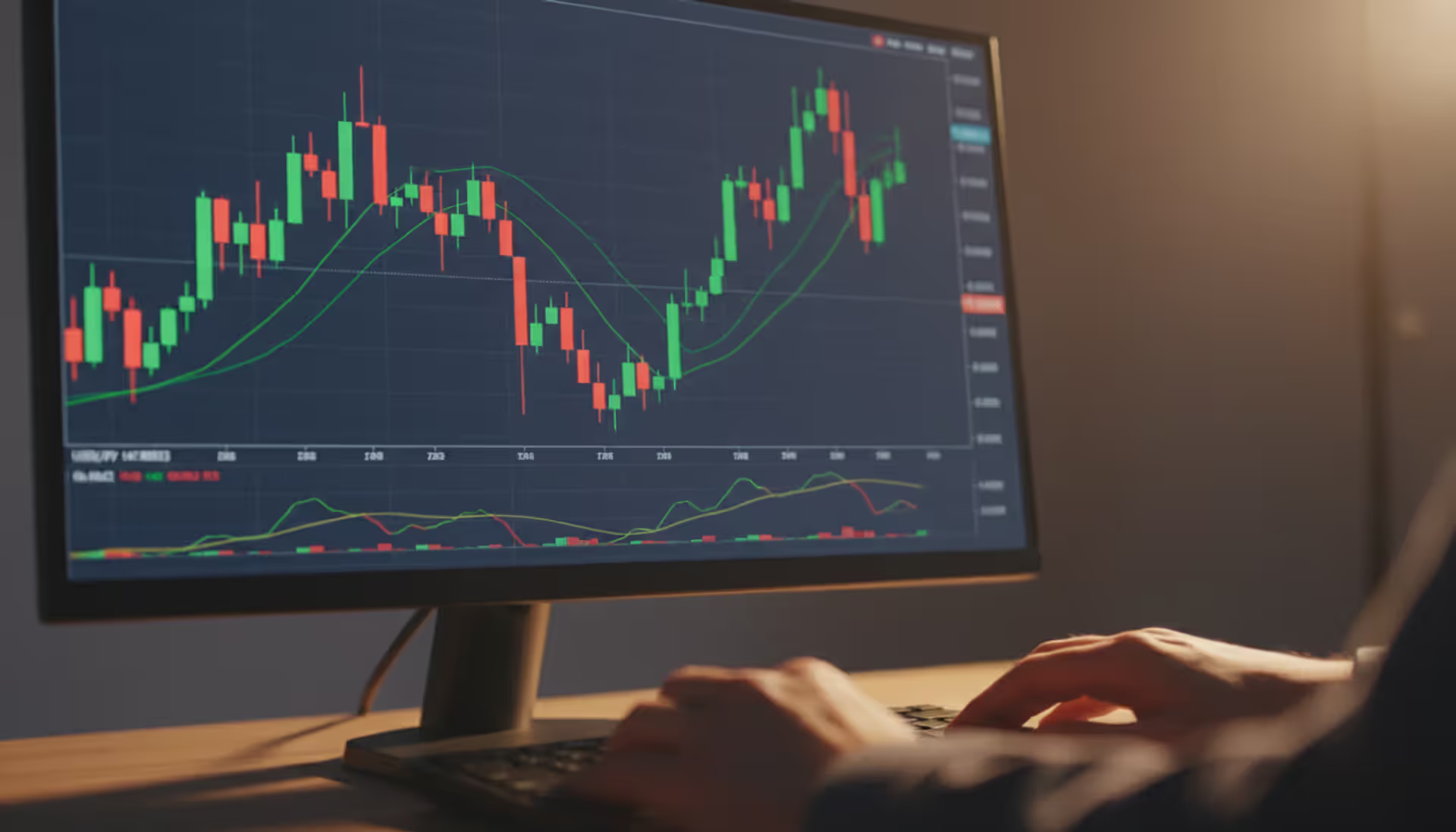
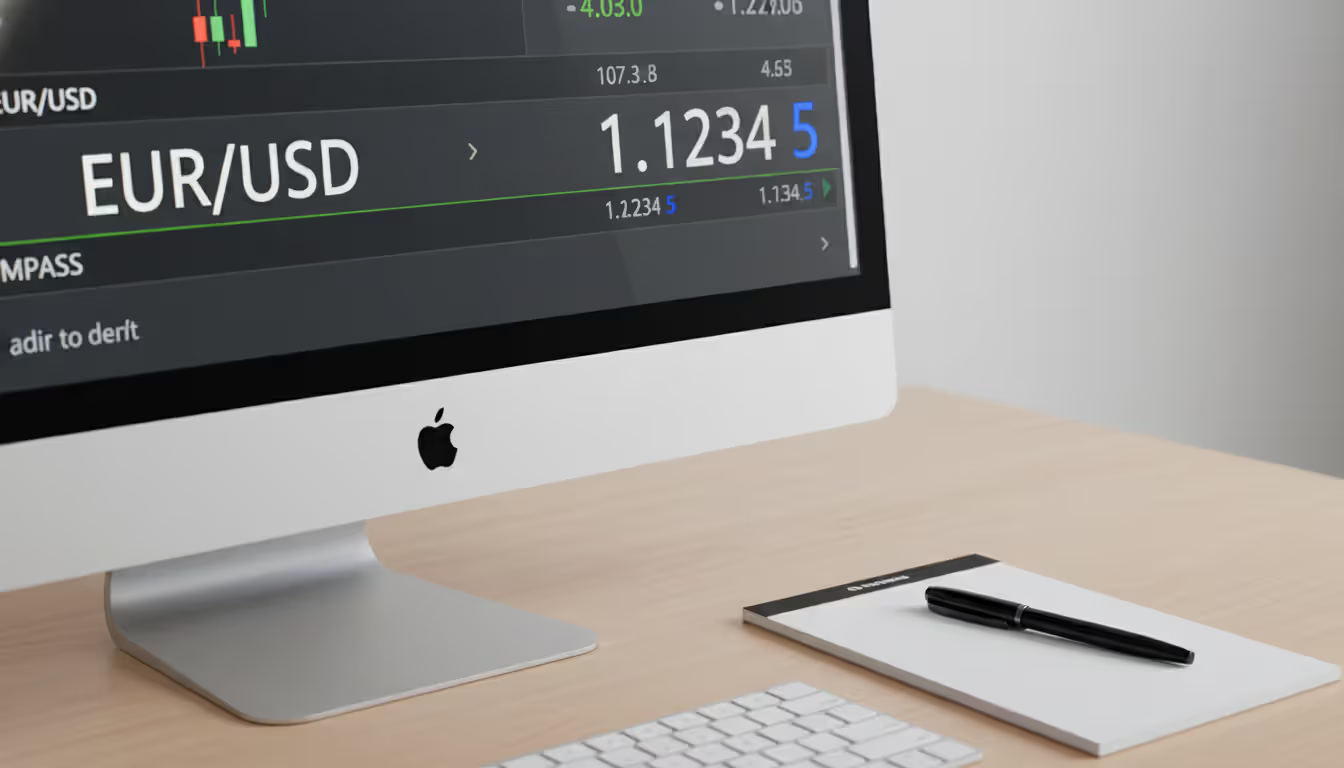
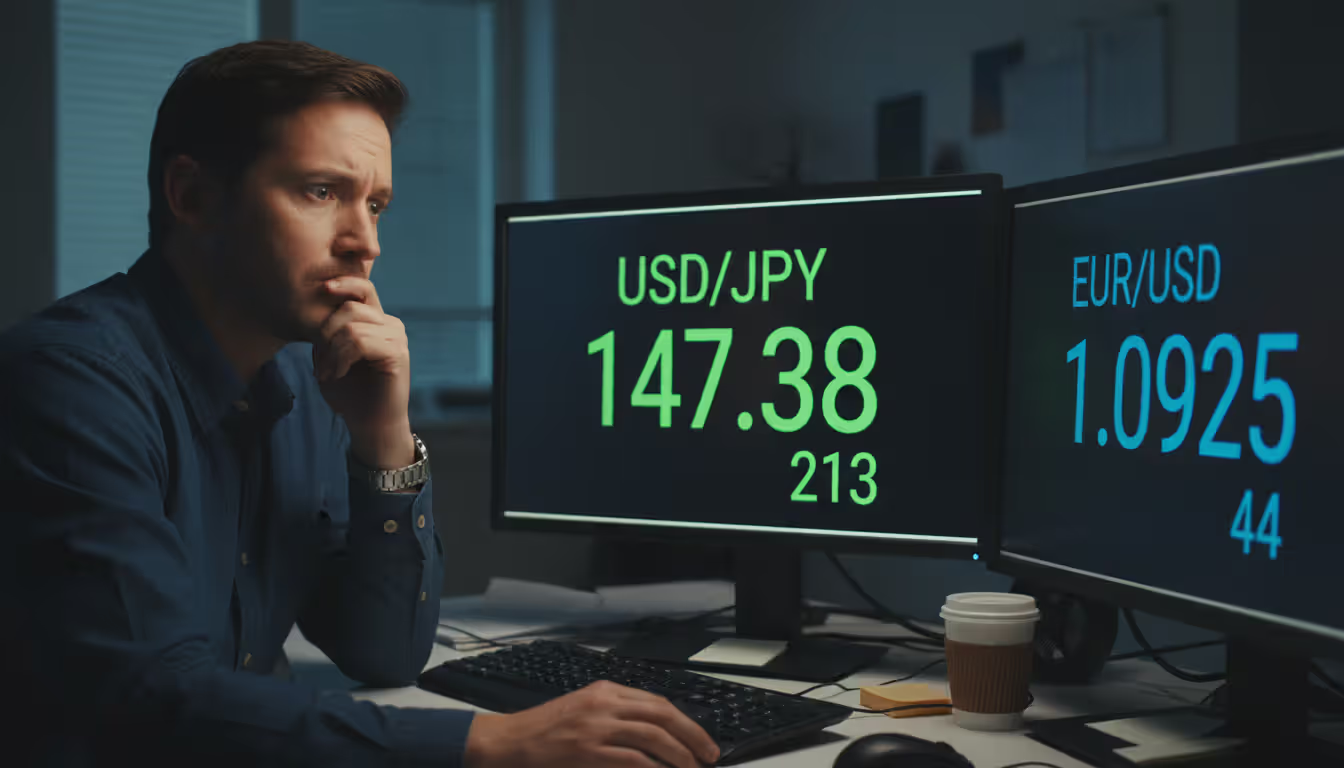
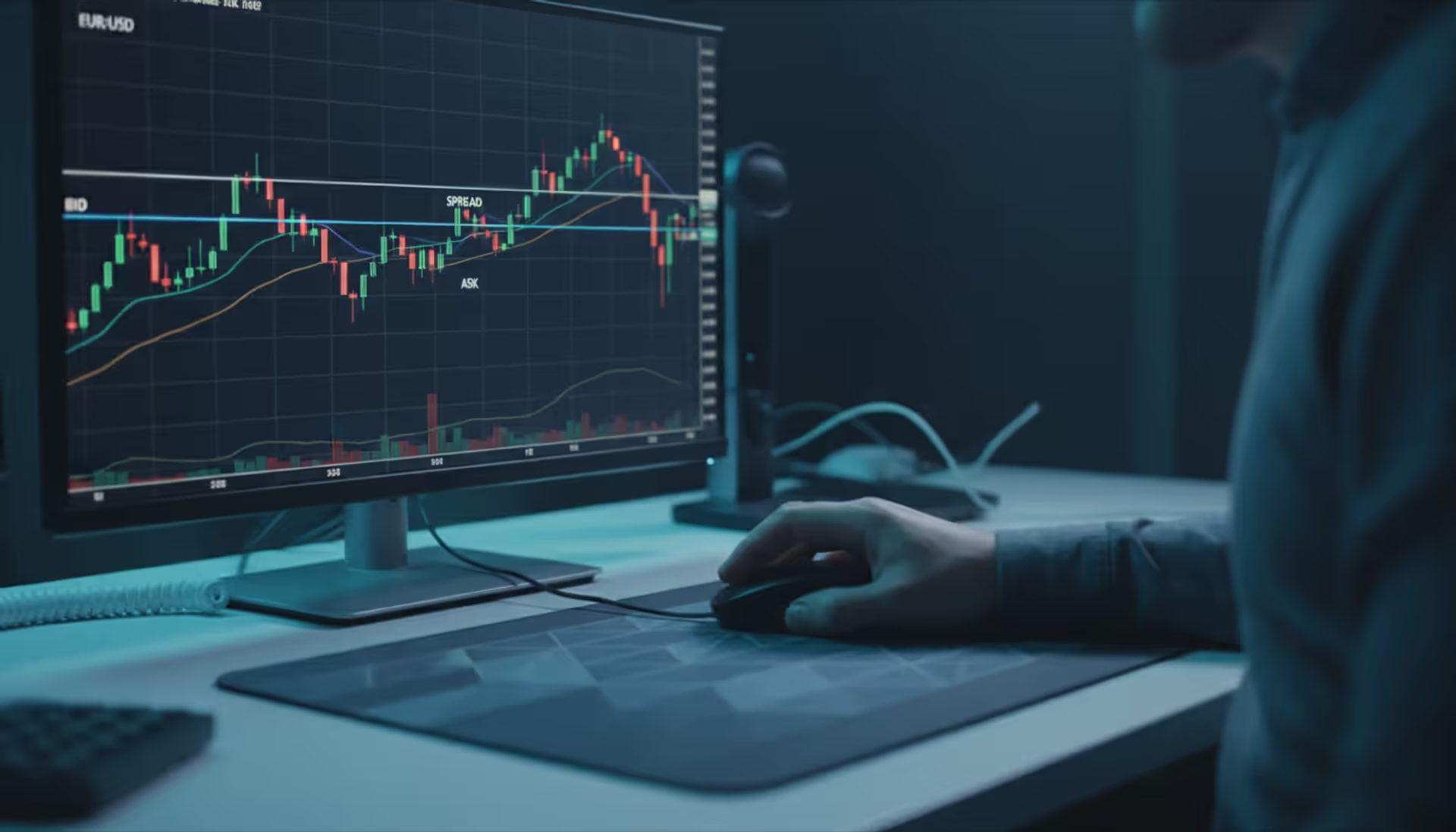
Your first week trading currencies, you'll notice traders casually mention "I grabbed 50 pips on EUR/USD" like everyone understands what that means. If you're nodding along while secretly confused, you're not alone—pips baffle nearly every beginner who steps into forex.
Here's what matters: pips measure how much a currency pair's price moves. Think of them like inches on a ruler, except this ruler measures money entering or leaving your trading account. Get comfortable calculating pips, or you'll be guessing how much you're actually risking on each trade.
In forex, a pip tracks the tiniest standardized shift in exchange rates between two currencies. You can't wing it here—position sizing, setting stop losses, and counting your profits all depend on pip math. Try trading without understanding this, and you might as well be throwing darts blindfolded.
Understanding Pips in Forex
Most forex traders will tell you "pip" means "percentage in point," though some say "price interest point." Both explanations work. What actually matters is this: for major currency pairs, you're looking at the fourth number after the decimal. That's your pip.
Take EUR/USD trading at 1.0850. The pair climbs to 1.0851? That's a one-pip gain. Drops to 1.0849? One-pip loss. Simple enough once you know where to look.
Why does this measurement exist? Imagine trying to discuss forex movements without a standard unit. One trader talks in percentage terms, another uses raw decimal changes, a third references dollar amounts. Chaos. Pips give every trader worldwide the same language. Someone in Tokyo and someone in London both instantly understand "GBP/USD jumped 80 pips today."
Decimal precision varies based on which currencies you're pairing. EUR/USD, GBP/USD, AUD/USD—these show four decimals (0.0001 as one pip). But pair anything with the Japanese yen? You'll only see two decimals (0.01 as one pip). The yen naturally trades at higher numerical values compared to dollars or euros, which explains the different structure.
Pips show up everywhere in your trading. Your broker's spread? Measured in pips. That distance you set for your stop loss? Pips again. Profit targets, daily volatility ranges, strategy performance—all measured using this same unit.
Author: Ethan Blackwell;
Source: martinskikulis.com
How Pips Are Calculated in Currency Pairs
Calculating how many pips a pair has moved follows clear patterns once you match the right decimal place to the right currency combination. Just remember that yen pairs play by different rules than everything else.
Standard Pairs vs. Japanese Yen Pairs
Pick any major pair like EUR/USD, GBP/USD, or AUD/USD. Count four spaces past the decimal point—that's where your pip lives. Say GBP/USD shifts from 1.2645 to 1.2670. You're measuring a 25-pip move.
The math: (1.2670 - 1.2645) × 10,000 = 25 pips
Now switch to yen pairs—USD/JPY, EUR/JPY, GBP/JPY. Count just two spaces past the decimal. If USD/JPY rises from 149.50 to 149.75, that's still 25 pips, but calculated differently:
(149.75 - 149.50) × 100 = 25 pips
Beginning traders constantly trip over yen pairs. The price looks like it's barely moving because you're seeing fewer decimals, but the pip count remains identical to other pairs. A 25-pip move on USD/JPY carries the same weight as 25 pips on EUR/USD in terms of standard measurement—though the dollar value differs (we'll get to that shortly).
Pip Location by Currency Pair
Currency Pair
Sample Price
Where's the Pip?
Add One Pip
EUR/USD
1.0850
Fourth decimal (0.0001)
1.0851
GBP/USD
1.2645
Fourth decimal (0.0001)
1.2646
USD/JPY
149.50
Second decimal (0.01)
149.51
EUR/JPY
161.25
Second decimal (0.01)
161.26
AUD/USD
0.6580
Fourth decimal (0.0001)
0.6581
USD/CHF
0.8920
Fourth decimal (0.0001)
0.8921
What Are Pipettes and Fractional Pips
Pull up any modern trading platform, and you'll probably see five decimals on EUR/USD instead of four. That extra digit? It's called a pipette—worth one-tenth of a standard pip.
So what is a pipette beyond just an extra decimal? It lets brokers advertise tighter spreads and gives you more granular pricing. Instead of a broker claiming a "1 pip spread," they can now offer "0.7 pips," which really means 7 pipettes.
These fractional pips in forex matter more than you'd think. Trade large positions or scalp for small gains, and pipettes add up fast. Catch a 5-pipette move on a standard lot? That's $5 in your pocket or out of it. String together ten trades like that, and you're talking about real money.
Swing traders who hold positions for days often ignore pipettes completely, rounding everything to the nearest full pip. Makes the math cleaner. But if you're in and out of trades within hours or minutes, you need that precision. Your edge might live in those fractional pips.
Author: Ethan Blackwell;
Source: martinskikulis.com
How to Calculate Pip Value
Now we get to the money question: what's a pip actually worth in dollars? The answer shifts based on three things—your position size, which pair you're trading, and what currency your account uses.
The pip value explained through a basic formula:
Pip Value = (One Pip / Exchange Rate) × Position Size
When USD sits as the second currency in the pair (the "quote currency"), life gets easier. Pairs like EUR/USD or GBP/USD make pip value calculations straightforward. Other combinations require an extra conversion step.
Pip Value Per Lot Size
Forex operates on standardized lot sizing. A standard lot controls 100,000 units of whatever currency comes first. Drop to a mini lot, you're controlling 10,000 units. Micro lots handle 1,000 units.
These size differences directly change how much each pip is worth per lot:
Trading EUR/USD (with USD as the quote currency): - Standard lot (100,000 euros): Each pip = $10 - Mini lot (10,000 euros): Each pip = $1 - Micro lot (1,000 euros): Each pip = $0.10
Notice these values stay fixed regardless of whether EUR/USD trades at 1.0850 or 1.1500. USD being the quote currency locks in consistent pip values.
Flip to USD/JPY at 149.50, where USD becomes the base currency: - Standard lot: Each pip = roughly $6.69 (calculated as 1,000 ÷ 149.50) - Mini lot: Each pip = roughly $0.67 - Micro lot: Each pip = roughly $0.067
See the difference? Pip values on USD/JPY fluctuate as the exchange rate moves. They're also worth less per pip compared to EUR/USD on the same lot size.
This creates strategic implications. Risk a 50-pip stop on EUR/USD with a standard lot? You're putting $500 on the line. Same 50-pip stop on USD/JPY? About $335 at current rates. Different pairs = different risk profiles, even with identical pip counts.
Calculating Pip Value in EUR/USD
Let's walk through calculating pips in eur usd with a complete example. You're long one standard lot on EUR/USD at 1.0850. That means you control 100,000 euros worth of this trade.
Since USD is quoted second, one pip (0.0001) equals: 0.0001 × 100,000 = $10 per pip
The pair rallies to 1.0880, and you close. How many pips did you capture? 1.0880 - 1.0850 = 0.0030 0.0030 × 10,000 = 30 pips
Your profit: 30 pips × $10 = $300
Reduce your position to a mini lot (10,000 euros)? Same 30-pip move nets you: 30 pips × $1 = $30 profit
Drop to a micro lot (1,000 euros): 30 pips × $0.10 = $3 profit
The relationship scales linearly. Double your position size, double your pip value. Cut your size in half, your pip value halves too. Once you nail down the base pip value for each lot size, the rest becomes multiplication.
Dollar Value Per Pip Across Major Pairs
Currency Pair
Standard Lot (100,000 units)
Mini Lot (10,000 units)
Micro Lot (1,000 units)
EUR/USD
$10.00 per pip
$1.00 per pip
$0.10 per pip
GBP/USD
$10.00 per pip
$1.00 per pip
$0.10 per pip
USD/JPY*
$6.69 per pip
$0.67 per pip
$0.067 per pip
USD/CHF*
$11.21 per pip
$1.12 per pip
$0.112 per pip
*Calculated using approximate 2026 rates (USD/JPY at 149.50, USD/CHF at 0.8920); values shift as exchange rates change
How Pip Movement Affects Your Trading
Understanding pip movement forex mechanics turns abstract numbers into concrete trading decisions. Watch EUR/USD during a Federal Reserve announcement—the pair can swing 100 pips in under an hour. Hold a standard lot through that? Your account just moved $1,000 in one direction or the other.
Major pairs typically travel 60-100 pips daily during normal conditions. The London-New York session overlap brings the heaviest movement, sometimes pushing EUR/USD or GBP/USD through 80-pip ranges in three hours. Economic data releases can double or triple that in minutes.
Knowing typical pip ranges keeps your expectations realistic. Trading a pair that averages 50 pips of daily movement? Don't build strategies expecting 200-pip gains every session. You'll hold positions too long, watch profits evaporate, and kick yourself for greed.
Author: Ethan Blackwell;
Source: martinskikulis.com
Risk management lives and dies by pip calculations. Say you're running a $10,000 account and following the 1% risk rule—you'll risk $100 per trade maximum. Now calculate backward from there.
With a mini lot on EUR/USD ($1 per pip), you can afford a 100-pip stop loss. Bump up to a standard lot ($10 per pip)? Your stop tightens to 10 pips to keep dollar risk at $100. This inverse relationship forces you to choose between wider stops with smaller positions or tighter stops with larger positions.
Consider this scenario: You spot a setup on GBP/USD targeting 40 pips with a 20-pip stop (2:1 reward-to-risk ratio). Using a standard lot means risking $200 to potentially make $400. Trade a mini lot instead—you're risking $20 to make $40. Identical pip counts, totally different monetary exposure.
Don't forget spread costs eating into your pip targets. Your broker charges a 2-pip spread on EUR/USD? You start every trade down 2 pips automatically. That 30-pip profit target actually requires a 32-pip favorable move. Scalpers aiming for 5-10 pips per trade feel this acutely—a 2-pip spread represents 20-40% of their gross profit before they've even considered the market direction.
Traders obsess over finding perfect entries and ignore pip mathematics. You could nail market timing but still blow up your account if you miscalculate position size against pip value. Risk management isn't about playing it safe—it's about knowing precisely how many pips you're risking and what that costs in real dollars
— Dr. Alexander Chen
Common Pip Calculation Mistakes to Avoid
Mixing up pipettes and pips wrecks more trading accounts than you'd expect. Your platform shows a 15-pipette gain, but you read it as 15 pips. On a standard lot, you just confused $15 with $150—possibly leading you to hold a position longer than you should or miscalculate your win rate.
Yen pairs cause constant confusion. Traders who spend weeks on four-decimal pairs switch to USD/JPY and forget the decimal adjustment. They see the price move from 149.00 to 149.50 and think it's barely budged. Wrong—that's 50 pips, not 0.50 pips. The two-decimal display tricks your brain until you retrain it.
Position size errors multiply into disasters quickly. You intend to click mini lot (10,000 units) but accidentally select standard lot (100,000 units). Now every pip is worth ten times what you planned. A 20-pip loss that should've cost $20 just drained $200 from your account. On smaller accounts, that triggers margin calls.
Author: Ethan Blackwell;
Source: martinskikulis.com
Many traders nail the pip value calculation but forget currency conversion. You're based in Europe with a EUR account, trading GBP/USD. The pip value comes out in USD, which you then need to convert to EUR using the current EUR/USD rate. Skip that conversion, and your risk calculations are off.
Pip values on certain pairs aren't fixed—they float with the exchange rate. Trading USD/CHF? The dollar value of each pip changes as the exchange rate moves. A pip value calculated when USD/CHF sits at 0.8900 won't match the actual value when the rate hits 0.9100. Small discrepancies, but they compound over dozens of trades.
Stop losses placed at arbitrary round-number pip distances ignore market reality. You set a 50-pip stop because it sounds reasonable, but you haven't checked if the pair typically swings 30 pips or 120 pips during your trading session. Either you get stopped out by normal noise, or you're risking way more than the market structure demands.
Frequently Asked Questions About Pips
How much is one pip worth in dollars?
The dollar value shifts based on your lot size and which pair you're trading. On EUR/USD with 100,000 units (standard lot), you're looking at $10 per pip. Cut that to 10,000 units (mini lot), and each pip drops to $1. Go micro at 1,000 units? Just $0.10 per pip. But here's where it gets trickier—pairs with USD as the base currency like USD/JPY require dividing by the current exchange rate, creating pip values that fluctuate as the market moves.
What's the difference between a pip and a pipette?
A pip measures the standard price increment in forex—typically the fourth decimal on most pairs (0.0001). Meanwhile, a pipette slices that pip into ten smaller pieces, representing the fifth decimal place (0.00001). Look at EUR/USD quoted as 1.08505—that final 5 is your pipette. Brokers love pipettes because they can advertise spreads like "0.8 pips" instead of rounding up. For most calculation purposes, you'll focus on full pips unless you're scalping or managing huge positions.
How many pips should I aim for per trade?
Your pip target needs to match two things: the pair's normal volatility and how long you hold trades. Day traders often chase 10-30 pips on major pairs during active sessions. Swing traders might wait several days to capture 100-200 pips. Here's the truth though—arbitrary pip goals miss the point. What matters more is your reward-to-risk ratio. Risking 20 pips? Target at least 40 pips (2:1 ratio) to ensure that even with a 50% win rate, you're profitable over time.
Do all currency pairs calculate pips the same way?
Not quite. Most pairs track pips at the fourth decimal spot (0.0001), but Japanese yen pairs shift that to the second decimal (0.01) because yen trades at higher nominal values than currencies like USD or EUR. The underlying concept stays identical—one pip still represents a standardized small price shift. Venture into exotic pairs or start trading commodities and crypto, and you'll encounter different conventions entirely. Always check your broker's specs for unfamiliar instruments before diving in.
How do I calculate pips for crypto or commodities?
You don't—crypto and commodities don't use forex pip conventions. Bitcoin moves in straight dollar amounts per coin. Gold shifts in dollars per ounce. Oil trades in cents per barrel. These markets use "points" or "ticks" instead of pips. A $100 Bitcoin move is just that—$100, with no pip conversion needed. Each instrument defines its own minimum price fluctuation. Check your broker's contract specifications to understand what each tick is worth for your position size on any non-forex instrument.
Can pip values change during a trade?
Depends on the pair. Trading EUR/USD or GBP/USD where USD is the quote (second) currency? Pip values stay locked throughout your trade. Switch to USD/JPY or USD/CHF with USD as the base currency, or trade cross-pairs like EUR/GBP? Your pip values will drift as exchange rates shift. The fluctuation usually stays minor and matters most when you're holding large positions for extended periods. Most traders calculate risk using the pip value at entry and accept small variations that might occur before exit.
Pips create the universal measuring system that makes forex trading function. Without this standardized unit, you'd struggle to compare trades, manage risk precisely, or calculate profits consistently across different currency pairs and position sizes.
The gap between profitable traders and those who struggle often narrows down to pip calculation accuracy. Knowing exactly what each pip represents for your specific lot size and trading approach isn't optional—it's foundational. Miss these calculations, and you're guessing your risk instead of managing it.
Start with the basics and drill them until they're automatic. Where does the pip sit in your currency pair's quote structure? What's its dollar value for your chosen lot size? How do pip movements translate into actual account balance changes? These three questions should have instant answers before you click the trade button.
The math itself isn't complicated—it's just specific. But one misplaced decimal or wrong lot size selection can transform a manageable 20-pip loss into an account-crushing event. Practice pip calculations on paper trades first. Verify your numbers twice before entering real positions.
Eventually, these calculations will become second nature. You'll instantly know your risk per pip without conscious thought. But that fluency only develops through understanding the mechanics thoroughly first. Ask any consistently profitable trader what they're risking per pip on their current position—they'll answer in under three seconds. That precision isn't luck. It's the difference between professional trading and expensive guesswork.
The spread is the difference between bid and ask prices in forex trading—your cost to enter every position. Understanding how spreads work, when they widen, and how to minimize these costs can dramatically improve your trading profitability over time
Spread betting allows you to speculate on price movements without owning assets. This leveraged derivative offers access to thousands of markets but carries substantial risks. Learn how spread betting works, profit/loss mechanics, tax implications, and critical mistakes to avoid
The forex market moves $7.5 trillion daily, yet most retail traders lose money. Regulatory data shows only 15-25% maintain profitable accounts. This guide examines real statistics, common failure causes, and what actually makes traders profitable based on 2026 data
The forex market processes over $7.5 trillion daily, yet fraud complaints have surged 340% since 2022. This guide explains how legitimate currency trading coexists with widespread scams, details CFTC and NFA oversight, identifies red flags, and provides a step-by-step broker verification process
The content on this website is provided for general informational and educational purposes only. It is intended to explain concepts related to Forex (FX) trading, currency markets, leverage, hedging, and risk management.
All information on this website, including articles, guides, and examples, is presented for general educational purposes. Forex trading carries significant risk, and outcomes may vary depending on market conditions, leverage, and individual decisions.
This website does not provide financial, investment, or trading advice, and the information presented should not be used as a substitute for consultation with qualified financial professionals.
The website and its authors are not responsible for any errors or omissions, or for any outcomes resulting from decisions made based on the information provided on this website.