If you've ever wanted to speculate on the dollar rising against the euro—or hedge your company's overseas revenue—currency futures give you a centralized, exchange-traded way to do it. These aren't the wild-west over-the-counter forex trades you see advertised on Instagram. Currency futures live on regulated exchanges like the Chicago Mercantile Exchange, where every contract follows uniform rules, prices update in real time on public order books, and a clearinghouse stands between you and your counterparty.
Here's what makes futures different: you're not negotiating terms with a broker's dealing desk. Contract size, expiration date, margin requirements—all of it is set in stone before you ever click "buy." That structure attracts institutional players, from multinational corporations locking in payment rates to hedge funds running macro strategies. For retail traders, it means you can see actual traded volume, compare your fill to the last sale, and know you're playing on the same field as the pros.
We'll break down the entire process—account setup, reading a futures quote, calculating your risk per tick, surviving a margin call, and rolling contracts forward when expiration looms. By the end, you'll understand why a single euro FX contract moves $6.25 for every half-pip and what to do when your broker sends that dreaded margin-call email at 4 a.m.
What Are Currency Futures and How Do They Work
Think of a currency futures contract as a promise stamped and notarized by an exchange. You agree to buy or sell a fixed quantity of one currency for another—say, €125,000 against U.S. dollars—at a price you lock in today, with delivery (or cash settlement) happening on a specified date three months out. The CME sets every detail: contract size, tick increments, expiration schedule. No negotiation, no customization. That uniformity is the whole point—it creates a liquid, competitive marketplace where thousands of participants can trade identical contracts.
Leverage turns small moves into big swings. You don't wire $150,000 to buy one euro contract. Instead, you post initial margin—often $5,000 or less—which acts as a performance bond. If the euro climbs one cent (100 ticks), you pocket $1,250 on that $5,000 deposit—a 25 % return. Flip side: if it drops one cent, you lose $1,250, and your account is down 25 %. Leverage is neutral. It just makes everything louder.
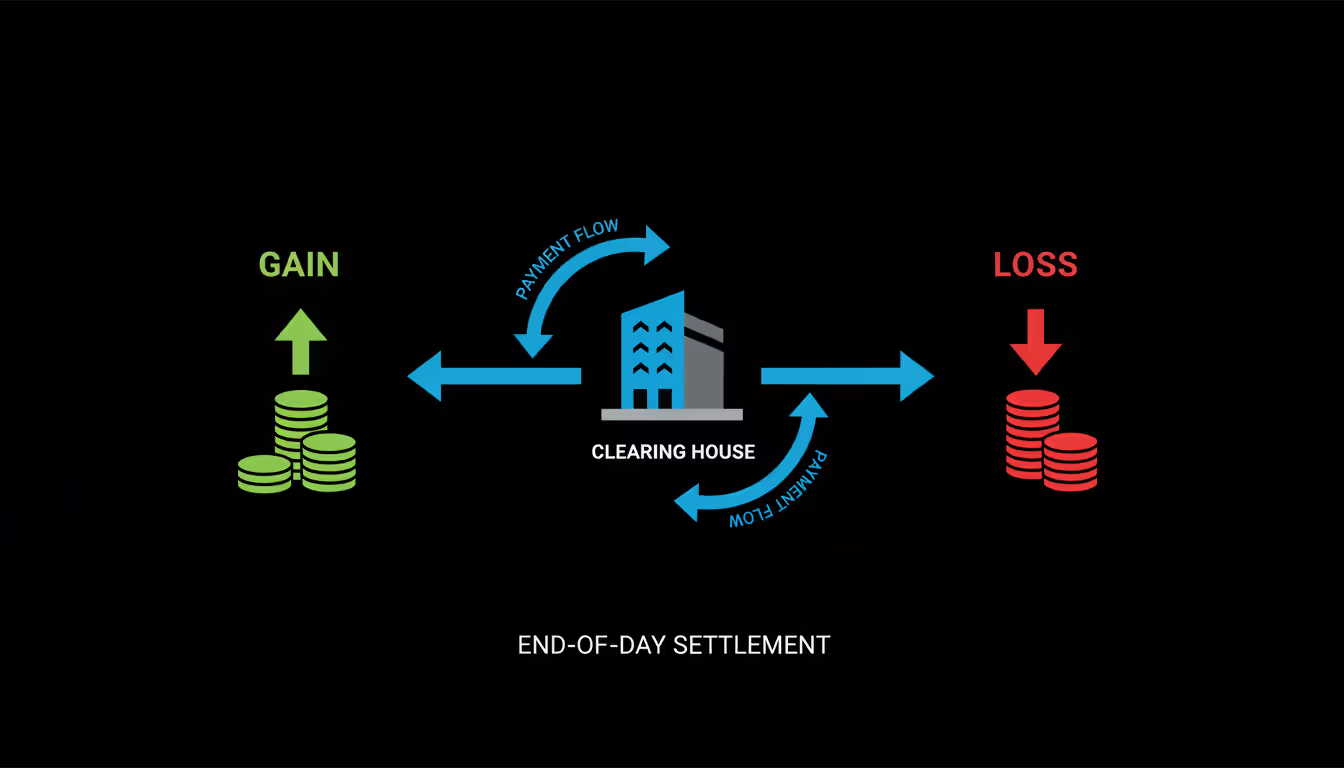
Mark-to-market happens every single day. At the end of each session, the clearinghouse calculates your profit or loss based on the settlement price and moves cash in or out of your account. Gain $800 today? It hits your balance tonight. Lose $800? It's gone by morning. This daily true-up prevents the kind of hidden, accumulating losses that blow up over-the-counter forward contracts.
Author: Marcus Ellington;
Source: martinskikulis.com
How does this compare to spot forex? Spot is decentralized—dozens of banks and brokers quoting prices, no central order book, spreads that vary by platform. You can trade micro-lots (1,000 units) and hold positions indefinitely. Futures require larger contract sizes (the smallest euro E-micro is still €12,500), trade on an exchange with one price feed, and expire on a fixed calendar. Institutions prefer futures for the audit trail and regulatory oversight; retail traders often like spot for ease of entry and fractional position sizing. Neither is "better"—they serve different needs.
Steps to Trade Currency Futures
Opening your first currency futures position isn't complicated, but each step has traps for the unwary.
Choosing a Broker and Opening an Account
You need a Futures Commission Merchant licensed by the CFTC and registered with the National Futures Association. Interactive Brokers, TD Ameritrade (thinkorswim), TradeStation, and NinjaTrader all offer direct CME access. Compare commissions—typically $0.85 to $2.50 per contract per side—and check whether they charge platform fees or market-data subscriptions.
The application asks about your trading experience, annual income, net worth, and risk tolerance. Regulators want brokers to confirm you understand that futures can lose more than your initial deposit. Answer honestly; exaggerating won't help if you're unprepared for a margin call. You'll upload a driver's license, proof of address, and provide your Social Security number for tax reporting.
Funding is the next decision. A single euro FX contract needs roughly $5,000 initial margin, but pros suggest starting with $15,000–$20,000. Why the cushion? A 50-tick adverse move costs $312.50. If your account has only $5,500, you're one modest swing from a margin call. Leaving breathing room keeps you in control.
Placing Your First Currency Futures Trade
Navigate to the futures ladder or chain in your platform. You'll see a list of expirations: March (H), June (M), September (U), December (Z). The front month—soonest to expire—has the tightest bid-ask spread and highest volume. If it's April 2026, June (6EM6) is probably the active contract.
To go long (bet the euro strengthens), you'd buy one 6EM6 contract. Choose your order type:
Market order: fills immediately at the best available price. Fast, but you might give up a tick or two in slippage.
Limit order: specifies your maximum buy price. You wait in the order book; if the market doesn't reach your limit, you don't get filled.
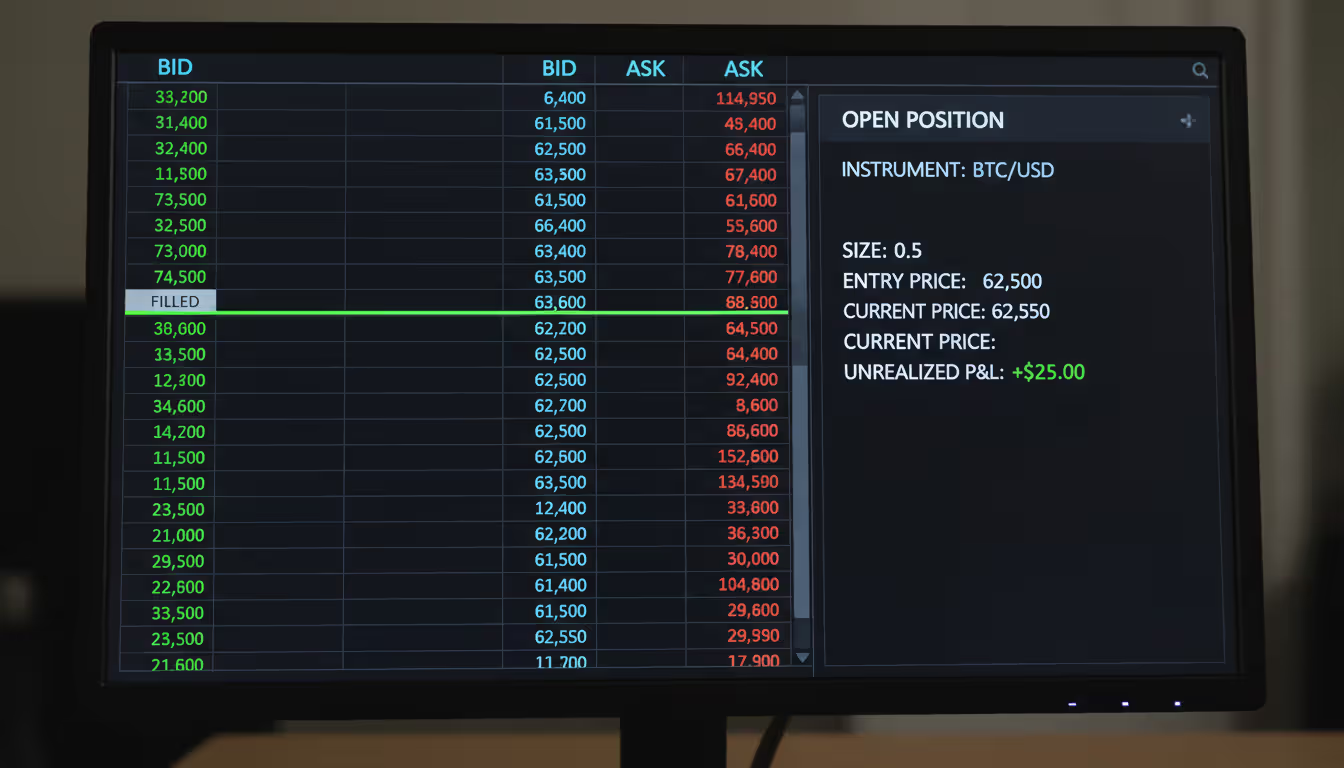
Enter quantity (start with one), review the margin requirement, and submit. Within milliseconds, you'll see a fill confirmation showing your entry price, timestamp, and open position. Your platform now tracks real-time P&L as the market ticks up or down.
Watch the position during U.S. data releases—non-farm payrolls, CPI, Fed announcements—when currency futures can move 50–100 ticks in seconds. New traders often freeze or panic-close at the worst moment. Set alerts, use stop-loss orders, and remind yourself that the first trade is tuition, not a retirement plan.
Every futures contract is built from five elements: the currency pair, notional size, minimum price fluctuation (tick size), dollar value of that tick, and the expiration cycle. Get any of these wrong and you'll misjudge your risk.
Notional size tells you how much currency changes hands. The standard euro FX (6E) represents €125,000. If you're long at 1.0850 and exit at 1.0900, you captured a 50-tick (0.0050) move on €125,000, which equals $625 in profit. The British pound (6B) is £62,500; Japanese yen (6J) is ¥12,500,000; Canadian dollar (6C) is C$100,000. E-micro contracts—one-tenth the size—let you trade €12,500 chunks, useful for fine-tuning hedge ratios or testing strategies with less capital.
Tick size and tick value define the smallest price increment and its dollar impact. For 6E, the tick is 0.00005 (half a basis point in spot-forex language), worth $6.25 per contract. A 20-tick rally—one full cent—puts $125 in your pocket per contract. The yen contract ticks at 0.0000005, also $6.25, but because USD/JPY trades around 145.00, a "big figure" (one yen) equals 2,000 ticks, or $12,500 per contract. Price can feel slow until it isn't.
Expiration and settlement mechanics: Currency futures expire on the second business day before the third Wednesday of the contract month. If the third Wednesday of June 2026 falls on the 17th, expiration is June 15th. At expiration, the euro FX and most major pairs settle to cash—the clearinghouse credits or debits your account based on the final settlement price, and your position vanishes. Physical delivery is possible but rare in retail accounts; brokers typically force-close positions a day or two beforehand to avoid the hassle.
Here's a comparison of the four most-traded currency futures as of early 2026:
Contract
Symbol
Notional Size
Minimum Tick
Tick Value
Hours (Eastern)
Approx. Initial Margin
Euro FX
6E
€125,000
0.00005
$6.25
Sun 6 PM – Fri 5 PM
$5,000
British Pound
6B
£62,500
0.0001
$6.25
Sun 6 PM – Fri 5 PM
$4,200
Japanese Yen
6J
¥12,500,000
0.0000005
$6.25
Sun 6 PM – Fri 5 PM
$3,800
Canadian Dollar
6C
C$100,000
0.00005
$5.00
Sun 6 PM – Fri 5 PM
$2,500
Margin figures shift with volatility—always verify current numbers in your broker's margin tool before trading.
Reading and Analyzing Currency Futures Quotes
A currency futures quote crams several data points into one line. Here's a realistic example for the June 2026 euro contract on a Tuesday afternoon:
6EM6 breaks down as: "6E" = euro FX; "M" = June; "6" = 2026.
Bid/Ask shows the highest buy order (1.08450) and lowest sell order (1.08455). The five-tick spread here is tight—a sign of healthy liquidity. During thin Asian hours, that spread might widen to 10 or 15 ticks.
Last is the most recent trade price.
Volume counts contracts traded since the open. High volume confirms strong participation; a breakout on light volume often fizzles.
Open interest is the total number of contracts still open—not yet offset or expired. It's updated once a day, after the close.
Decoding price levels: Currency futures prices track the spot exchange rate but can trade at a slight premium or discount because of interest-rate differentials (the carry). If U.S. rates are 5 % and eurozone rates are 3 %, holding dollars earns more, so the euro futures curve slopes downward (contango). When eurozone rates exceed U.S. rates, the curve slopes upward (backwardation). Arbitrageurs keep the basis—the gap between futures and spot—razor-thin, rarely more than a few ticks outside transaction costs.
Open interest as a sentiment tool: Rising open interest during a rally means new money is entering long positions—bullish confirmation. If open interest falls while prices climb, the move is likely short-covering, which can reverse quickly once shorts are exhausted. Conversely, rising open interest during a decline signals aggressive new shorts piling in—bearish confirmation—while falling open interest during a drop suggests long liquidation, which may exhaust itself soon. Track open interest daily alongside price and volume for the full story.
Managing Your Currency Futures Positions
Position management determines whether you survive long enough to catch the winners. Three areas matter most: margin discipline, exit mechanics, and contract rollovers.
What Happens During a Margin Call
Your broker's risk system monitors your account equity every few seconds. When unrealized losses drag your equity below maintenance margin—usually 75–85 % of initial margin—you get a margin call. The broker will email, text, or post a platform alert demanding you either deposit cash to restore your account to initial-margin levels or close positions to free up margin.
Real-world scenario: You're long one 6E at 1.0850 with $5,000 initial margin and $4,000 maintenance margin. The euro tumbles to 1.0800—a 100-tick ($625) loss. Then overnight it hits 1.0750—another 100 ticks ($625). Your equity is now $3,750, below the $4,000 threshold. The margin call arrives at 7:03 a.m., giving you until market open to wire $1,250 or close the position. If you ignore it, the broker liquidates your position at the current market price, possibly locking in the worst possible fill if the market is gapping.
Pro traders never let it get that far. They set stop-loss orders that automatically close the position if the market moves against them by a predefined amount—say, 75 ticks. Yes, you might get stopped out and then watch the market reverse, but that's infinitely better than a forced liquidation at 2 a.m. when spreads are wide and you have no control.
How to Roll Over Currency Futures Contracts
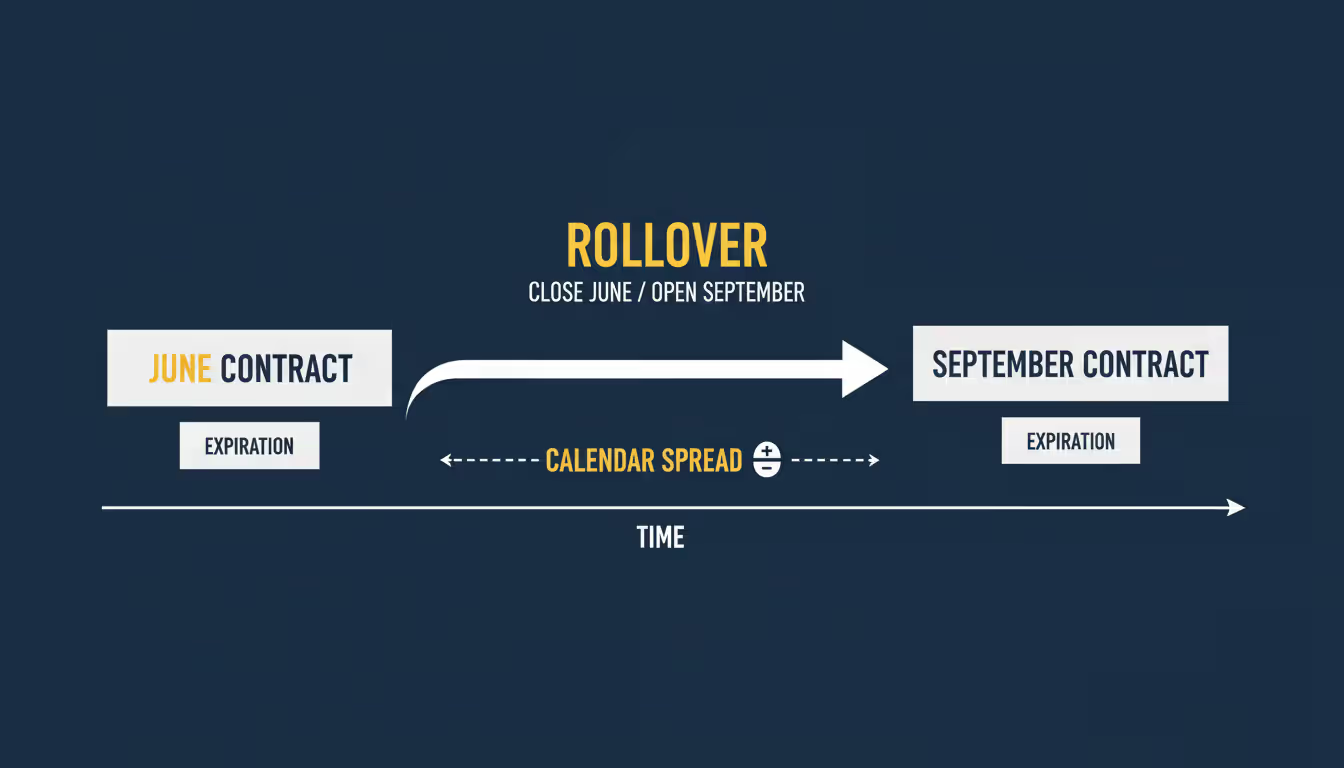
Currency futures expire quarterly (March, June, September, December), but many strategies require continuous exposure. Rolling means exiting your position in the expiring contract and simultaneously entering the same position in the next quarterly contract.
Imagine you're long one 6EM6 (June euro) in mid-May 2026. Open interest and volume are shifting to 6EU6 (September). On May 20th, you decide to roll. You place a calendar-spread order: sell one 6EM6 and buy one 6EU6 in a single transaction. Most platforms have a "roll" function that bundles both legs, minimizing slippage.
The price difference between June and September—the calendar spread or "roll yield"—reflects the interest-rate differential. If the spread is 15 ticks (about $94), rolling costs you $94 to maintain the position. Sometimes the back month is cheaper (backwardation), and rolling actually credits your account. Either way, ignoring the roll date can leave you stuck in an illiquid expiring contract or facing unintended physical delivery.
Closing a position is simpler: If you're long one 6E, you sell one 6E of the same expiration. The broker nets the two trades, your position disappears, and you realize whatever profit or loss accumulated. The P&L is your exit price minus entry price, times tick value, times number of contracts. Long at 1.0850, exit at 1.0900, that's 100 ticks × $6.25 = $625 profit (before commissions).
Author: Marcus Ellington;
Source: martinskikulis.com
Currency Futures Trading Hours and Market Sessions
The CME Globex platform runs almost around the clock. Currency futures start trading Sunday at 6 p.m. Eastern and continue until Friday at 5 p.m. Eastern, pausing for a one-hour maintenance break each weekday evening from 5 to 6 p.m.
When liquidity peaks:
Asian session (7 p.m.–4 a.m. ET): Yen and Aussie dollar futures come alive. Tokyo equity open, Reserve Bank of Australia announcements, and Chinese PMI releases can swing yen contracts 30–40 ticks in minutes.
European session (3 a.m.–12 p.m. ET): Euro, pound, and Swiss franc contracts hit maximum volume. London opens at 8 a.m. London time (3 a.m. ET), and the European Central Bank's policy decisions usually land around 8:45 a.m. ET. Spreads tighten, order books deepen, and institutional flows dominate.
U.S. session (8 a.m.–5 p.m. ET): New York equity open overlaps with London until noon ET—the most liquid window for any pair. U.S. employment reports (8:30 a.m. ET first Friday of the month), CPI (8:30 a.m. mid-month), and Federal Reserve rate decisions (2 p.m. ET) generate explosive moves.
Overnight and weekend risk: Holding through the 5–6 p.m. maintenance window or over a weekend exposes you to gap risk. If a central bank surprises with an emergency rate hike on Saturday, you'll see the gap when trading resumes Sunday evening. Stop-loss orders don't protect you from gaps—they convert to market orders and fill at the new price, which could be 100 ticks away from your stop level. Size your positions so that a worst-case gap won't wipe you out.
Major holidays—New Year's, Memorial Day, Independence Day, Thanksgiving, Christmas—see abbreviated hours or full closures. The CME publishes a holiday calendar every December; bookmark it and avoid holding positions into uncertain liquidity.
Using Technical Analysis and Open Interest in Currency Futures
Currency futures publish transparent tick-by-tick price, volume, and daily open-interest data—a dream for technical analysts used to fragmented spot-forex feeds. Every trade on the CME shows up in the volume count, so you know exactly how many contracts changed hands at each price level.
Charts, patterns, and indicators: Currency futures respect the same technical levels as spot forex—support, resistance, moving averages, Fibonacci retracements—but with added clarity. Round numbers like 1.1000 for EUR/USD or 150.00 for USD/JPY act as magnets because institutional algorithms and human traders cluster limit orders there. If the euro breaks above 1.1000 on triple the average volume, the breakout is real. If it breaks on a trickle of contracts, expect a head-fake.
Volume confirmation: Rising volume during an uptrend validates the move; declining volume suggests weakening conviction. Suppose the pound rallies from 1.2500 to 1.2600 over three days, but daily volume drops each day. That divergence warns of exhaustion—longs are running out of buyers. Conversely, a breakout accompanied by a volume spike often leads to follow-through the next session.
Open interest for deeper insight: Pair open-interest changes with price direction to gauge market sentiment:
Price rises, open interest rises: New longs entering; bullish.
Price rises, open interest falls: Shorts covering; rally may be short-covering, not genuine buying.
Price falls, open interest rises: New shorts entering; bearish.
Price falls, open interest falls: Longs liquidating; decline may lack follow-through once sellers are exhausted.
Common trap: Treating open interest like a stock's short interest. In futures, every long contract has a matching short contract, so open interest doesn't inherently favor bulls or bears. What matters is the rate of change and how it aligns with price movement.
Practical example: Two days before a Federal Reserve meeting, euro open interest jumps from 300,000 to 350,000 contracts while price drifts sideways. Traders are loading up on both sides, expecting volatility. After the Fed announces a dovish hold, price surges 80 ticks and open interest drops to 320,000 the next day—longs took profits, shorts capitulated, and the trade resolved. Anticipate wider spreads and whippy price action around these events; consider tightening stops or stepping aside entirely if you're uncomfortable.
In futures, being right doesn't matter as much as managing risk and staying solvent long enough to be there when the market pays you
— Linda Raschke
Frequently Asked Questions About Trading Currency Futures
What is the minimum amount needed to start trading currency futures?
Technically, one euro contract requires about $5,000 initial margin. Realistically, fund your account with at least $10,000—preferably $15,000—so a normal 50-tick swing doesn't trigger a margin call. Underfunding guarantees you'll get stopped out by routine volatility before your analysis has time to work.
How do currency futures differ from forex spot trading?
Futures trade on a regulated exchange (CME) with standardized contracts, a central order book, and zero counterparty risk thanks to clearinghouse guarantees. Spot forex is over-the-counter: brokers set spreads, there's no unified price feed, and you rely on your broker's solvency. Futures shine for transparency and institutional-grade execution; spot forex wins on account minimums and position flexibility (you can trade 1,000-unit micro-lots).
Can I trade currency futures outside regular market hours?
Absolutely. CME Globex runs from Sunday 6 p.m. to Friday 5 p.m. Eastern, with only a one-hour nightly break. You can buy euro futures at 3 a.m. or sell yen at 11 p.m. Just know that liquidity thins during off-peak hours—spreads widen, and large orders can move the market more than they would during London or New York hours.
What happens if I don't close my currency futures position before expiration?
Most retail brokers force-close your position one or two business days before expiration to sidestep delivery logistics. If you somehow hold until expiration, cash-settled contracts (euro, pound) settle to the final mark-to-market price, and your position evaporates. Physically deliverable contracts (rare in retail) would require you to deliver or accept the actual currency—brokers won't let that happen, so they'll liquidate for you, often at an inconvenient price.
How does a margin call work in currency futures trading?
When unrealized losses push your account equity below maintenance margin, the broker sends a margin call via email, SMS, or platform alert. You have until the next business day—sometimes only hours in fast markets—to deposit enough cash to restore initial margin or close positions to free up margin. Fail to act, and the broker liquidates at the current market price, potentially locking in your worst-case scenario. Always keep a cash buffer and use stop-loss orders to avoid this nightmare.
Do I need to use technical analysis to trade currency futures successfully?
Not necessarily. Plenty of traders rely on fundamental macro analysis—tracking central-bank policy divergence, GDP growth differentials, trade balances—and ignore charts entirely. Others run quantitative models based on carry, momentum, or mean reversion. Technical analysis helps with entry and exit timing, but it's one tool in the toolbox. The most consistent traders blend fundamentals for trade direction with technicals for precise execution and risk management.
Trading currency futures isn't rocket science, but it's unforgiving if you skip the fundamentals. You're operating in a leveraged, mark-to-market environment where a single misunderstood contract specification or ignored margin threshold can cost you real money before you finish your coffee. The upside: exchange-traded transparency, centralized pricing, and regulatory oversight that eliminates the shadowy conflicts of interest haunting some over-the-counter brokers.
Start with one contract. Track every tick. Document why you entered, where you planned to exit, and what actually happened. Master rolling positions forward and responding to margin calls before you even think about trading three contracts at once. Use the interplay of volume, open interest, and technical levels to refine your timing, but never ignore the macro drivers—interest-rate differentials, central-bank rhetoric, geopolitical shocks—that ultimately steer exchange rates over weeks and months.
Swap rates represent the interest cost or credit applied when forex traders hold positions past the daily rollover time. Understanding how these overnight fees work, when you pay or earn them, and their cumulative impact is essential for swing traders and anyone implementing carry trade strategies in 2026
Spread betting lets you speculate on market moves without owning the asset. This guide walks through real examples—long and short positions, forex pairs, margin calculations—showing exactly how profits and losses accumulate, how to size stakes responsibly, and what happens when trades go wrong
An overnight index swap is a derivative where parties exchange fixed and floating interest payments based on compounded overnight rates. These instruments have become the standard for derivatives discounting and provide key insights into central bank policy expectations and market stress levels
Interest rate movements can transform profitable loans into financial burdens overnight. Companies with floating-rate debt and bond investors face the same challenge: protecting against adverse rate shifts without sacrificing upside. This guide explains hedging instruments, duration strategies, and how to match protection to your specific exposure
The content on this website is provided for general informational and educational purposes only. It is intended to explain concepts related to Forex (FX) trading, currency markets, leverage, hedging, and risk management.
All information on this website, including articles, guides, and examples, is presented for general educational purposes. Forex trading carries significant risk, and outcomes may vary depending on market conditions, leverage, and individual decisions.
This website does not provide financial, investment, or trading advice, and the information presented should not be used as a substitute for consultation with qualified financial professionals.
The website and its authors are not responsible for any errors or omissions, or for any outcomes resulting from decisions made based on the information provided on this website.