A single percentage point shift can add millions to your debt service or wipe out a quarter's gains in your bond holdings. That's not a theoretical risk—it happened to countless CFOs during the 2022-2023 rate cycle when the Fed pushed rates up 525 basis points in roughly 18 months.
Three groups lose sleep over rate moves: companies carrying variable-rate loans, institutional investors managing fixed-income portfolios, and firms planning to borrow down the road. Each faces a version of the same problem: how do you protect against brutal rate swings without giving up all the benefit if rates move your way?
You've got options ranging from vanilla swaps to intricate structured deals. Each carries different upfront costs, ongoing obligations, and protection levels. Picking the right tool means understanding not just how these instruments work, but whether your balance sheet can handle the commitment and whether hedging beats just accepting the risk.
What Is Interest Rate Hedging and Why Companies Use It
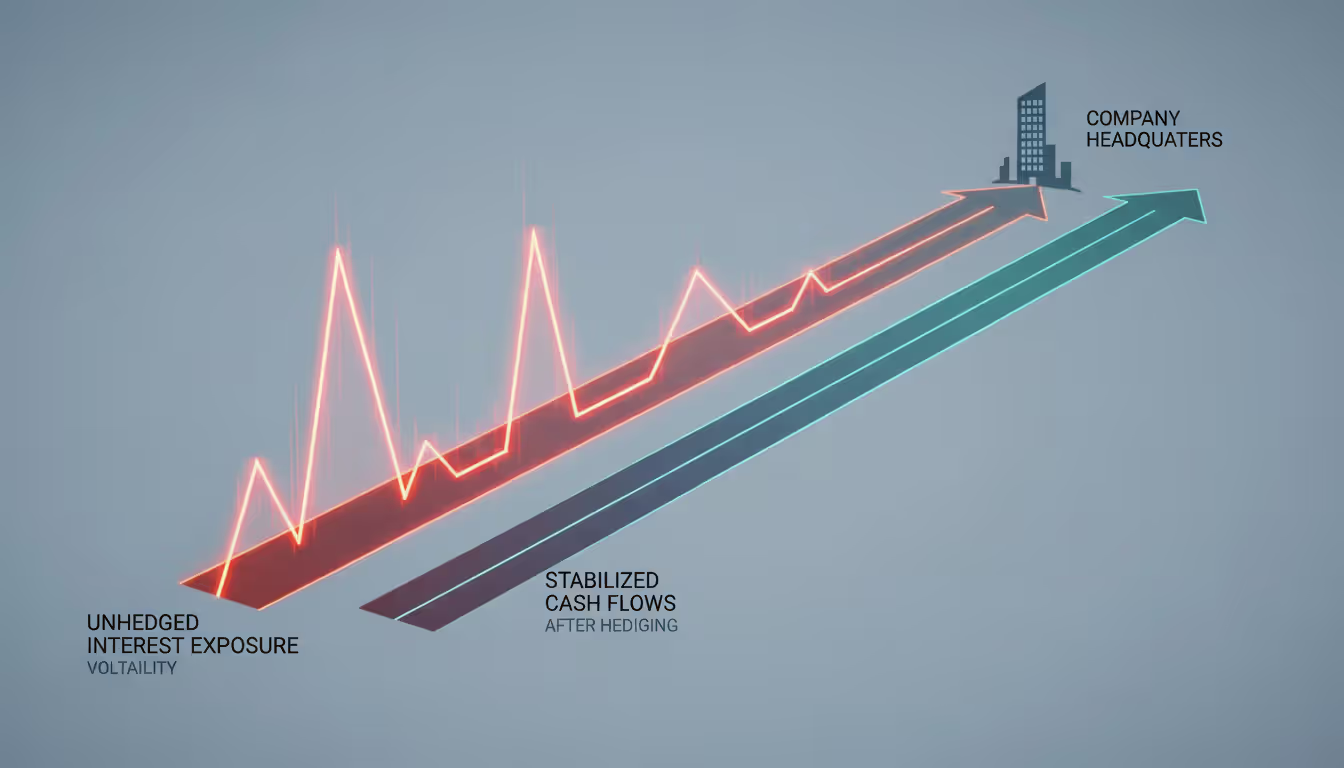
Interest rate hedging means using financial contracts to shield yourself from rate fluctuations. You're not betting on where rates go—you're buying stability for your cash flows, defending your margins, or preventing portfolio losses when rates turn against you.
Most corporates start thinking about hedges when they've got floating debt pegged to SOFR or similar benchmarks. Take a mid-size distributor with $50 million in term loans at SOFR plus 175 bps. When SOFR sat at 1.5% in early 2022, they were paying 3.25% all-in. By mid-2023, SOFR hit 5.3%, pushing their rate to 7.05%—that's an extra $1.9 million in annual interest they didn't budget for. A hedge would've locked in something closer to their original rate, making their P&L predictable instead of a hostage to Fed policy.
Bond investors hedge for different reasons. A pension fund sitting on $200 million in Treasuries watches its portfolio value crater when yields spike—that's just math, not a reflection of credit quality. These funds use duration hedges to cushion the blow without dumping bonds and losing their income stream. They're not trying to avoid volatility entirely; they're keeping it within tolerance bands their actuaries can live with.
Then you've got companies hedging borrowing costs they'll incur later. Real estate developers locking in financing terms 18 months before construction starts. Project finance teams protecting pro forma returns for deals that won't close for two years. They're essentially buying rate insurance for future transactions, which only makes sense if today's rates look reasonable and your deal economics can't survive a 200 bp increase.
Here's what ties these scenarios together: separating your core business results from rate noise. A logistics company's margins should reflect how efficiently they move freight, not whether SOFR jumped 150 bps last quarter because the Fed got hawkish.
Author: Ethan Blackwell;
Source: martinskikulis.com
Common Interest Rate Hedging Instruments
Interest Rate Swaps: Fixed vs Floating Rate Exchange
Swaps let two counterparties trade payment streams on an agreed notional amount—no principal changes hands. The standard setup: you're paying fixed while collecting floating, or the reverse.
Picture a healthcare company with $30 million in floating debt at SOFR plus 140 bps. SOFR's at 4.2% today, so they're paying 5.6%. They're worried rates keep climbing. They enter a swap where they pay 4.8% fixed and receive SOFR. Now their floating loan payments get offset by the floating receipts from the swap, leaving them with a synthetic fixed rate of 6.2% (the 4.8% swap rate plus their 140 bp loan spread). SOFR could hit 6%, 7%, even 8%—they still pay 6.2% all-in.
The catch? If SOFR drops to 3%, they're still stuck paying 6.2%. They've traded upside for certainty. And if they need out early, they could face six-figure breakage costs if rates have moved significantly since they entered the trade.
Swaps generally don't require upfront payment, which makes them attractive for straightforward hedges. But they're commitments, not options—you can't just walk away when the market moves in your favor.
Interest Rate Caps and Floors for Downside Protection
Caps work like insurance policies with a deductible. Buy a cap and you get paid when your reference rate crosses above the strike. A borrower worried about SOFR running away might buy a 5.25% cap on three-month SOFR. When SOFR hits 6%, they collect 75 bps on the notional from the cap seller, offsetting their higher loan cost. If SOFR never breaks 5.25%, the cap expires worthless—but they benefited from below-strike rates the whole time.
You're paying upfront for this optionality, typically 0.6% to 2.5% of notional depending on where you set the strike, how long the term runs, and what implied volatility looks like. For a $40 million five-year cap struck near current rates, budget $800k to $1.2 million. That premium is your maximum loss—unlike a swap, there's no mark-to-market liability that could grow.
Floors flip the logic. They pay when rates fall below the strike. Lenders and bond investors who depend on interest income use floors to prevent their yields from collapsing. Combine a purchased cap with a sold floor and you've built a collar—narrowing your rate range while cutting the net premium, sometimes to zero. You've capped your cost but also capped your savings if rates fall.
Cross-Currency Interest Rate Swaps
These instruments tackle both rate risk and FX exposure. A U.S. manufacturer earning euros might issue dollar bonds at attractive rates, then enter a cross-currency swap to pay euro interest and receive dollars. The swap exchanges principal amounts at inception and maturity, with periodic interest swaps in different currencies throughout.
Multinationals use these to match revenue currencies with debt currencies, reducing translation volatility. They also let issuers tap cheaper funding markets and synthetically convert back to their operating currency. A European firm might issue yen bonds at 1.2% (thanks to Japan's rate environment), swap into euros at 3.5%, and still come out ahead of issuing euro bonds directly at 3.8%.
You've also got interest rate futures (SOFR futures, Treasury futures) and options for shorter exposures or when you prefer exchange-traded liquidity over negotiated OTC contracts. Each has its place, though none offer the precision of a customized swap for matching specific debt terms.
How to Hedge Interest Rate Exposure in Practice
Start by cataloging every floating-rate liability: notional amounts, reset frequencies, underlying benchmarks, maturity dates. A company with quarterly SOFR resets on a five-year loan faces different exposure than one with monthly resets on a three-year facility—the reset timing matters for basis risk.
Next, define success. Are you eliminating all rate risk? Capping worst-case cost? Reducing volatility by half while staying open to some upside? A 100% hedge swaps every dollar of floating exposure to fixed. A 50% hedge gives you partial protection while leaving room to benefit if rates cooperate. There's no "correct" hedge ratio—it depends on how much uncertainty your finance team and board can stomach.
Match your instrument to the exposure's DNA. For a $40 million term loan with four years left, a four-year pay-fixed swap creates a natural hedge. If the loan amortizes, structure the swap notional to amortize on the same schedule. Maturity alignment and notional alignment minimize basis risk—the nightmare scenario where your hedge and exposure diverge.
Here's a real-world scenario. A regional hospital system carries $75 million in floating bonds tied to one-month SOFR, currently 3.9%. Their bond spread is 155 bps, so all-in cost is 5.45%. The CFO models scenarios and concludes that anything above 7% total cost creates budget stress. Three options hit the desk:
Option 1: Pay-fixed swap at 4.35%. This converts everything to fixed at 5.9% all-in (4.35% swap plus 155 bps spread). Zero upfront cost, but you've kissed goodbye to any savings if rates drop. You're paying 5.9% whether SOFR is 2% or 8%.
Option 2: A 5% cap for 1.1% premium. You're protected above 5%, which translates to 6.55% all-in. Below that, you ride the floating rate. The $825,000 premium feels steep. Breakeven math says SOFR needs to average above 4.65% over the cap's life to justify the cost versus going unhedged.
Option 3: Collar—buy the 5% cap, sell a 3% floor, net premium 0.4%. You've locked yourself into a 4.55% to 6.55% range. Costs $300,000 upfront. You've given up savings below 3% SOFR, but you've dramatically cut your premium versus the standalone cap and still capped your downside.
The hospital picks the collar. They value budget certainty over maximizing savings, and the 0.4% premium fits their cash constraints better than 1.1%. Another organization with different priorities might've chosen differently—there's no objectively "best" answer here.
Author: Ethan Blackwell;
Source: martinskikulis.com
Duration Hedging Strategies for Bond Portfolios
Duration quantifies how much a portfolio's value shifts when yields move. A portfolio with 7.5 duration will drop roughly 7.5% in value for every 100 bp rise in rates. Portfolio managers hedge duration when they want to keep their bond positions (for income, credit exposure, or strategic reasons) but dial down the rate sensitivity.
Duration matching means building a portfolio where your asset duration equals your liability duration. A pension fund with liabilities averaging 12 years might hold bonds with similar duration—so when rates move, assets and liabilities move in sync. That's the holy grail for liability-driven investing.
You can adjust duration without selling a single bond. Selling Treasury futures or entering pay-fixed swaps reduces your effective portfolio duration. Say you're managing $500 million in corporate bonds with duration around 8. You're worried about rising rates but don't want to liquidate—these bonds yield 5.5% and still have solid fundamentals. Sell $200 million notional in 10-year Treasury futures (duration roughly 8.5), and you've cut your portfolio's effective duration to approximately 5. The exact math depends on the hedge ratio and the futures contract's specific duration, but you've materially reduced rate sensitivity.
When should you hedge versus just accept duration risk? If you're an active manager who thinks rates are heading down, you might deliberately extend duration to capture gains. If you're running a liability-driven portfolio, you maintain tight duration matching regardless of your rate views—that's the mandate. Over-hedging creates its own problem: if you reduce duration below target and rates fall, you underperform while your liabilities grow faster than your assets.
We see this mistake constantly—companies hedge a five-year loan with a three-year swap because the three-year rate is 40 bps cheaper. Then years four and five arrive, the hedge is gone, and rates have moved 200 bps against them. They saved $120k annually for three years and now they're paying an extra $800k annually for two years. The hedge term should match your exposure term, period
— Jennifer Caldwell
Risks and Limitations of Interest Rate Hedging
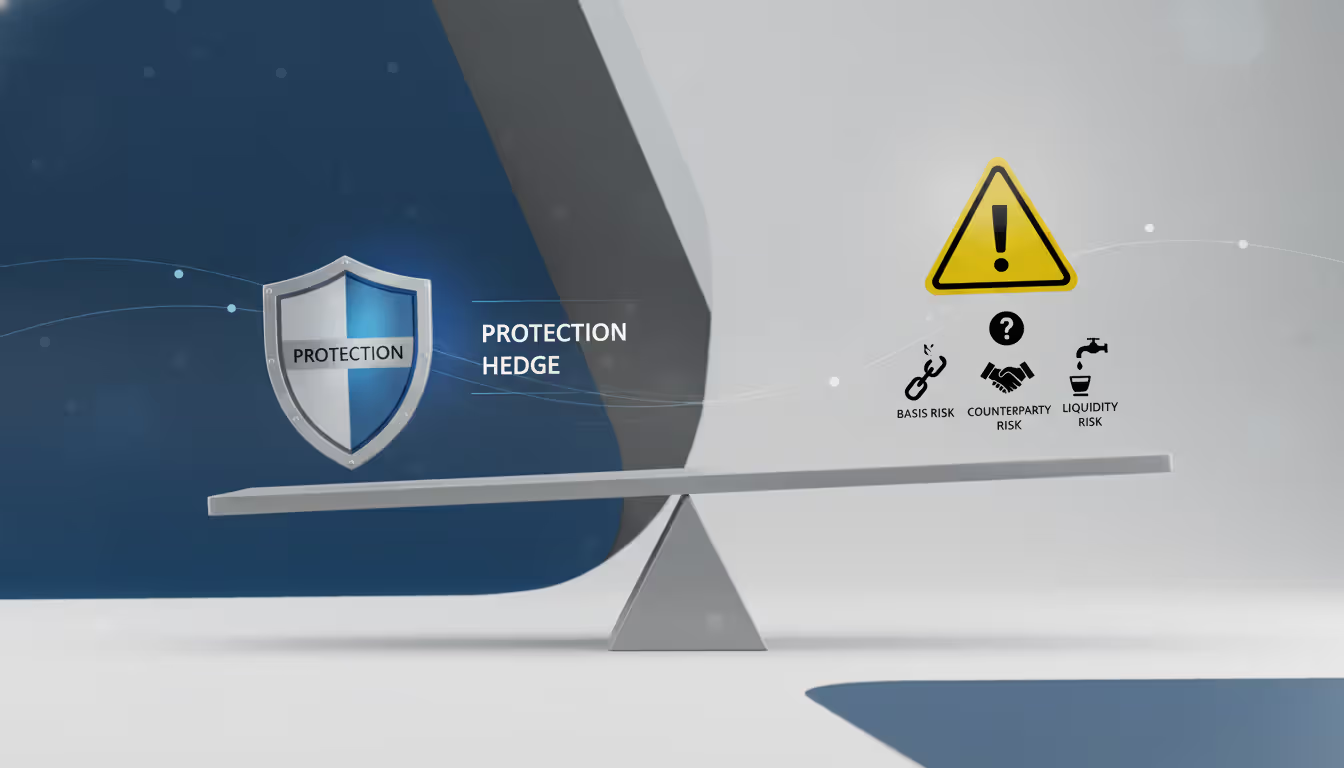
Basis risk shows up when your hedge doesn't mirror your exposure perfectly. You've got a loan tied to one-month SOFR, but you hedged with a swap based on three-month SOFR. Most of the time these rates track each other closely—but during market stress they can diverge by 20, 30, even 50 bps. You're still exposed to that spread.
Tenor mismatches create similar headaches. Hedge a seven-year loan with a five-year swap and you've got two years of naked exposure when the swap matures. Maybe you refinance the hedge then, maybe rates have spiked and the new hedge costs 250 bps more than your original. Notional mismatches happen when hedge amounts don't track actual debt balances—common with amortizing loans hedged with bullet swaps that don't amortize.
Counterparty risk is real with OTC derivatives. Your swap counterparty fails when the swap has $2 million positive value to you—that asset vanishes and you're scrambling to re-hedge at current rates, which are probably worse. Central clearing through clearinghouses and collateral agreements (via Credit Support Annexes) reduce this risk but don't eliminate it entirely.
Liquidity risk bites when you need to exit early. Swaps aren't exchange-traded. Unwinding means negotiating with your counterparty or entering an offsetting swap. In calm markets, no big deal. In March 2020 or October 2008? Bid-ask spreads blow out to 50-100 bps. Exiting becomes expensive fast.
Don't forget opportunity cost. You swap to fixed at 4.6% and rates subsequently crater to 2.2%. You're not showing an accounting loss, but you're paying 240 bps above market for however many years are left on that hedge. Real economic cost.
Author: Ethan Blackwell;
Source: martinskikulis.com
Over-hedging creates speculative positions you didn't intend. You hedge 100% of your $60 million credit facility, but you only draw $40 million. That extra $20 million hedge? You're receiving floating and paying fixed with no offsetting liability. You've accidentally become a rates trader. Under-hedging leaves obvious gaps—you haven't solved the problem you set out to fix.
Choosing the Right Hedging Strategy for Your Situation
Fixed versus floating comes down to three things: where you think rates are headed (if you're willing to take a view), how much uncertainty you can handle, and what you can afford to spend. If current fixed rates look reasonable by historical standards and you value predictable payments above all else, swapping to fixed makes sense. If you think rates will soften or you want to preserve optionality, caps or collars let you protect downside while keeping some upside.
Here's how the main instruments stack up:
Instrument Type
Protection Provided
Cost Structure
Best For
Flexibility
Interest Rate Swap
Transforms floating payments into fixed (or vice versa); complete protection against rates rising past your fixed rate
Zero upfront; potential mark-to-market swings
Borrowers demanding payment certainty; investors converting to fixed income
Limited; early exit can cost six figures
Interest Rate Cap
Sets a ceiling on your rate; you still benefit below the cap
Upfront premium of 0.6-2.5% notional
Borrowers protecting against spikes while preserving savings potential
High; walk away or sell back if circumstances change
Interest Rate Floor
Establishes a minimum rate; protects against falling rates
Upfront premium comparable to caps
Income investors; lenders protecting margins
High; walkaway or resale possible
Collar (purchased cap + sold floor)
Confines rates to a defined range
Minimal or zero net premium upfront
Budget-conscious borrowers who can live with limited upside
Moderate; both positions need management
Accounting treatment isn't trivial. Hedge accounting under ASC 815 lets you defer derivative gains and losses, matching them with the hedged item's P&L impact. That avoids earnings whipsaws from mark-to-market moves. But qualifying for hedge accounting requires mountains of documentation and quarterly effectiveness testing. Miss the effectiveness thresholds and you're back to marking the derivative through earnings each quarter.
Banks and regulated entities face capital charges on derivative exposures. A regional bank hedging its commercial loan book has to hold capital against CVA (credit valuation adjustment) on those swaps. That capital requirement adds cost beyond the swap rate itself—sometimes another 15-20 bps when you factor in the bank's target ROE.
Working with a hedging advisor or derivatives dealer makes sense once exposures exceed $25 million or when you're dealing with multiple currencies. Dealers provide pricing, structure customized solutions, and handle ISDA documentation. You're paying for this via bid-ask spread—typically 2-5 bps on vanilla swaps, 10-20 bps on structured products. For complex situations, professional guidance usually more than pays for itself by avoiding structural errors that create basis risk or unintended exposures.
Frequently Asked Questions About Interest Rate Hedging
What separates an interest rate swap from a cap?
With a swap, you're exchanging your floating payments for fixed payments—it's a straight trade that locks you in for the full term. Rates fall below your fixed rate? Too bad, you're still paying fixed. A cap sets a maximum rate but lets you benefit from anything below that ceiling. Swaps carry no upfront cost but bind you to that fixed rate; caps cost premium upfront (often $500k to $1 million per $50 million notional) but give you optionality—if rates never hit your strike, you're out the premium but you enjoyed lower rates the whole time.
What's the actual cost to hedge interest rate risk?
Swaps typically have zero upfront premium, though you're locking in a fixed rate that might be above or below current floating rates. Caps run 0.6% to 2.5% of notional upfront based on strike level, term length, and volatility conditions. For a $50 million five-year cap struck at-the-money, budget $750k to $1.2 million. Collars can drop that premium to 0.2-0.5% or even zero by selling a floor, but you've given up benefit below the floor strike. Don't forget dealer spreads (2-5 bps) and legal costs ($15k-$50k for ISDA documentation on first-time setups).
Can smaller companies access interest rate hedging?
Yes, though minimums vary. Most banks offer swaps and caps down to $5-10 million notional. Below $5 million, finding competitive pricing gets tough—dealers aren't interested in the small ticket size, and the fixed costs (legal, documentation) become prohibitive relative to the hedge benefit. Some regional banks and credit unions run simplified hedging programs for smaller borrowers with higher spreads but less complexity. Below $2-3 million, you're probably better off just managing the exposure operationally or considering fixed-rate debt to begin with.
What if rates move in my favor after I hedge?
With a swap, you're stuck—you keep paying your fixed rate even if floating rates tank 300 bps below it. You gave up that upside for certainty. That's the deal. With a cap, you simply let it expire worthless and enjoy the lower rates. You're out the premium you paid upfront, but that's the maximum loss. Many companies view the foregone upside from swaps (or the lost premium from caps) as the insurance cost for avoiding disaster scenarios. You don't complain about homeowner's insurance premiums in years your house doesn't burn down.
How long should my hedge run?
Match your hedge maturity to your debt maturity as precisely as possible. Four-year loan? Four-year hedge. Shorter hedges leave you exposed after they expire; longer hedges create speculative positions after your debt matures. For revolving credit or uncertain future borrowing, consider shorter hedges (1-2 years) that you roll forward as needed, or structured products with optional extension features. The worst scenario: hedging a five-year loan with a three-year swap to capture a better rate, then facing unhedged exposure in years four and five when rates have moved 200 bps against you. Don't get cute trying to save 25 bps.
Do I need a derivatives dealer to execute these hedges?
For swaps and caps, yes. These are OTC instruments negotiated bilaterally with banks or dealers. You'll need an ISDA Master Agreement and Credit Support Annex in place before trading—that's 30-60 days for first-time setups. Exchange-traded alternatives like Treasury futures or SOFR futures can be accessed through futures brokers with lighter documentation, but they don't provide the precise matching you get from customized OTC hedges. A few fintech platforms now offer simplified hedging for middle-market companies (think $10-50 million exposures), though liquidity and pricing usually aren't quite as sharp as dealing with major banks.
Hedging transforms an unpredictable cost into something you can plan around. Whether that's worth doing depends on your specific exposure, how much volatility you can absorb, and what your core business or investment mandate actually requires—not on what some generic best practice suggests or where analysts think rates are going.
The real question: what keeps you up at night? If spiking rates threaten your debt covenants, blow up your project returns, or force you to liquidate positions at the worst time, hedging makes sense even if it costs premium upfront or means giving up potential savings later. If your balance sheet can weather rate swings without blinking and your business model isn't rate-sensitive, the hedging cost might exceed the benefit. Not every exposure needs hedging.
The instruments exist to match almost any situation. Swaps deliver simplicity and no upfront cost for those wanting full certainty. Caps provide protection plus optionality for those willing to pay premium. Collars balance cost and protection for budget-conscious situations. The key is aligning structure with your underlying risk, avoiding maturity and notional mismatches, and understanding the trade-offs each instrument forces you to accept.
Most hedging disasters don't come from market moves—they come from structural problems. Wrong notional amount. Wrong term length. Wrong benchmark. Or treating the hedge like a rates bet instead of insurance. Use these tools properly and they do exactly what they're designed for: let you focus on your actual business or investment strategy without rate risk torpedoing your plans.
Swap rates represent the interest cost or credit applied when forex traders hold positions past the daily rollover time. Understanding how these overnight fees work, when you pay or earn them, and their cumulative impact is essential for swing traders and anyone implementing carry trade strategies in 2026
Spread betting lets you speculate on market moves without owning the asset. This guide walks through real examples—long and short positions, forex pairs, margin calculations—showing exactly how profits and losses accumulate, how to size stakes responsibly, and what happens when trades go wrong
An overnight index swap is a derivative where parties exchange fixed and floating interest payments based on compounded overnight rates. These instruments have become the standard for derivatives discounting and provide key insights into central bank policy expectations and market stress levels
Interest rate arbitrage exploits interest differentials between countries to generate profit. This comprehensive guide explains covered and uncovered strategies, carry trades, why covered arbitrage is considered risk-free, and the real-world constraints that limit arbitrage opportunities in modern currency markets
The content on this website is provided for general informational and educational purposes only. It is intended to explain concepts related to Forex (FX) trading, currency markets, leverage, hedging, and risk management.
All information on this website, including articles, guides, and examples, is presented for general educational purposes. Forex trading carries significant risk, and outcomes may vary depending on market conditions, leverage, and individual decisions.
This website does not provide financial, investment, or trading advice, and the information presented should not be used as a substitute for consultation with qualified financial professionals.
The website and its authors are not responsible for any errors or omissions, or for any outcomes resulting from decisions made based on the information provided on this website.