Two businessmen shaking hands in a modern glass-walled corporate office with financial documents on the table and a city skyline with skyscrapers visible through the window
Think of a forward starting swap as buying insurance today that doesn't kick in until next year. You're locking in the price now, even though coverage starts later.
Here's the deal: Two parties agree on all the terms of an interest rate swap today—who pays what, at which rates, on how much notional principal. But here's the twist. Nobody exchanges a single dollar until some future date you both pick. Could be three months. Could be two years. That gap changes everything.
Why would anyone do this? Picture a CFO who knows her company will issue $500 million in bonds next September. She's losing sleep over where rates might be in six months. Instead of crossing her fingers and hoping, she can execute a forward starting swap right now. When September rolls around and those bonds get issued, the swap activates at the rate she locked in back in March. Problem solved.
The market for these things has exploded over the past decade. Companies got tired of watching their carefully planned financing deals blow up because rates moved 50 basis points during the approval process. Forward starting swaps let you separate two decisions that used to be glued together: when to hedge and when to actually borrow.
Understanding Forward Starting Swaps
A forward starting swap works like its spot-starting cousin—one party pays fixed, the other pays floating (typically SOFR these days). Standard swap stuff. The magic happens in the timing.
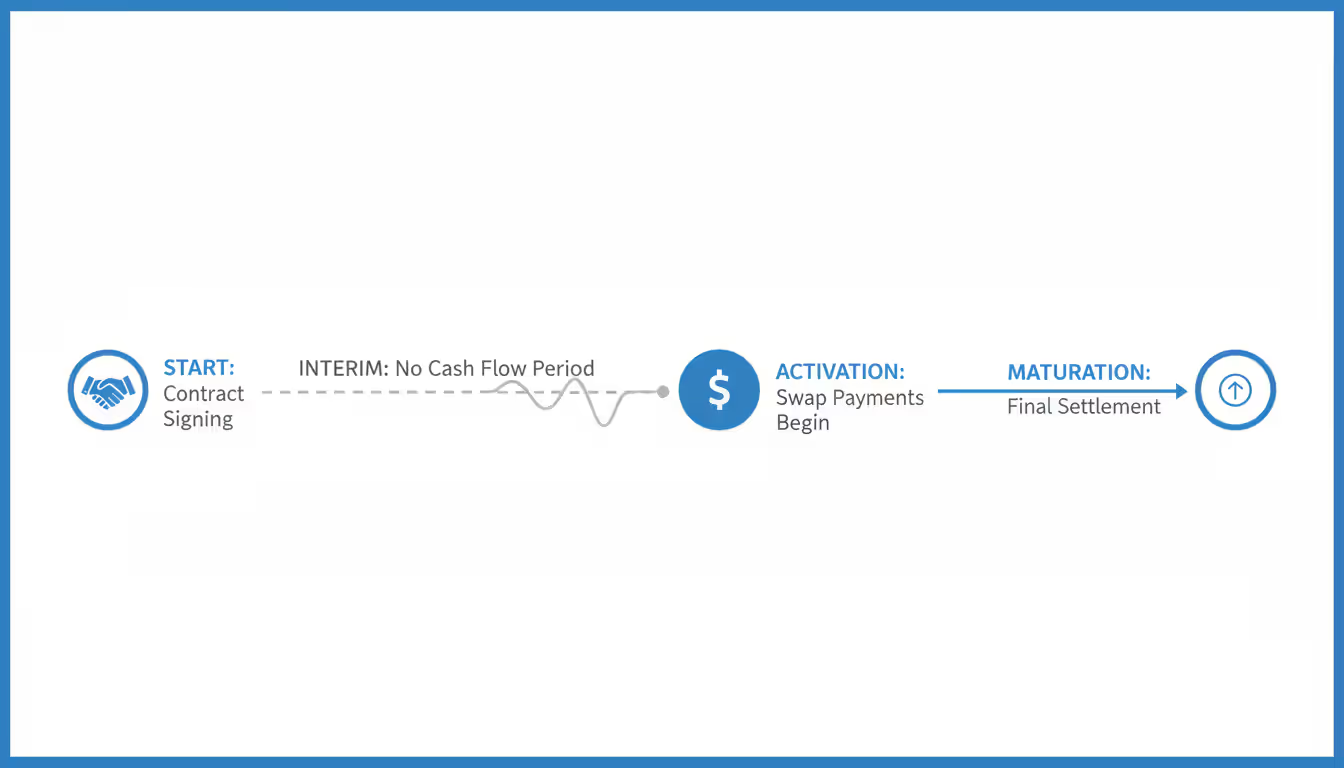
Between signing the contract and when it "goes live," you're in limbo. The contract exists. Both sides are committed. But there's no cash changing hands yet. This waiting period? That's your forward period.
Let's walk through a real scenario. A manufacturing firm needs to refinance a $200 million credit facility in eighteen months when the current one matures. The treasurer checks the five-year swap rate: 4.10%. Not terrible, but the Fed's making hawkish noises. Eighteen months from now, who knows? Could be 5%. Could be 6%.
So she calls her derivatives dealer. "I want a five-year swap starting in eighteen months." They price it at 4.35%—higher than today's rate because the forward curve slopes upward. She pulls the trigger.
Author: Olivia Kensington;
Source: martinskikulis.com
Here's what she's locked in:
Trade date (today): Contract executed. Fixed rate set at 4.35%. Notional is $200 million. Everything's agreed. No money moves.
Effective date (eighteen months later): The swap comes alive. The company starts paying 4.35% fixed quarterly. They receive three-month SOFR in return. This runs for five years.
Maturity (six and a half years from today): Final payment settles. Contract terminates.
During those first eighteen months, the swap's value bounces around based on where rates go. If the five-year rate jumps to 5%, our treasurer looks like a genius—she locked in 4.35%. If rates crater to 3%, well, that's a different conversation.
The basic structure involves the same pieces as any swap: two counterparties, a notional amount (never actually exchanged), fixed and floating legs, payment schedules. What's different? That deferred start date. You're contracting today for risk management that doesn't begin until tomorrow.
It's worth noting that during the forward period, you've got exposure even though no payments are flowing. The mark-to-market value swings around. Your credit department might require you to post collateral if the swap moves against you. All before the thing even "starts" in the operational sense.
How Forward Starting Swaps Work
The timeline matters here. A lot. Let's break down exactly what happens and when.
At execution, you're nailing down every detail. The fixed rate gets determined based on where forward rates are trading for your specific time horizon. If you're doing a one-year forward starting five-year swap, the dealer pulls up the forward curve and calculates what five-year swaps are implied to trade at in one year. That's your starting point, plus their margin.
Then you wait.
During the forward period, your swap is essentially dormant operationally but very much alive financially. Interest rates don't stand still. That 4.35% you locked in might look brilliant or bone-headed depending on where the market goes. The swap's market value—what it would cost to exit early—fluctuates daily.
Here's where it gets interesting. If you're the fixed-rate payer and rates climb, you're winning. You've committed to paying 4.35% while the market's now demanding 5%. The swap has positive value from your perspective. Flip side? If rates drop to 3.50%, you're stuck paying above-market rates. That hurts.
Once the effective date hits, everything normalizes. The swap behaves exactly like one you would've executed on that date, except your rate was locked in months or years earlier.
A detailed example helps. Say it's January 2026:
January 15 (Trade Date): A REIT anticipates refinancing a $150 million mortgage in nine months. They execute a forward starting swap. Current five-year swap rate is 4.10%, but the nine-month forward rate for a five-year swap prices at 4.28%. They agree to pay 4.28% fixed starting in nine months, receive three-month SOFR, on $150 million notional.
February-September (Forward Period): No operational cash flows occur. In March, the Fed hikes rates aggressively. The five-year swap rate jumps to 4.75%. Suddenly that 4.28% locked rate looks fantastic. The REIT's swap shows a mark-to-market gain of roughly $3.2 million. Nobody's paying anybody yet—but the contract's value has shifted significantly.
October 15 (Effective Date): The swap activates. First calculation period begins. If three-month SOFR is at 4.60%, the REIT pays 4.28% and receives 4.60%—a net 32 basis points in their favor. Quarterly settlements begin.
October 2026 - October 2031: Normal swap operations. Every quarter, they exchange the net difference between fixed and floating. Rate resets happen based on SOFR observations.
October 2031 (Maturity): Final payment settles. Contract expires. The refinancing loan it was hedging? Also paid off (or refinanced again, possibly with another forward starting swap).
The lag between contracting and activation creates both strategic opportunity and timing risk. You've got rate certainty for future needs. But you're committed to terms that might not look great if circumstances change dramatically.
Forward Swaps vs Spot Swaps
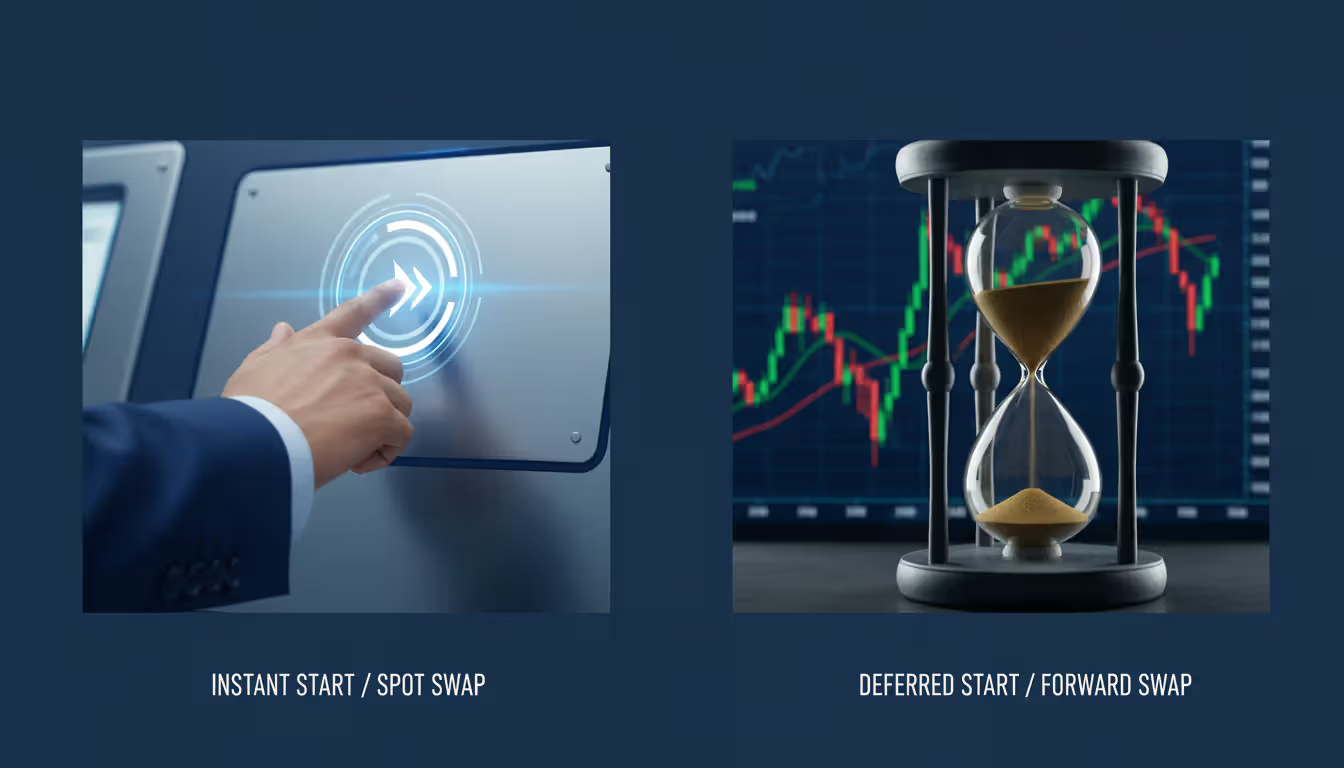
The core difference? When stuff starts happening.
Spot swaps are immediate. You execute Monday, and by Wednesday (T+2) you're making payments. These work great when you've got exposure sitting right in front of you. Floating-rate loan on the books? Swap it to fixed today.
Forward swaps are for exposure that hasn't shown up yet. You know it's coming—maybe you're 90% sure that bond issuance happens in Q3—but it's not here now. Forward swaps let you lock in rates before the exposure materializes.
Feature
Forward Starting Swap
Spot Swap
Effective Date
Anywhere from 1 month to 3+ years out
Two business days after execution
Primary Use Case
Hedging future transactions you're planning but haven't executed yet
Managing existing floating-rate debt or investments you already own
Straightforward—based on current swap curve and prevailing market rates
Risk Exposure Timing
Mark-to-market risk starts immediately during forward period; operational cash flow risk begins at effective date
Everything starts right away—both market risk and cash flow obligations
Typical Market Application
Pre-hedging debt issuance, project finance before construction loans convert, anticipated M&A financing
Converting existing loans to fixed, duration management for investment portfolios, immediate hedge needs
Cancellation Flexibility
Can exit before going live by paying mark-to-market; no operational disruption since cash flows haven't started
Unwinding affects active payment streams; potentially messier if underlying debt can't adjust
Let's get practical. You've got $100 million in floating-rate debt outstanding right now. Rates are climbing and you want to convert to fixed immediately. That's a spot swap situation. Execute today, effective Wednesday, start paying fixed by month-end.
Same company, different scenario: Your board just approved issuing another $100 million in bonds in six months to fund an acquisition. You want to lock in rates now, but you can't borrow until the deal closes. Forward starting swap. Lock the rate today for a swap that activates in six months when you actually issue the bonds.
The risk profiles diverge significantly. Spot swaps give you immediate operational cash flows—you know exactly what you're paying next month. Forward swaps create this in-between period where the contract's value bounces around based on rate movements, but you're not actually paying or receiving anything yet.
That forward period risk isn't trivial. If you execute a one-year forward swap and rates move 100 basis points in either direction during that year, you could be looking at meaningful mark-to-market gains or losses before a single operational payment occurs. Your credit agreement with the dealer might require collateral posting. That's liquidity you need to plan for.
Pricing mechanics differ too. Spot swap rates come straight off the current swap curve. Pull up Bloomberg, check the five-year swap rate, done. Forward swap pricing requires calculating implied forward rates from the curve shape, then applying convexity adjustments because forward rates don't perfectly predict future spot rates. Dealers also charge wider spreads—maybe 2-4 basis points versus 1-2 for spot swaps—because they're committing for a longer period before cash flows begin.
Author: Olivia Kensington;
Source: martinskikulis.com
Pricing Forward Starting Swaps
Forward swap pricing starts with the forward curve, but it doesn't end there. Not even close.
The forward curve shows implied future interest rates based on today's spot curve. If two-year swaps are trading at 3.50% and five-year swaps at 4.00%, you can mathematically derive what the market "expects" for a three-year swap starting in two years. That calculation gives you the foundation, but several adjustments follow.
First adjustment: convexity. Forward rates extracted from bond math don't translate perfectly to swap pricing because of differences in how cash flows work and how volatility affects value. This typically shaves a few basis points off the raw forward rate.
Second: credit and liquidity. Dealers are committing to enter a swap with you at some future date. The longer that commitment extends, the more uncertainty they face about their own hedging costs and balance sheet capacity. They'll add a spread to compensate, especially for forward periods beyond twelve months.
Third: supply and demand. If everyone and their brother wants to execute six-month forward swaps because half the corporate world plans to issue bonds in Q3, dealers will widen prices. They're not looking to accumulate massive one-sided exposure.
Curve shape drives huge differences in forward versus spot pricing. When the curve slopes sharply upward—like in early 2022 when the Fed was signaling aggressive hikes—forward rates sit well above spot rates. A six-month forward five-year swap might price 40-60 basis points higher than today's five-year spot rate.
Inverted curves flip this. When short rates exceed long rates (like mid-2023), forward rates actually come in below current spot rates. You can lock in cheaper future financing than what's available today, though curve inversion usually signals economic concerns that might affect your business in other ways.
Here's a worked example from current markets (early 2026):
Five-year SOFR swap rate (spot): 4.10%
One-year SOFR swap rate (spot): 3.60%
You want: Five-year swap starting in one year (so really a four-year swap from that future start date, but market quotes this as "one-year forward four-year")
The math works like this: The five-year rate represents five years of discount factors. The one-year rate covers the first year. The difference implies what the market thinks four-year swaps will trade at in one year's time.
Without getting into heavy fixed-income math: (1.041)^5 = (1.036)^1 × (1 + forward rate)^4
Solving gives you roughly 4.23% as the implied forward rate. But you're not done. Add 3 basis points for convexity adjustment: 4.26%. Add another 2-4 basis points for dealer margin: 4.28-4.30%. That's your quoted rate for the forward starting swap.
The cost differential versus spot swaps isn't really a "cost" in the penalty sense. It's a reflection of where the market thinks rates are heading. If the curve is steep, forward rates are higher—but that's because the market anticipates rate increases. You're not paying extra for the forward structure; you're paying the rate expected to prevail when your swap starts.
Transaction costs do run higher, though. Bid-ask spreads on forward swaps typically run 2-4 basis points versus 1-2 for liquid spot swaps. On a $100 million notional, that's an extra $25,000-$50,000 per year in implicit costs. Not nothing, but usually worth it for the rate certainty you're getting.
Author: Olivia Kensington;
Source: martinskikulis.com
Why Companies Use Forward Starting Swaps
Corporate treasurers love forward starting swaps for one big reason: they separate financing decisions from interest rate risk management. You can lock in your borrowing cost today while still waiting for the right time to actually issue debt.
The alternative—waiting until you're ready to borrow to worry about rates—leaves you exposed to potentially massive moves. Planning a $300 million bond offering for next fall? Rates could move 75 basis points between now and then. That's $2.25 million per year in extra interest expense if they move against you. Forward starting swaps eliminate that uncertainty.
Forward starting swaps have become indispensable for sophisticated treasury operations.They allow CFOs to separate the timing of financing decisions from interest rate risk management, providing strategic flexibility while maintaining cost certainty. In volatile rate environments, this capability often determines whether companies hit earnings targets or miss them due to factors completely outside operational control
— Dr. Patricia Ramirez
That last point hits home. Your operations might be crushing it—sales up, margins expanding, market share growing. Then rates spike 100 basis points between board approval and bond pricing, and suddenly your carefully projected interest expense blows up. Forward swaps prevent that nightmare scenario.
Forward Swap Applications in Corporate Hedging
Real-world applications cluster in a few areas:
Project finance is huge. You're building a $500 million manufacturing plant. Construction takes two years. You're funding with a construction loan (floating rate) that converts to a seven-year term loan when the project completes. Day one of construction, you execute a two-year forward starting seven-year swap. When the facility opens and the term loan activates, your swap goes live at the rate you locked in two years earlier. No surprises on your debt service costs.
Acquisition financing runs a close second. You're buying a competitor for $750 million. Deal announcement to closing takes six months minimum—regulatory approvals, shareholder votes, the usual drill. You're funding with a mix of bonds and term loans. Board approves the deal in January; closing happens in July. You execute forward starting swaps in February when rates look reasonable. July arrives, rates have moved 50 basis points higher, but you're hedged at February levels. Your CFO sleeps well.
Pension funds use these extensively. They've got actuarial projections showing they'll receive $200 million in contributions on specific dates over the next two years. They want to invest those contributions in fixed-income securities matching their liability duration. Rather than accepting whatever rates prevail when each contribution arrives, they execute a series of forward starting swaps—one for each expected contribution date. This locks in the returns they'll earn on those future investments, stabilizing their funded status.
Refinancing prep is probably the most common use case. You've got $400 million in bonds maturing in fourteen months. You're definitely refinancing (business is solid, you'll need the capital), but you're not issuing new bonds until maybe two months before maturity. That leaves a twelve-month window where rate movements could kill you. A forward starting swap executed now locks in your interest rate for the refunding bonds you'll issue next year.
Author: Olivia Kensington;
Source: martinskikulis.com
Managing Future Debt Issuance Risk
This deserves special attention because it's where forward starting swaps really shine.
The scenario: Your board approves issuing $250 million in ten-year bonds in Q3 to fund expansion into two new markets. It's February. You're not issuing until September because you want to complete Q2 earnings first and because credit markets typically improve after summer doldrums.
Without a hedge, you're naked to rate risk for seven months. If the Fed surprises hawkish or credit spreads widen, your borrowing cost could jump significantly. The expansion's NPV was calculated assuming 4.50% all-in borrowing costs. At 5.25%, the project's still positive but materially less attractive. At 5.75%? Board might reconsider the whole thing.
Forward starting swap solution: Execute a forward starting interest rate swap today with a September effective date. Lock in the fixed rate—say 4.20% (swap rate component, not including credit spread). When September arrives and you issue the bonds, you issue them with floating-rate coupons or execute a spot swap to convert fixed-rate bonds to synthetic floating. Your forward starting swap converts that floating exposure to fixed at 4.20%.
Now your interest rate risk is eliminated. You've still got credit spread risk—your company's spread over benchmarks could widen—but the base rate component is locked. For many companies, that's 80% of the rate volatility right there.
Additional benefits stack up:
You're not forced to issue bonds in February just because rates look good. You can wait for optimal market conditions, complete your Q2 disclosure, time the offering to avoid competing deals, whatever makes sense operationally. Interest rate risk is managed independently of issuance timing.
If your plans shift slightly—maybe you issue in August instead of September—the forward swap can usually accommodate minor adjustments. Dealers typically allow effective date modifications within a 30-60 day window, though you'll pay or receive any mark-to-market difference.
If rates fall dramatically during the forward period and you want to walk away from the locked-in rate, you can unwind the forward swap (paying the mark-to-market loss) and just issue at prevailing lower rates. You're not irreversibly committed if circumstances change materially.
Tenor and Structure Considerations
Tenor—how long the swap runs once active—operates completely independently from the forward period. They're separate dials you can turn.
Forward period choices typically range from one month to thirty-six months, with most corporate activity concentrated between three and eighteen months. Anything beyond three years becomes difficult to price efficiently because liquidity drops off. Dealers will still quote longer forward periods for large, investment-grade names, but expect wider spreads.
Why the forward period matters:
Longer periods mean more mark-to-market volatility before cash flows start. That six-month forward swap might swing $500K in value before going live. A two-year forward? Could easily swing $2-3 million on a $100 million notional if rates move significantly. Your collateral management needs to account for this.
Pricing spreads widen as forward periods extend. Six-month forward swaps might price 2-3 basis points wide of spot. Eighteen-month forwards? More like 4-6 basis points. Dealers are committing their balance sheet for longer without compensation from cash flows.
Amendment flexibility decreases. A three-month forward gives you less time for circumstances to change. Many companies negotiate flexibility to adjust the effective date by ±30-60 days without repricing, but this requires agreement with the dealer and depends on how much rates have moved.
Tenor options mirror spot swaps: one year to thirty years, though five to ten years dominates for corporate hedging. The relationship between forward period and tenor creates your total exposure duration, which should align with your confidence in long-term plans.
Example: You're planning to issue seven-year bonds in one year. A one-year forward starting seven-year swap makes sense—you've got eight years total from today until the swap matures. That's a long commitment. You should be pretty confident the underlying business need will persist that long. If there's material uncertainty about whether you'll actually refinance after seven years, a shorter tenor or cancelable structure might make more sense.
Structural variations let you match specific financing profiles:
Amortizing notional schedules work great for term loans with principal repayments. Your $200 million loan pays down $20 million annually. Your swap notional should amortize on the same schedule—starting at $200 million, declining to $180 million after year one, $160 million after year two, etc. Otherwise you'll end up over-hedged.
Step-up structures handle phased financing. Building three facilities over two years? Your debt (and swap notional) might start at $100 million, step to $150 million when facility two opens, then to $200 million when facility three completes. The swap can mirror this exactly.
Cancellable provisions give you an out if circumstances change. You're pretty sure you'll need that $300 million financing in fifteen months, but there's a 20% chance the project gets shelved. A cancellable forward starting swap lets you walk away on a predetermined date without paying mark-to-market. You'll pay a higher fixed rate upfront for this optionality—maybe 15-25 basis points—but it might be worth it given project uncertainty.
The key is matching structure to the specific financing you're hedging. Generic structures work fine for straightforward bond refinancings. Complex project finance or acquisition scenarios benefit from customized schedules and terms.
Frequently Asked Questions
What's actually different between a forward starting swap and a regular interest rate swap?
Only the start date. Once a forward starting swap becomes effective, it's identical to a regular swap executed on that date—same cash flows, same mechanics, same everything. The distinction exists only in that gap between signing the contract and when payments begin. Regular swaps start in two business days (spot settlement). Forward starting swaps wait weeks, months, or years. The waiting period lets you lock in rates today for hedging needs that don't materialize until later. After the effective date arrives, nobody could tell which swap started spot versus forward just by looking at cash flows.
How far out can you realistically execute forward starting swaps?
Liquid markets support forward periods up to about three years for standard structures with investment-grade counterparties. Some dealers will quote out to five years for very large clients with strong credit, but pricing becomes less competitive and spreads widen significantly. Most corporate treasury applications cluster between six and eighteen months, which offers the sweet spot of reasonable pricing and useful planning horizons. Ultra-short forwards (one to three months) don't make much sense—there's not enough time for circumstances to change enough to justify the complexity. Ultra-long forwards (beyond three years) suffer from poor liquidity and wide dealer spreads that erode the hedging benefit.
Do forward starting swaps cost more than executing a spot swap later?
Not "more expensive" in the sense of paying a premium, but the fixed rate reflects where the market thinks rates will be at your effective date. If the yield curve slopes upward, your forward swap rate will exceed today's spot rate—but that's the market's expectation of future rates, not an extra charge. You're paying what the market thinks rates will be, locked in today. Transaction costs (dealer spreads) do run 1-3 basis points wider for forwards versus spot swaps because of reduced liquidity and longer dealer commitment. Whether that's "worth it" depends on how much value you place on rate certainty versus just waiting and taking whatever rate prevails when you actually need to borrow.
Can you exit a forward starting swap before it goes live?
Absolutely, but you're settling the current market value. If rates moved in your favor since execution (you locked in 4.25% and five-year swaps are now 4.75%), you'll receive the mark-to-market gain when unwinding—essentially getting paid for the value of your below-market forward rate. If rates fell (market's now at 3.75%), you pay the mark-to-market loss to exit. Some treasurers negotiate optional cancellation rights upfront, allowing them to walk away on specific dates without paying mark-to-market, though you'll pay a higher initial fixed rate for this embedded optionality—typically 15-30 basis points. Another approach: execute an offsetting forward swap with identical terms, creating a matched position that neutralizes your exposure without formally canceling anything.
Which industries rely most heavily on forward starting swaps?
Real estate and REITs dominate—they're constantly dealing with construction financing that converts to permanent loans on known dates. Utilities and infrastructure companies use them extensively because major capital projects involve long planning horizons and future debt issuance schedules set years in advance. Healthcare systems employ forward swaps when planning facility expansions funded by bond offerings approved well before issuance. Manufacturing firms use them for refinancing preparation and acquisition financing. Pension funds and insurance companies apply them to asset-liability matching when they know contribution timing but want to lock in returns today. The common thread isn't industry-specific—it's having predictable future borrowing or investment needs combined with unwillingness to accept interest rate uncertainty. Any treasurer who knows they'll need money on a specific future date and wants cost certainty today becomes a natural user.
How exactly does the forward curve influence what rate you'll pay?
The forward curve determines your fixed rate's starting point. Dealers extract implied forward rates from today's spot curve—mathematical relationships that prevent arbitrage opportunities. If two-year swaps trade at 3.50% and five-year swaps at 4.10%, there's an implied rate for a three-year swap starting in two years that makes these prices consistent. That implied forward rate becomes your base. A steep upward-sloping curve generates forward rates well above current spot rates, so your forward swap rate will be meaningfully higher than executing a spot swap today. Flat curves produce forward rates close to spot rates. Inverted curves (short rates above long rates) actually create forward rates below current spot rates—you can lock in cheaper future financing than what's available today, though inverted curves usually signal economic worries. Critically, forward rates aren't predictions—they're arbitrage-free rates given today's prices. Actual rates when your swap goes live frequently differ from what the forward curve implied months earlier.
Forward starting swaps solve a problem that used to drive treasurers crazy: knowing you'll need financing in six months but having no way to lock in today's rates without actually borrowing money you don't need yet.
The tool's value shows up most clearly in volatile rate environments. When the Fed's actively moving rates or economic uncertainty drives big market swings, having rate certainty for future transactions delivers real economic value. You can plan acquisitions, approve capital projects, and commit to growth initiatives without worrying that rate movements will blow up your financing assumptions before you even issue debt.
Effective use requires understanding the mechanics—especially how forward curves drive pricing and how mark-to-market volatility during the forward period affects collateral needs and accounting treatment. You're not just locking in a rate; you're creating a contract with financial value that fluctuates significantly before operational cash flows begin.
Application sweet spots include debt refinancing (you know bonds mature in twelve months), project finance (construction converts to permanent financing on a scheduled date), acquisition preparation (deal closes in six months with known financing needs), and any scenario where financing timing is predictable but you want rate certainty today.
Tenor and structure flexibility let you match forwards to specific circumstances. Standard bullet structures work for bond refinancings. Amortizing notionals suit term loans with scheduled principal repayments. Cancelable features help when financing plans carry meaningful uncertainty.
As we move through 2026 with continued rate volatility, forward starting swaps will keep growing in corporate hedging programs. Finance teams that master these instruments gain measurable advantages in budget accuracy, strategic planning, and risk management over competitors who simply react to whatever rates prevail when financing needs arrive. The difference between locking in 4.25% in February and accepting 5.10% in September isn't trivial—it's $850,000 annually on $100 million of debt. Repeated across multiple financing events, that adds up to material value creation.
Swap rates represent the interest cost or credit applied when forex traders hold positions past the daily rollover time. Understanding how these overnight fees work, when you pay or earn them, and their cumulative impact is essential for swing traders and anyone implementing carry trade strategies in 2026
Spread betting lets you speculate on market moves without owning the asset. This guide walks through real examples—long and short positions, forex pairs, margin calculations—showing exactly how profits and losses accumulate, how to size stakes responsibly, and what happens when trades go wrong
An overnight index swap is a derivative where parties exchange fixed and floating interest payments based on compounded overnight rates. These instruments have become the standard for derivatives discounting and provide key insights into central bank policy expectations and market stress levels
Interest rate movements can transform profitable loans into financial burdens overnight. Companies with floating-rate debt and bond investors face the same challenge: protecting against adverse rate shifts without sacrificing upside. This guide explains hedging instruments, duration strategies, and how to match protection to your specific exposure
The content on this website is provided for general informational and educational purposes only. It is intended to explain concepts related to Forex (FX) trading, currency markets, leverage, hedging, and risk management.
All information on this website, including articles, guides, and examples, is presented for general educational purposes. Forex trading carries significant risk, and outcomes may vary depending on market conditions, leverage, and individual decisions.
This website does not provide financial, investment, or trading advice, and the information presented should not be used as a substitute for consultation with qualified financial professionals.
The website and its authors are not responsible for any errors or omissions, or for any outcomes resulting from decisions made based on the information provided on this website.