Throughout the first quarter of 2026, the pound's been stuck in a channel between 1.2450 and 1.2850 against the dollar. Think of it as a tennis match where neither player can land a decisive blow—the ball keeps bouncing back and forth within the same court boundaries.
Why the stalemate? Late 2025 brought some serious turbulence when UK fiscal policy debates coincided with mixed signals from central banks. The pound took a beating then, dropping below 1.25 at one point. We've climbed back since, but not explosively.
Right now, you'll find the pair hovering near 1.2650 on most trading days. Here's something interesting: pound to dollar historical volatility has crashed to levels we haven't seen since early 2024. Daily price swings that used to span 100-150 pips now barely crack 60 pips. Traders call this "coiling"—when a currency pair compresses like a spring before eventually releasing energy in one direction or another.
The big question everyone's asking: which way will it break? Markets aren't showing their hand yet. Both the Federal Reserve and Bank of England have adopted a wait-and-see approach, refusing to commit to aggressive action. Until one of them blinks, expect more of this sideways shuffle.
What Drives GBP USD Movement
Interest Rate Differential Between UK and US
Here's the single most important thing to understand about currency pairs: money flows toward higher returns. If US Treasury bonds pay 5% while UK gilts pay 4%, international investors will pile into dollars to capture that extra yield. It's that simple—and that complicated.
Right now in mid-2026, we've got an unusual situation. The Bank of England's base rate sits at 4.75%, actually 50 basis points higher than the Fed's 4.25-4.50% range. You'd think that would rocket the pound higher, right? Not quite. That half-percent advantage isn't big enough to overcome other concerns investors have about the UK economy.
Historical data shows you need at least a 75 basis point gap to generate real momentum in either direction. Anything narrower, and other factors start mattering just as much—growth rates, political stability, trade balances, you name it.
Author: Vanessa Cole;
Source: martinskikulis.com
Here's where it gets tricky: markets care more about where rates are going than where they are now. Let's say the Fed hints at holding rates steady through 2027 while the Bank of England starts talking about cuts by autumn 2026. Even though UK rates are technically higher today, the dollar would likely strengthen on that expectation shift. Currency traders live three to six months in the future, constantly repositioning based on what central banks might do rather than what they're currently doing.
Inflation Differential and Pound Value
The UK's been fighting a stickier inflation problem than America throughout this cycle. UK core CPI's been running 0.5 to 0.8 percentage points hotter—not a massive gap, but persistent enough to matter. As of the latest readings, UK services inflation sits at 5.2% versus 4.1% stateside.
Now, you might think higher inflation automatically hurts a currency by eroding purchasing power. That's Economics 101, sure. But reality's messier. When inflation runs hot, central banks typically respond by cranking up interest rates. Those higher rates can actually support the currency despite the inflation problem they're meant to solve.
The Bank of England's caught in exactly this bind. Inflation's uncomfortably high, which argues for keeping rates elevated. But maintain tight policy too long, and you risk tipping the economy into recession. It's like driving with one foot on the gas and one on the brake—you're going to wear something out eventually.
Recent market behavior suggests investors are more worried about the recession risk than encouraged by the higher-rate support. When services inflation hit 5.2% in February 2026, you'd expect the pound to rally on expectations the BoE would stay hawkish. Instead, it dipped. Why? Because traders figured that level of price pressure, despite aggressive rate hikes, signals deeper economic problems that no amount of monetary policy can quickly fix.
Author: Vanessa Cole;
Source: martinskikulis.com
Economic Indicators Affecting GBP
Growth differentials have consistently favored the dollar since Brexit, and that pattern's held through 2025. The US economy expanded at a 2.4% annual clip in Q4 2025, while the UK managed just 0.9%. When one economy's growing nearly three times faster than another, capital naturally gravitates toward the stronger performer.
Jobs data tells a surprisingly different story for the UK, though. Unemployment's holding at 4.3%—remarkably resilient considering the economic headwinds. You'd expect a sluggish economy to shed jobs, but the UK labor market's proven stickier than GDP figures suggest. That said, wage growth has cooled from its 7%+ peaks in 2024 down to 4.8% currently. That deceleration takes pressure off the Bank of England to maintain emergency-level rates, which paradoxically weakens the pound even though falling wage growth is technically "good news" for inflation.
Then there's the UK's current account deficit—basically, the country imports more than it exports and has to attract foreign investment to cover the gap. That deficit widened to 3.8% of GDP by late 2025, which makes the pound vulnerable during risk-off periods. When global investors get nervous and start pulling money from riskier assets, the UK needs to work harder (read: offer better returns) to keep funding that deficit. It's like borrowing from your neighbors to maintain your lifestyle—works great when everyone's friendly, but becomes dicey when they start questioning your ability to pay them back.
Bank of England Policy and Pound Sterling Strength
Governor Andrew Bailey's repeated mantra lately has been "data dependent," which is central banker speak for "we're not committing to anything until we see how things develop." That kind of flexibility sounds prudent, but it creates headaches for currency traders who desperately want clear guidance.
Look at the March 2026 meeting as a perfect example. The Monetary Policy Committee voted 6-3 to hold rates steady, but—and this is crucial—three members wanted to cut by 25 basis points. That's not a unanimous "steady as she goes" vote; that's a fractured committee with genuine disagreement about whether policy's too tight, too loose, or just right.
When central banks show internal division like this, currencies struggle to build momentum in either direction. Contrast that with periods when the Fed or BoE speaks with one voice, clearly signaling a path forward. During those phases, you see sustained trends develop as traders align their positions with the communicated strategy.
The Bank of England's also running quantitative tightening in the background, letting £25 billion in gilts roll off its balance sheet annually without replacement. That's a form of monetary tightening separate from rate policy—it removes pounds from the financial system, theoretically supporting the currency's value. But the effect's subtle and mostly priced in already. Think of it as background noise compared to the loud signal of actual rate changes.
Bailey's challenge is that he's managing multiple competing risks simultaneously. Cut too soon, and inflation could reignite. Hold too long, and recession becomes unavoidable. The pound's range-bound trading reflects this uncertainty—markets genuinely don't know which risk the BoE will prioritize, so they're split roughly 50/50 on direction.
Author: Vanessa Cole;
Source: martinskikulis.com
How Brexit Affected Pound Performance
June 23, 2016—that's the date when the pound dropped off a cliff. Before the Brexit referendum results came in, GBP/USD traded around 1.50. Within 48 hours of the Leave victory, it had plunged to 1.32, a gut-wrenching 12% freefall. Currency markets hate uncertainty, and Brexit delivered it in spades.
The immediate crash was panic-driven, sure. But here's the thing: the pound never recovered those losses. Not even close. We're eight years out now, and the pair hasn't sustainably traded above 1.35 since. That tells you Brexit wasn't just a temporary shock—it fundamentally repriced Britain's economic potential downward.
The mechanics of why are complex, but boil down to reduced economic integration with the UK's largest trading partner. New customs paperwork, regulatory mismatches, services trade barriers—each adds friction that wasn't there before. Research suggests Brexit has cost the UK economy 2-3% of GDP compared to remaining in the EU. That might not sound devastating, but consider that 2-3% represents about £60-90 billion in lost annual output. That's real money not flowing through the economy.
By 2026, Brexit headlines don't move the pound the way they did from 2016-2020. Remember "backstop" debates and "meaningful votes" sending the pair on wild 200-pip swings? Those days are gone. The separation is done, the trade agreement exists, and markets have adjusted. But adjusted doesn't mean forgotten—analysts estimate the pound trades with a permanent 8-12% "Brexit discount" built into its valuation relative to purchasing power parity models.
Recent UK-EU discussions about tweaking the Trade and Cooperation Agreement have produced minor improvements in specific sectors—veterinary checks, financial services equivalence negotiations, that sort of thing. None of it fundamentally changes the economic reality that Britain's now outside Europe's single market and customs union. That's a permanent structural shift, not a temporary condition waiting to be reversed.
GBP USD Technical Levels and Trading Range Analysis
Chart-watchers have circled 1.2500 in red ink. That level's been tested four times since November 2025, and each time buyers stepped in aggressively. Why's it so important? Two reasons: it's a round psychological number (humans love zeros), and it aligns almost exactly with the 200-week moving average. When technical indicators stack up like that, traders pay attention.
The multiple successful defenses of 1.2500 have reinforced its importance. Each bounce creates what technicians call "memory"—traders remember the level held before and trust it'll hold again. That trust becomes self-fulfilling as more traders place buy orders just above 1.2500, ensuring sufficient demand to absorb selling pressure. Until it doesn't work, of course. And when key support finally breaks, the move tends to be violent as all those clustered stop-loss orders trigger simultaneously.
Upside resistance has formed between 1.2850-1.2900. The pair's bumped its head on that ceiling three times in Q1 2026, failing each time to push through. Those failed breakout attempts create their own reinforcing pattern—traders who bought expecting a break above 1.29 got burned, so they're quicker to sell when the pair approaches that zone again.
What's really interesting is the volatility compression. Thirty-day realized volatility has dropped to 6.8% annualized, well below the ten-year average of 9.2%. Options traders have noticed, too—they're paying up for three-month volatility, pricing it above current realized levels. Translation: the market expects a big move is coming, just doesn't know when or which direction.
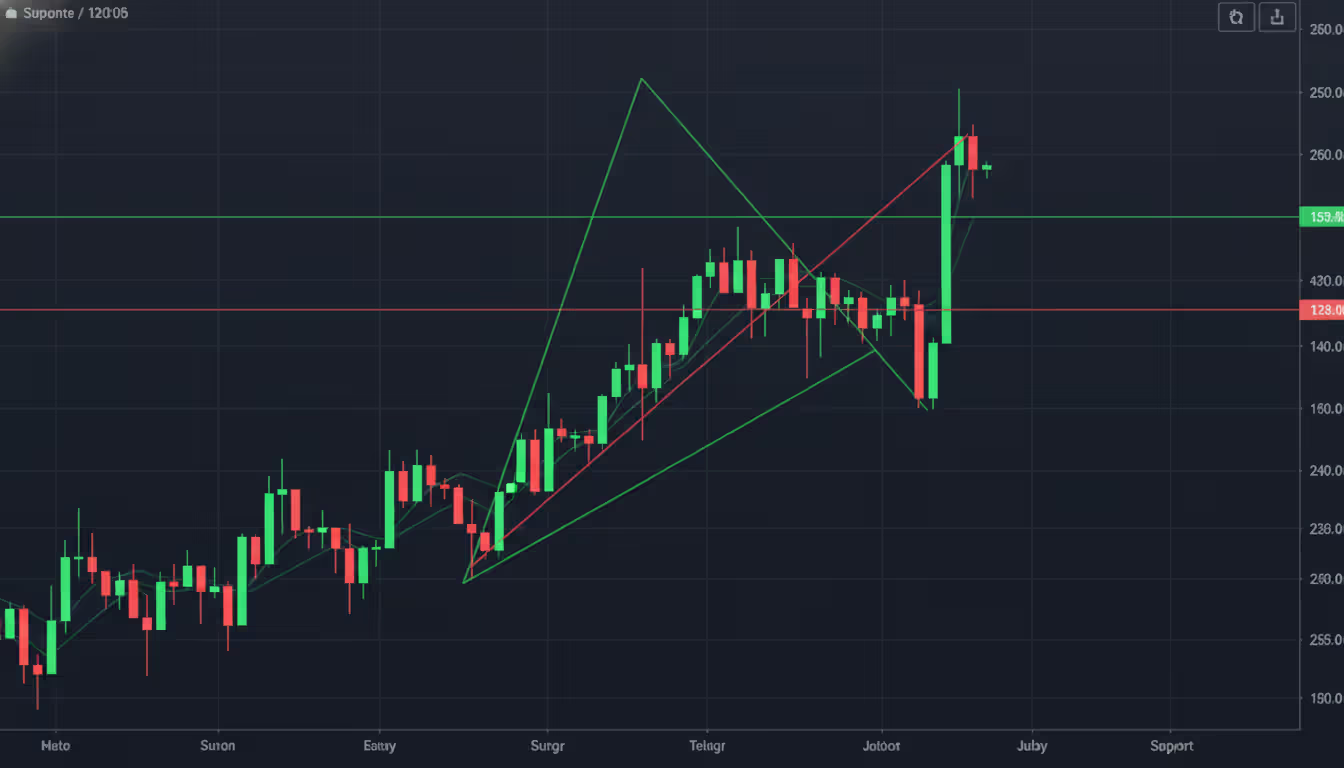
The daily chart shows a textbook symmetrical triangle forming, with trendlines converging like the mouth of a funnel. Technical theory suggests the eventual breakout—and there's always an eventual breakout—will move roughly the distance of the pattern's height. Measure from top to bottom of this triangle, and you get about 300 pips. So if we break above 1.2850, target 1.3150. Break below 1.2500, target 1.2200. Simple in theory, though timing that breakout beforehand is the multi-billion-dollar question.
Author: Vanessa Cole;
Source: martinskikulis.com
Long Term Trends and Expert Forecasts
Wall Street's foreign exchange desks have published their outlooks, and what's striking is how clustered the forecasts are. Nobody's calling for dramatic moves—most targets sit within 200 pips of current levels. That's unusual. Typically you see wider disagreement reflecting genuinely different views about fundamentals.
Bank
6-Month Forecast
12-Month Forecast
Core Thesis
Goldman Sachs
1.2400
1.2200
Federal Reserve maintains restrictive stance longer than BoE
JP Morgan
1.2700
1.2600
Fed pivots to gradual easing, providing modest pound support
Citibank
1.2300
1.2100
US economic outperformance continues attracting capital flows
HSBC
1.2650
1.2750
Bank of England stays hawkish on stubborn inflation
Barclays
1.2500
1.2400
Range-bound consolidation with slight dollar bias
The median target around 1.2400 for year-end 2026 implies maybe 2% downside from current prices. That's barely worth mentioning for long-term investors, though short-term traders can certainly profit from 200-pip moves.
Stretch your timeline to five years, and forecasts diverge dramatically, ranging from 1.1500 to 1.3200. That 1,700-pip spread reflects genuine uncertainty about structural trends. Will the UK's productivity challenges prove permanent, or can post-Brexit regulatory freedom unlock new growth? Will London maintain its status as a global financial hub, or will Paris and Frankfurt gradually capture market share? Does the UK's services-sector strength offset its manufacturing decline?
These aren't questions with clear answers, which is why long-term pound forecasts vary so widely. Recession scenarios could push GBP/USD to 1.15 or below. A resurgence of UK growth combined with US economic problems could drive it to 1.32 or higher. Both extremes are plausible depending on how the next few years unfold.
Sterling's credibility gets tested in the second half of this year. Should UK inflation stay hotter than US price pressures, the Bank of England must keep policy tight even while the Fed's cutting. That scenario could actually lift the pound—but only if markets believe the BoE won't cave to political pressure when growth falters
— Jane Foley
Frequently Asked Questions About GBP to USD Forecast
What is the GBP to USD forecast for 2026 and 2027?
Major banks cluster their 2026 year-end forecasts between 1.2100 and 1.2800, with most leaning toward the lower half of that range. We're talking about modest pound weakness, nothing dramatic—maybe 2-3% downside from current levels. For 2027, predictions scatter more widely from 1.1800 up to 1.3000 depending on central bank policy assumptions. The widening range for 2027 reflects how difficult it is to predict 18+ months out when both the Fed and Bank of England refuse to commit to clear forward guidance. Consensus, if there is one, expects limited movement through late 2026 followed by potentially bigger swings once one central bank or the other commits to a definitive policy path.
Will the pound get stronger against the dollar?
Depends entirely on the interest rate race between the Bank of England and Federal Reserve. If the Fed cuts aggressively while the BoE holds firm, you'd expect pound appreciation toward 1.30. But if American economic growth keeps outpacing Britain's while UK inflation stays problematic, the dollar probably maintains its edge. Current market positioning tilts slightly bearish on sterling—more traders are betting on weakness than strength. That positioning could reverse quickly on hawkish Bank of England rhetoric or disappointing US data, though. Currency forecasting's notoriously difficult because positions can flip on a single speech or data release.
When should I exchange pounds for dollars to get favorable rates?
Trying to nail the perfect exchange rate is like trying to catch a falling knife—looks easy until you try it, then suddenly you're hurt and confused. Professional traders with decades of experience and sophisticated models fail at timing more often than they succeed. Here's a practical approach instead: split your exchange into three chunks. Convert one-third immediately at whatever rate's available—that's your insurance against things moving against you. If rates improve by 2% or more in your favor, convert another third. Set a final deadline or target level for the remaining third. This layered strategy means you won't get the absolute best rate, but you also won't get the worst. You'll land somewhere in the middle while reducing the psychological stress of trying to time it perfectly.
How does the Federal Reserve affect GBP/USD?
The Fed's interest rate decisions drive dollar strength through basic supply and demand. Hike rates, and dollar-denominated assets become more attractive, pulling capital toward America and strengthening the currency. Cut rates, and the reverse happens. But it's not just actual rate changes that matter—Fed communications shape expectations months in advance. When Chair Powell uses hawkish language in a speech, the dollar can strengthen even without any immediate policy change because traders start pricing in future tightening. The Fed's balance sheet policy matters too, though it's less visible. Quantitative tightening (letting bonds roll off without reinvestment) reduces dollar supply, theoretically supporting the currency. All these factors—rates, rhetoric, balance sheet—filter through to GBP/USD by changing the relative attractiveness of holding dollars versus pounds.
Is GBP/USD a good pair to trade?
For active traders, cable (as GBP/USD is nicknamed) offers several advantages: excellent liquidity means tight bid-ask spreads, usually just 0.5-1.0 pips on major platforms. There's sufficient volatility to create profit opportunities without the wild swings you see in emerging market currencies. You get constant news flow from two major economies, providing fundamental catalysts several times per week. The downsides? The pair can gap violently around UK or US economic releases—inflation reports, jobs data, GDP figures. If you're overleveraged when surprise data hits, you can get wiped out in minutes. The current low-volatility environment frustrates momentum traders but creates opportunities for range-bound strategies. Success depends less on the pair's inherent characteristics than on your risk management discipline and whether your strategy matches current market conditions.
What was the GBP/USD rate during Brexit?
In the days before the June 23, 2016 referendum, the pound traded around 1.50 against the dollar. Most polls predicted Remain would win, so markets were relatively calm. Then the results came in showing a 52-48 victory for Leave, and the pound cratered to 1.32 within two days—roughly a 12% collapse in 48 hours. That was just the beginning. The pair ground lower throughout summer and autumn 2016, hitting an intraday low of 1.1946 in October during a brief flash-crash episode. By early 2017, it had stabilized in a 1.20-1.25 range where it remained throughout the tortuous Article 50 negotiations and parliamentary battles. The pound's never sustainably recovered to pre-referendum levels, not even close. That persistent weakness tells you Brexit wasn't just a temporary shock—markets fundamentally repriced Britain's economic prospects downward and haven't revised that assessment upward even years later.
GBP/USD in 2026 reflects a standoff between competing forces: monetary policy uncertainty, growth differentials favoring America, and Brexit's lingering structural impact on the UK economy. The pair's been pinned between 1.2450 and 1.2850 for months now, with neither bulls nor bears able to seize control.
Interest rate differentials remain the dominant short-term driver. The Bank of England's 50-basis-point advantage over the Fed provides modest pound support, but that edge isn't large enough to generate sustained appreciation. Markets are watching for signals about which central bank will move next and in what direction. Inflation dynamics complicate the picture—higher UK price pressures argue for tighter Bank of England policy, but persistent inflation despite elevated rates suggests underlying economic problems that worry investors.
Technical indicators point to compressed volatility that typically precedes significant directional moves. The symmetrical triangle forming on daily charts suggests energy building for an eventual breakout of 300 pips or more. Whether that break comes to the upside or downside depends on fundamental developments—central bank surprises, economic data shocks, or geopolitical events.
Major bank forecasts converge on modest pound weakness over the next year, with median targets near 1.2400. That represents just 2% downside from current levels—hardly a dramatic call. Beyond 12 months, uncertainty increases substantially, with five-year forecasts ranging from 1.1500 to 1.3200 depending on assumptions about structural economic trends.
For businesses managing currency exposure or individuals planning exchanges, the current environment doesn't favor aggressive timing bets. The balanced fundamental picture and compressed volatility suggest a layered approach to transactions makes more sense than trying to nail a single perfect rate. Convert what you need immediately, maintain flexibility for the rest, and avoid overleveraging on directional predictions that even professionals struggle to get right consistently.
The pound to dollar exchange rate reflects economic health, central bank policy, and political stability. This guide explains what drives Cable, historical context, purchasing power parity, seasonal patterns, and expert forecasts for 2026 to help Americans make informed currency decisions
Non-Farm Payroll releases create dramatic currency market swings on the first Friday of most months. Learn what NFP means for forex traders, how employment data drives USD volatility, and proven strategies for trading this high-impact economic event safely and profitably
Forex volatility describes the rate and magnitude of price changes in currency pairs. This guide covers measurement methods like ATR and historical volatility, explores factors driving volatility including news events and VIX correlation, and provides practical strategies for trading both high and low volatility conditions
Market sentiment acts as the invisible hand guiding currency prices, often before fundamentals catch up. This comprehensive guide shows traders how to read, measure, and trade forex sentiment using real data sources including COT reports, retail positioning tools, and institutional indicators
The content on this website is provided for general informational and educational purposes only. It is intended to explain concepts related to Forex (FX) trading, currency markets, leverage, hedging, and risk management.
All information on this website, including articles, guides, and examples, is presented for general educational purposes. Forex trading carries significant risk, and outcomes may vary depending on market conditions, leverage, and individual decisions.
This website does not provide financial, investment, or trading advice, and the information presented should not be used as a substitute for consultation with qualified financial professionals.
The website and its authors are not responsible for any errors or omissions, or for any outcomes resulting from decisions made based on the information provided on this website.