When the Federal Reserve announces a policy shift, traders around the world hold their breath. Within seconds of an FOMC statement release, billions of dollars change hands across stock exchanges and forex platforms. Understanding how these announcements ripple through markets can mean the difference between capitalizing on volatility and getting caught on the wrong side of a sudden price swing.
The relationship between Federal Reserve decisions and market movements isn't random. Patterns emerge when you study how the Fed communicates, what language signals future policy direction, and which economic indicators the committee prioritizes. Traders who decode these signals before the crowd often position themselves ahead of major currency and equity moves.
What Is the FOMC and Why It Matters to Markets
The Federal Open Market Committee represents the monetary policy arm of the United States Federal Reserve System. Twelve voting members—the seven governors of the Federal Reserve Board plus five rotating regional Federal Reserve Bank presidents—meet eight times annually to set the federal funds rate and determine the direction of U.S. monetary policy.
These meetings follow a predictable schedule, typically occurring every six to seven weeks. The committee reviews economic data ranging from employment figures and inflation metrics to GDP growth and consumer spending patterns. After deliberation, members vote on whether to raise, lower, or maintain the target federal funds rate.
Markets care intensely about these decisions because interest rates influence borrowing costs throughout the economy. When the Fed adjusts rates, it affects everything from mortgage payments to corporate bond yields. For currency traders, rate changes directly impact the attractiveness of dollar-denominated assets compared to other currencies. Stock investors watch closely because higher rates can compress corporate profit margins while making bonds more competitive with equities.
The committee releases its statement at 2:00 PM Eastern Time on the final day of each meeting. Four times per year, the chair holds a press conference thirty minutes after the statement, adding another layer of market-moving commentary. Three weeks after each meeting, the Fed publishes detailed minutes revealing the internal debate among members.
How FOMC Decisions Affect Currency and Forex Markets
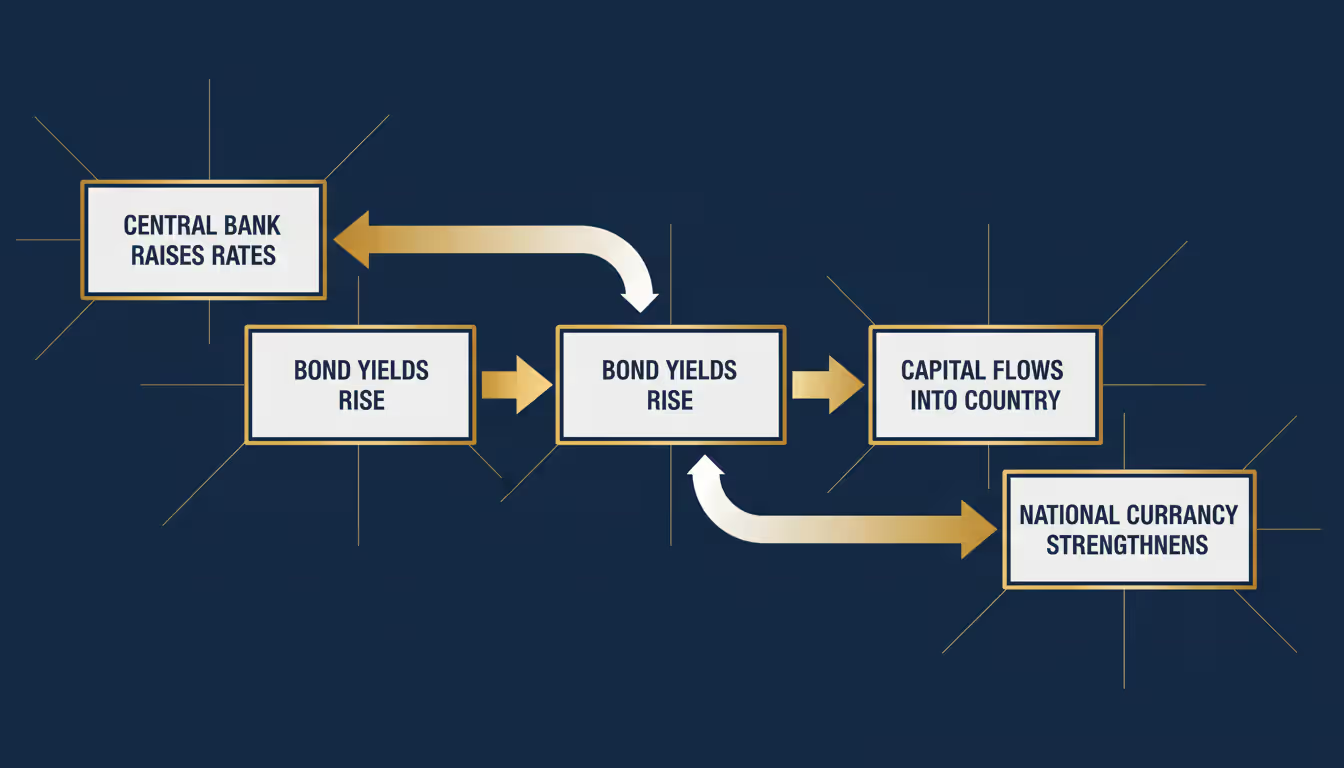
Currency markets respond to Federal Reserve policy faster than almost any other asset class. The mechanism is straightforward: higher interest rates typically strengthen a currency by attracting foreign capital seeking better returns. When the Fed raises rates while other central banks hold steady, capital flows toward dollar-denominated assets, pushing USD higher against competing currencies.
The Fed Funds Rate and Forex Price Movement
The federal funds rate sets the baseline for short-term interest rates across the U.S. economy. When this rate increases, Treasury yields usually rise in tandem, making dollar assets more attractive to international investors. A Japanese pension fund manager comparing U.S. bonds yielding 4.5% against Japanese government bonds at 0.5% faces a compelling incentive to buy dollars and invest in American debt.
Author: Olivia Kensington;
Source: martinskikulis.com
This dynamic creates predictable forex reactions. EUR/USD typically falls when the Fed raises rates more aggressively than the European Central Bank. USD/JPY often rallies when rate differentials widen between the United States and Japan. The magnitude of these moves depends on whether the decision surprises markets or merely confirms expectations already priced into currency pairs.
Traders distinguish between anticipated rate changes and unexpected ones. If markets already expect a quarter-point hike and the Fed delivers exactly that, the currency reaction may be muted. The real volatility emerges when the committee surprises with a larger move, an unexpected pause, or forward guidance that shifts rate expectations for future meetings.
FOMC Meeting and USD Immediate Reactions
The first sixty seconds after statement release often see the wildest price swings. Algorithmic trading systems parse the text instantly, searching for changes in key phrases. A shift from "inflation remains elevated" to "inflation has moderated" can trigger massive buy or sell orders before human traders finish reading the first paragraph.
USD strength or weakness in these initial moments depends on the gap between market expectations and actual policy. During the 2025 cycle, one meeting saw the Fed hold rates steady when markets had priced in a 70% chance of a cut. The dollar surged 1.2% against the euro within five minutes as traders unwound positions betting on easing.
Currency volatility typically remains elevated for the remainder of the trading session, then gradually diminishes over the following days. However, if the chair's press conference contradicts or clarifies the written statement, a second wave of volatility can emerge thirty minutes after the initial release.
Author: Olivia Kensington;
Source: martinskikulis.com
Understanding Hawkish vs Dovish FOMC Statements
Fed watchers categorize policy stances along a hawk-dove spectrum. Hawkish positions prioritize fighting inflation, even at the cost of slower economic growth. Dovish stances emphasize supporting employment and economic expansion, accepting somewhat higher inflation as a trade-off.
The committee rarely uses these terms directly. Instead, traders decode sentiment from specific language choices. A statement emphasizing "upside risks to inflation" signals hawkish thinking. References to "downside risks to employment" or "supporting economic activity" lean dovish.
Tone shifts matter more than static language. If the Fed has warned about inflation for six consecutive meetings, then suddenly removes that phrase, markets interpret the change as a dovish pivot even if the statement still mentions price pressures. Context and evolution drive interpretation.
Signal Type
Fed Language Examples
Typical USD Reaction
Typical Stock Market Reaction
Hawkish
"Inflation remains unacceptably high"; "additional tightening may be appropriate"; "upside risks to prices"
Strengthens (capital flows to higher-yielding USD assets)
"Committee will monitor incoming data"; "prepared to adjust policy as appropriate"
Mixed/range-bound (markets await clarity)
Modest moves (uncertainty limits conviction)
Chair commentary during press conferences adds nuance to written statements. A seemingly neutral statement paired with hawkish press conference remarks can reverse initial market reactions. In early 2026, one statement appeared balanced, but the chair's emphasis on "remaining vigilant" on inflation sent stocks down 1.5% during the Q&A session.
The dot plot—the committee's projections for future rate paths—provides another hawk-dove signal. When the median dot shifts higher, indicating members expect more rate hikes ahead, markets typically price in a stronger dollar and weaker equities. A downward revision suggests easier policy ahead, often supporting stocks while pressuring USD.
FOMC Minutes and Dollar Movement Patterns
Three weeks after each meeting, the Fed releases detailed minutes documenting the discussion among committee members. These transcripts reveal disagreements, alternative viewpoints, and the reasoning behind the final decision. Markets sometimes react more strongly to minutes than to the original statement, especially when they expose divisions within the committee.
Minutes move markets when they contain surprises about future policy direction. If the statement suggested unanimity but minutes reveal several members wanted a larger rate hike, traders adjust expectations for the next meeting. This recalibration flows through currency markets as rate probabilities shift.
Historical patterns show dollar strength following minutes that reveal more hawkish internal debate than the statement implied. When minutes from a May 2025 meeting showed "several participants" wanted to discuss accelerating balance sheet reduction, USD/JPY jumped 80 pips despite the original statement causing minimal reaction.
The timing of minutes releases—midway between meetings—can sustain market focus on Fed policy during otherwise quiet periods. Traders often position ahead of minutes if they suspect the statement undersold internal hawkishness or dovishness. This pre-positioning creates volatility even before publication.
Minutes also clarify ambiguous statement language. When the committee uses vague phrases like "some participants noted," minutes specify whether "some" means two members or seven. This precision helps traders gauge how close the committee might be to shifting policy at the next meeting.
FOMC Statement Analysis: What Traders Watch For
Experienced traders dissect statements line by line, comparing each sentence to previous versions. Specific elements carry more weight than others in predicting market reactions.
Forward guidance—the Fed's communication about likely future policy—ranks among the most market-sensitive components. When the committee signals that rates will remain "higher for longer," it extends the timeline for elevated borrowing costs, typically supporting the dollar while pressuring growth stocks. A shift to "data-dependent" language without specific forward guidance often increases volatility as markets lose their roadmap.
The opening assessment of economic conditions sets the tone. Changes here matter. If the Fed upgrades its economic outlook from "modest growth" to "solid expansion," markets anticipate the committee might tolerate higher rates longer. Downgrades to "subdued growth" or "softening activity" hint at potential easing ahead.
Inflation language deserves close attention. The Fed distinguishes between headline inflation and core measures excluding food and energy. When the statement shifts focus from headline to core, or vice versa, it signals which metric currently drives policy thinking. A committee concerned primarily with core inflation might look through temporary energy price spikes, suggesting less urgency to tighten.
Employment references reveal the other half of the Fed's dual mandate. Language describing labor markets as "tight" or showing "little slack" supports hawkish positioning. References to "rebalancing" or "cooling" suggest the Fed sees less wage pressure, potentially allowing easier policy.
The vote count provides a quick hawk-dove gauge. Unanimous decisions suggest strong consensus. Dissents—especially multiple dissents favoring tighter policy—signal internal pressure for more aggressive action, often supporting the dollar.
The four most dangerous words in investing are: 'This time it's different'
— Sir John Templeton
Interest Rate Decision Forex Impact: Real Examples
Theory matters less than real-world outcomes. Examining specific FOMC meetings shows how rate decisions translate into currency moves.
In March 2025, the Fed raised rates by 25 basis points as widely expected. The statement, however, removed language about "ongoing increases" being appropriate, replacing it with "some additional tightening may be appropriate." This subtle shift suggested the hiking cycle neared its end. EUR/USD rallied 140 pips within two hours as traders bet on a Fed pause. Stock indices jumped 2% on expectations that peak rates were close.
Contrast that with September 2025, when the Fed held rates steady but the dot plot showed members expected one more hike before year-end. The surprise wasn't the current decision but the forward guidance. USD/CHF surged 110 pips as safe-haven flows reversed. The S&P 500 dropped 1.8% as traders pushed back expectations for rate cuts into late 2026.
Author: Olivia Kensington;
Source: martinskikulis.com
January 2026 delivered a different scenario. The Fed cut rates by 25 basis points, the first reduction after eighteen months of restrictive policy. Markets had priced in the cut, but the chair's press conference emphasized this was a "recalibration" not the start of an easing cycle. The dollar initially weakened 60 pips on the cut announcement, then recovered fully during the press conference as traders absorbed the hawkish framing. Stocks ended the day flat after whipsawing in a 2% range.
These examples illustrate that the decision itself often matters less than the context and communication surrounding it. A rate hike paired with dovish guidance can weaken the dollar. A hold paired with hawkish projections can strengthen it. Reading the full message—decision, statement, dot plot, and chair commentary—provides the complete picture.
Trading Strategies Around Federal Reserve Announcements
FOMC meetings present both opportunity and risk. Volatility spikes create profit potential but also magnify losses for poorly positioned trades.
Many professional traders reduce position sizes ahead of meetings. The unpredictability of statement language and press conference remarks makes large directional bets risky. Cutting exposure by 30-50% the day before an announcement limits downside if markets move against you.
Author: Olivia Kensington;
Source: martinskikulis.com
Some traders avoid holding positions through the announcement entirely, preferring to react after the initial volatility subsides. This approach sacrifices potential early gains but avoids the risk of being on the wrong side when algorithms trigger massive orders in the first seconds.
Options strategies gain popularity around FOMC meetings. Buying straddles—simultaneously purchasing call and put options—profits from volatility regardless of direction. This works when implied volatility is relatively low heading into the meeting. The risk is that actual volatility disappoints, causing both options to lose value.
For those trading the announcement, speed matters. Retail traders can't compete with algorithmic systems parsing statements in milliseconds. Waiting 60-90 seconds for initial volatility to settle, then trading the secondary move once human interpretation takes over, often provides better risk-reward than trying to front-run the algorithms.
Currency pairs with the highest liquidity—EUR/USD, USD/JPY, GBP/USD—typically offer the tightest spreads during FOMC volatility. Exotic pairs can see spreads widen dramatically, turning potential profits into losses through execution costs alone.
Stop-loss orders require careful placement. Volatility can trigger stops before prices reverse, stopping you out at the worst possible moment. Wider stops account for initial whipsaws but increase potential losses. Some traders use mental stops rather than placing them in the market, though this demands discipline to execute when prices move against you.
Post-meeting analysis often reveals the best trades. If the initial market reaction seems disconnected from the statement's actual content, a reversal trade can be profitable. When the dollar surges on a dovish statement because traders misread one phrase, the correction over the following hours can be substantial.
FAQ
What time does the FOMC announcement move markets?
The statement releases at precisely 2:00 PM Eastern Time on the final day of scheduled meetings. Currency and stock markets typically see the most violent moves in the first 60-90 seconds, followed by sustained volatility through the end of the U.S. trading session. When the chair holds a press conference, a second wave of volatility begins at 2:30 PM as traders react to Q&A responses.
How long does FOMC volatility typically last?
Immediate volatility peaks in the first few minutes after release, then gradually diminishes over 2-4 hours. Meaningful price discovery continues through the following trading day as global markets digest the announcement. When statements significantly shift policy expectations, elevated volatility can persist for several days as traders reposition across multiple asset classes.
Do stocks always fall when the Fed raises rates?
No. Stock reactions depend on whether the hike matches expectations and what forward guidance accompanies it. A well-telegraphed rate increase often sees stocks rally if the Fed signals the hiking cycle is nearly complete. Surprise hikes or hawkish guidance suggesting many more increases ahead typically pressure equities. The key is whether the decision reduces or increases uncertainty about future policy.
Which currency pairs are most affected by FOMC decisions?
USD pairs show the strongest reactions, with EUR/USD, USD/JPY, and GBP/USD experiencing the largest moves. The dollar index, which measures USD against a basket of major currencies, often swings 0.5-1.5% on significant announcements. Emerging market currencies with carry trade appeal—like MXN or BRL—also react strongly as rate differentials shift.
How can I trade FOMC announcements safely?
Reduce position sizes by 30-50% ahead of meetings to limit risk. Avoid trading the first 60-90 seconds when algorithmic volatility peaks. Use wider stop-losses to account for initial whipsaws, or consider avoiding directional positions entirely and waiting to trade the post-announcement trend. Options strategies like straddles can profit from volatility without requiring correct directional prediction.
Where can I find the FOMC meeting schedule?
The Federal Reserve publishes the full year's meeting schedule on its official website at federalreserve.gov. The calendar lists all eight scheduled meetings, typically occurring every six to seven weeks. Markets also widely publicize upcoming meetings, and most financial news platforms maintain FOMC calendars with countdown timers to statement releases.
Federal Reserve decisions move markets with a force few other events can match. The interplay between FOMC announcements and both stock and currency markets follows patterns rooted in interest rate differentials, forward guidance interpretation, and the eternal tension between the Fed's dual mandate of price stability and maximum employment.
Successful traders don't just react to rate decisions—they decode the language, compare statements across meetings, weigh dot plot projections against economic data, and distinguish between what the Fed says and what it means. The gap between hawkish and dovish positioning often appears in subtle phrase changes invisible to casual observers but glaringly obvious to those who study Fed communication.
Currency markets offer the purest expression of FOMC impact, with dollar strength or weakness flowing directly from rate expectations and policy tone. Stock markets add complexity, balancing the negative impact of higher discount rates against the positive signal of an economy strong enough to withstand tightening.
The three-week delay before minutes publication creates a secondary opportunity for traders who missed the initial announcement or want to refine positions based on internal committee dynamics. These minutes frequently reveal nuances that shift rate probabilities for upcoming meetings.
As you develop your approach to trading around Federal Reserve announcements, remember that preparation matters more than prediction. Understanding what each section of the statement signals, how the chair's press conference can modify or contradict written language, and which economic indicators currently drive committee thinking gives you an edge when volatility strikes.
Markets will continue reacting to FOMC decisions as long as the Federal Reserve controls U.S. monetary policy. The traders who thrive in this environment are those who respect the volatility, manage their risk, and never assume they can predict exactly how the Fed will communicate its next move.
The pound to dollar exchange rate reflects economic health, central bank policy, and political stability. This guide explains what drives Cable, historical context, purchasing power parity, seasonal patterns, and expert forecasts for 2026 to help Americans make informed currency decisions
Non-Farm Payroll releases create dramatic currency market swings on the first Friday of most months. Learn what NFP means for forex traders, how employment data drives USD volatility, and proven strategies for trading this high-impact economic event safely and profitably
The British pound has traded within 1.2450-1.2850 against the dollar through early 2026, reflecting balanced fundamentals. Interest rate differentials, inflation dynamics, and Brexit's lasting impact shape the pair's outlook, with major banks forecasting modest weakness toward 1.2400 over 12 months
Forex volatility describes the rate and magnitude of price changes in currency pairs. This guide covers measurement methods like ATR and historical volatility, explores factors driving volatility including news events and VIX correlation, and provides practical strategies for trading both high and low volatility conditions
The content on this website is provided for general informational and educational purposes only. It is intended to explain concepts related to Forex (FX) trading, currency markets, leverage, hedging, and risk management.
All information on this website, including articles, guides, and examples, is presented for general educational purposes. Forex trading carries significant risk, and outcomes may vary depending on market conditions, leverage, and individual decisions.
This website does not provide financial, investment, or trading advice, and the information presented should not be used as a substitute for consultation with qualified financial professionals.
The website and its authors are not responsible for any errors or omissions, or for any outcomes resulting from decisions made based on the information provided on this website.