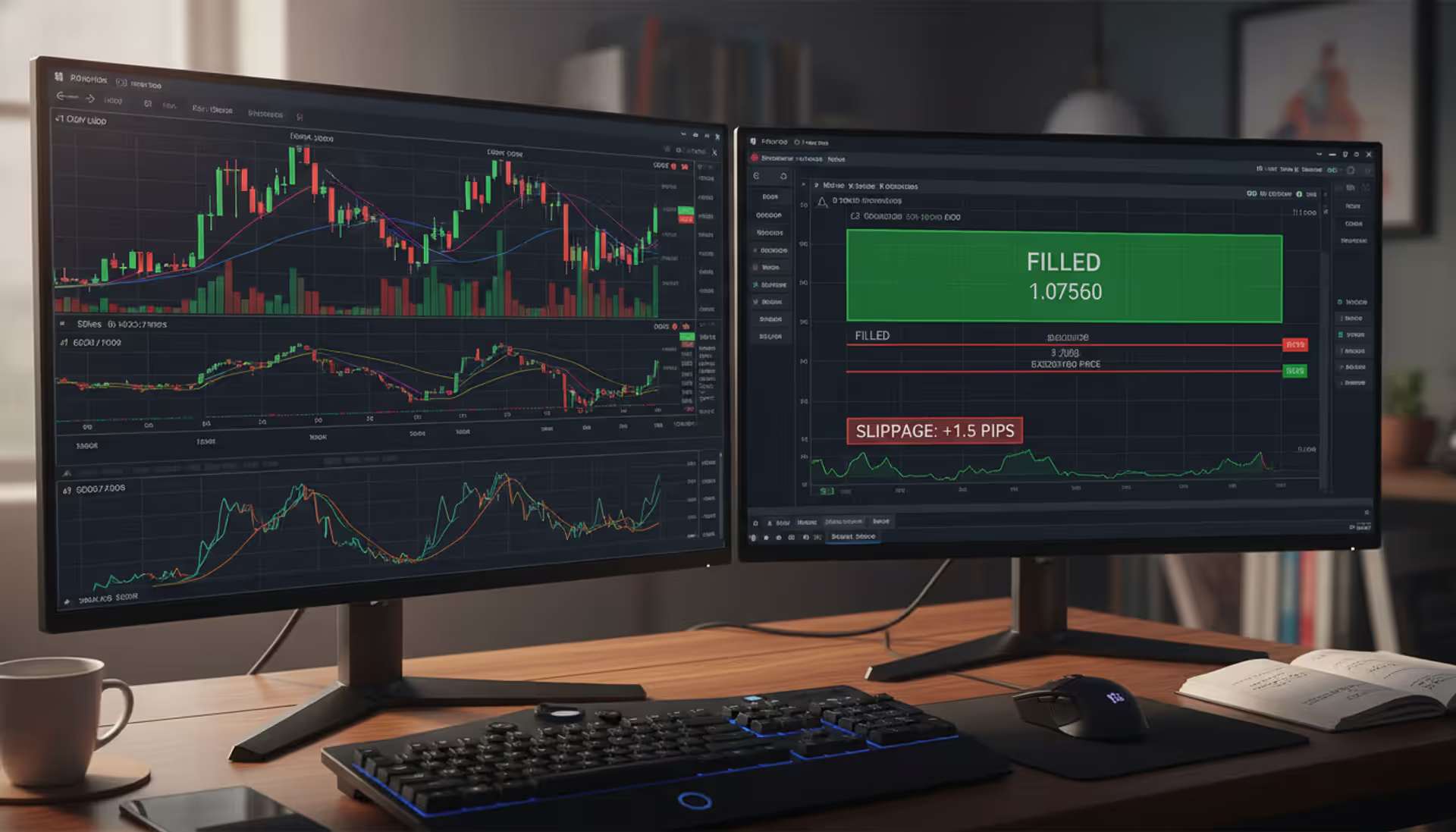
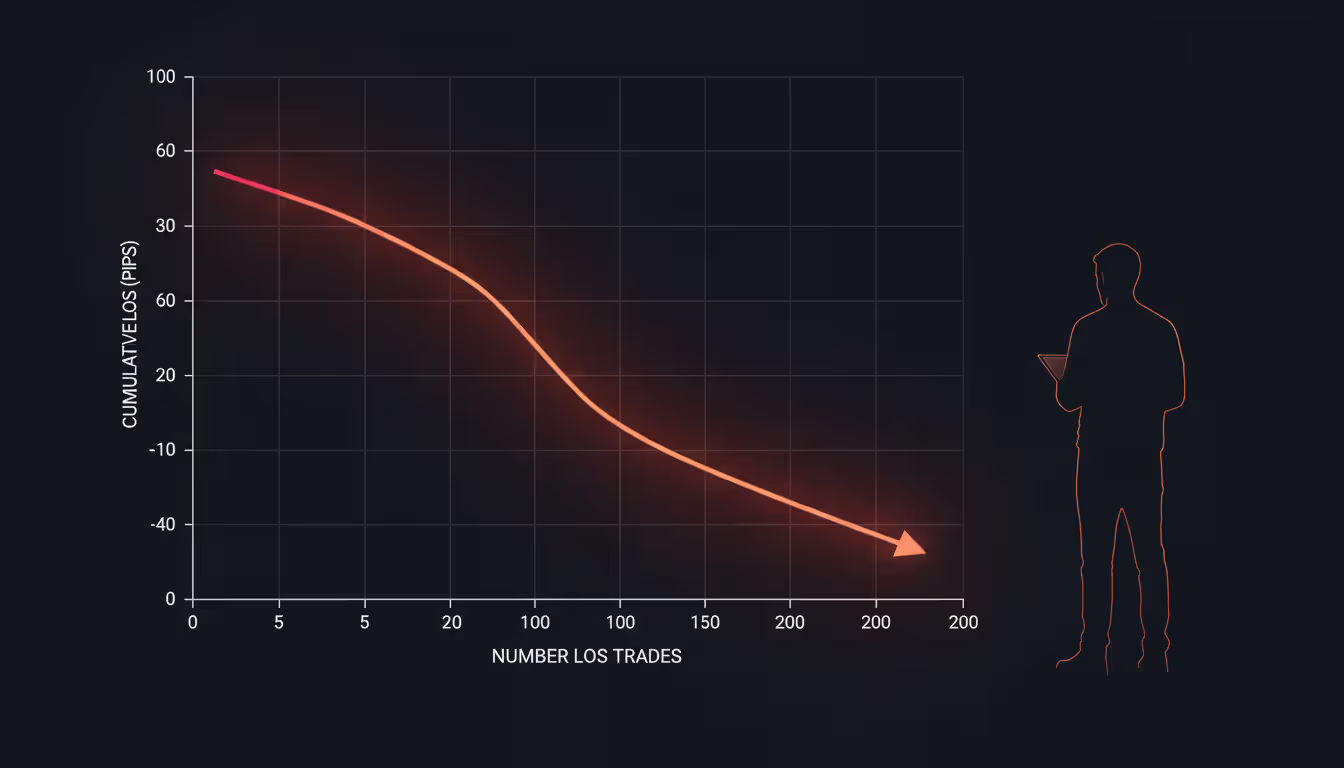
Most traders obsess over entry signals and ignore execution costs. That's backwards. I've seen profitable strategies fail in live trading because nobody bothered calculating how much slippage was bleeding out. Two pips per trade sounds harmless until you run the math on 200 trades per month—suddenly you're looking at 400 pips gone before you even factor in wins and losses.
Protecting yourself from excessive slippage isn't complicated, but it requires understanding when and why fills go bad.
What Slippage Is and Why It Happens in Forex
Your order fills at a different price than you expected. That's slippage.
You wanted in at 1.0850 on EUR/USD. Your confirmation says 1.0853. Those three pips? That's money you didn't plan to spend.
Here's what surprises newer traders: slippage can actually help you. Sometimes your buy order fills at 1.0847 instead of 1.0850. You saved three pips. That's positive slippage. Don't count on it happening often, though. Negative slippage—where you pay more or receive less than intended—shows up far more frequently, particularly when markets start moving fast.
Unlike stock exchanges with centralized order books, currency trading happens across a distributed network of banks, institutions, and liquidity providers. Your broker sends your order out to these providers hunting for someone willing to take the other side. What you're looking at on your trading screen represents a price quote, not a binding contract. Between clicking your mouse and your order reaching an actual counterparty, anything can happen. Prices shift. Liquidity dries up. Someone else's order gets there first.
Three things create the gap between intended price and actual fill: transmission delays (even milliseconds matter when prices move), availability of willing counterparties at your target price, and rapid price movements that burn through all available orders at your level. Modern fiber-optic connections have reduced delays dramatically, but during fast markets, currencies can jump five or ten pips before your order completes its journey.
Main Causes of Slippage in Currency Markets
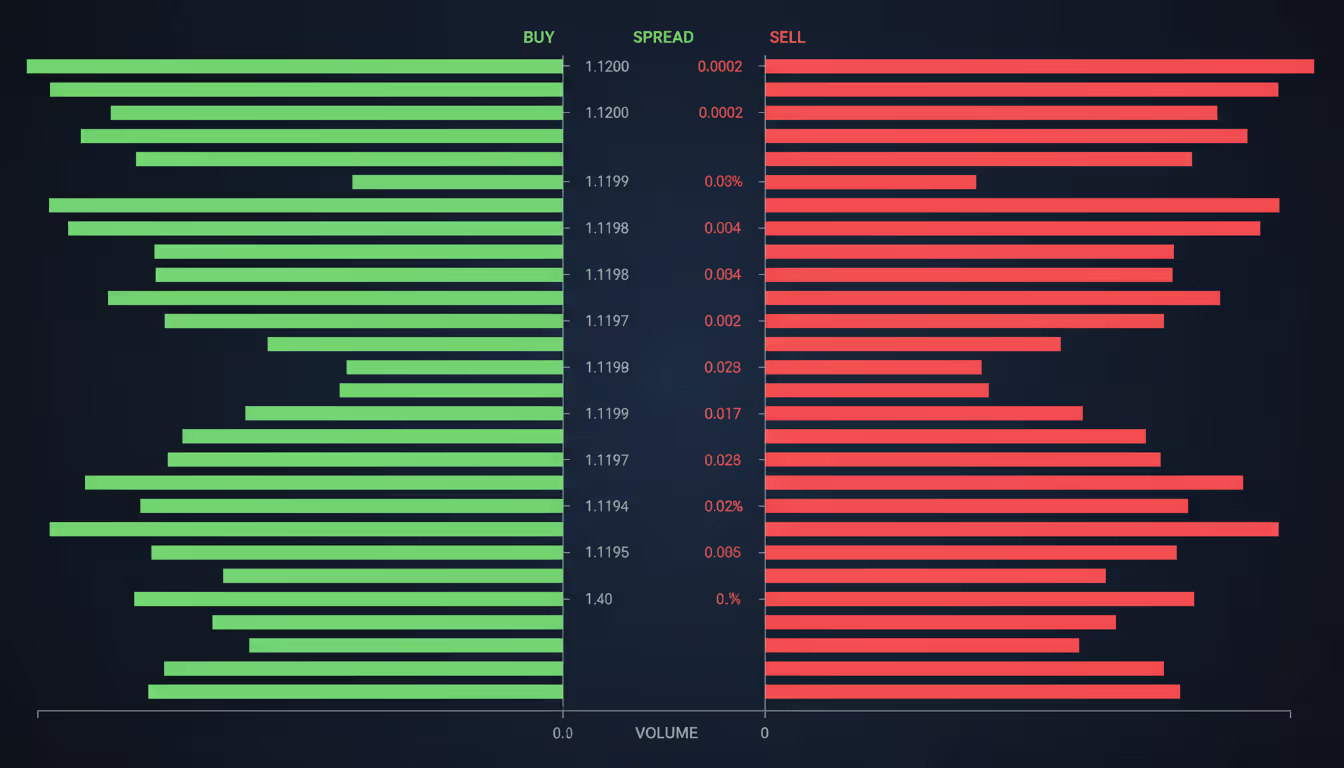
Available trading volume determines whether your order fills smoothly or badly. EUR/USD and USD/JPY trade several trillion dollars daily. Tight spreads, abundant willing buyers and sellers, reliable fills. Compare that to something like USD/TRY or EUR/ZAR—these pairs have fewer participants, wider bid-ask spreads, and you'll face slippage on ordinary trades that would execute perfectly in major pairs.
Volatility makes everything worse. Calm markets have stable order books with visible depth at each price level. When volatility spikes, those neat price levels disappear. Your market order has to chase progressively worse prices to find enough volume, resulting in fills that make you wince.
Your broker's infrastructure creates measurable differences in execution quality. Brokers maintaining direct connections to multiple liquidity sources can shop your order around for better prices. Dealing desk operations that take the other side of your trades face inherent conflicts—your loss is literally their gain, which doesn't exactly incentivize them to get you the best possible fill.
Position size matters more than most traders realize. Let's say you want to buy 10 standard lots, but only 3 lots are sitting at your target price. The remaining 7 lots? They'll fill at whatever prices exist above your target—each successive lot potentially worse than the last. Professional desks always check market depth before sizing their trades.
Author: Ethan Blackwell;
Source: martinskikulis.com
How News Events Trigger Slippage Spikes
Major economic releases—payroll numbers, central bank announcements, CPI data—create predictable chaos. Minutes before these announcements, liquidity providers start pulling their orders and widening spreads defensively. A pair normally trading with a half-pip spread might suddenly show 5 or 10 pips between bid and ask. Some providers disappear entirely.
Prices frequently gap during the initial reaction. One second you're seeing 1.0850, the next second the market is at 1.0870 with absolutely nothing in between. Market orders submitted during this window will fill wherever they can—often 15 or 20 pips away from the last visible price. Limit orders simply won't execute at all if price jumps over them.
I've watched traders place stops 20 pips away thinking they're protected, only to get filled 35 pips from entry when news hits. Their stop triggered during maximum volatility when slippage was at its worst. Stops don't protect you from bad fills—they just guarantee you'll exit, regardless of price.
The Relationship Between Liquidity and Slippage
More liquidity equals less slippage. Fewer participants equals worse fills. The relationship is that straightforward.
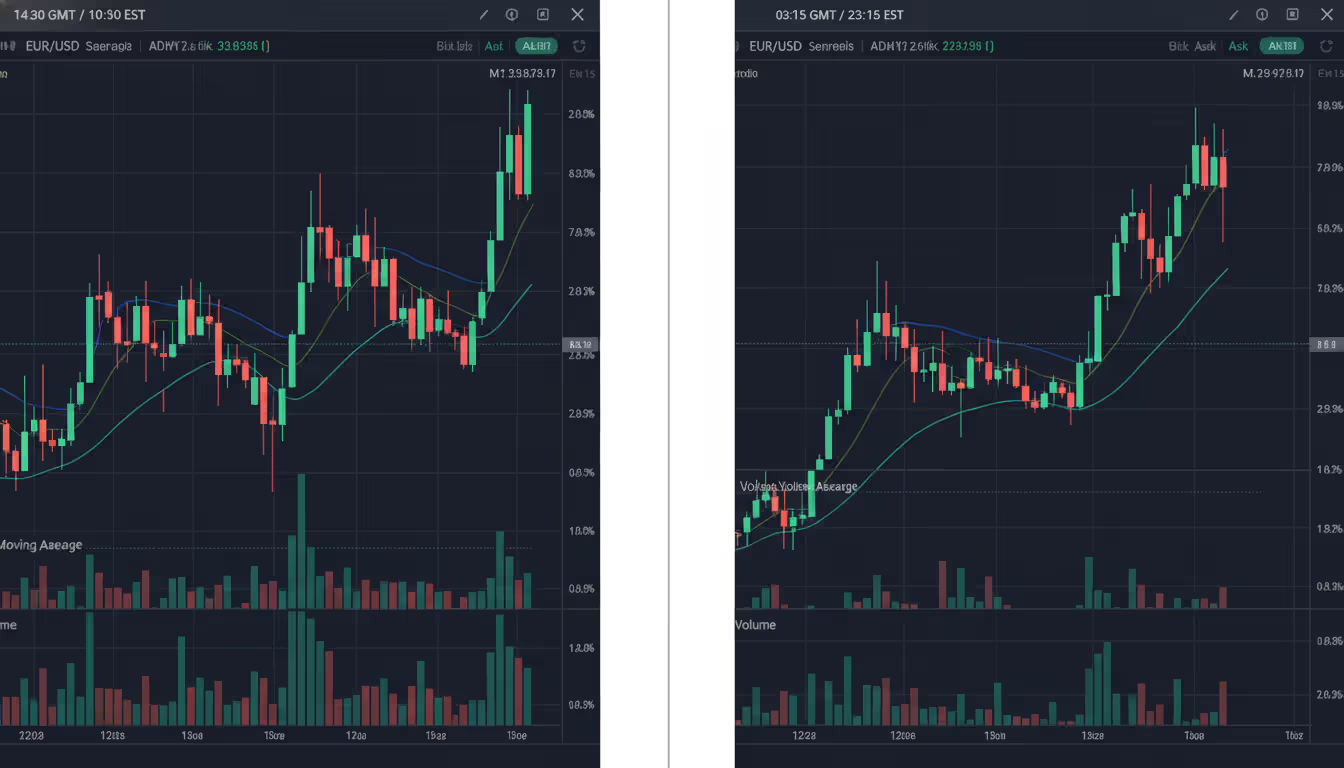
Trading session timing matters enormously. When London and New York both operate (roughly 8:00 AM to noon Eastern), you've got European banks, American institutions, and everyone in between actively quoting prices. That's when major pairs have their tightest spreads and deepest order books. Try trading EUR/USD at 2:00 AM Eastern during the Asian session—volume drops off because European and American traders are asleep. Your fills will suffer.
Currency pair selection determines your baseline slippage exposure. The majors—EUR/USD, GBP/USD, USD/JPY, USD/CHF—represent the vast majority of global forex volume. Minors like EUR/GBP or AUD/NZD have noticeably less depth. Exotics can be brutal; I've seen 100-pip moves in USD/MXN where traders experienced 10+ pips of slippage on positions that would have filled cleanly in EUR/USD.
Bank holidays and month-end flows create temporary liquidity vacuums. When London banks are closed for a holiday, that's a huge chunk of EUR/USD liquidity gone. The last business day of each month brings portfolio rebalancing flows that can distort normal liquidity patterns. Neither scenario is ideal for execution-sensitive strategies.
Order Types That Help Reduce Slippage
Market orders value speed over price. You're instructing your broker: "Get me in now, whatever it costs." During stable conditions with robust liquidity, these execute with minimal price impact. During volatility or when trading thinly-traded pairs, you're exposing yourself to potentially severe price deterioration.
Limit orders establish the absolute worst price you'll accept. A buy limit at 1.0850 means you'll only get filled at 1.0850 or better—never worse. This completely eliminates negative slippage. The tradeoff? Your order might not execute at all. If price touches 1.0851 and reverses, you're left watching the move without a position.
Here's your fundamental decision: do you need guaranteed execution or guaranteed price? Market orders give you the first but not the second. Limits give you the second but not the first. Your strategy requirements determine which makes sense.
Feature
Market Order
Limit Order
Fill Speed
Executes immediately at current market
Only fills when market reaches your specified price
Slippage Exposure
Significant during fast markets
Zero—you get your price or nothing
Price Certainty
None—you'll pay whatever is available
Complete certainty on maximum price
Optimal Scenario
Liquid markets, stable prices, urgency required
Choppy markets, patient entries, price discipline
Main Benefit
Position certainty
Cost control
Main Drawback
Unpredictable cost
Missed trades
Stops generally convert to market orders once triggered, making them vulnerable during rapid price movements. Some brokers offer guaranteed stops (for a fee or wider spread) that promise to honor your stop price even if the market gaps through it. These aren't available across all account types, and they cost extra, but they eliminate execution uncertainty.
Trailing stops follow price at a set distance but execute as market orders when triggered. During sharp reversals, they can get terrible fills as the market blows through your trail level faster than you can blink.
Practical Steps to Minimize Slippage
Target high-volume trading windows. For EUR, GBP, and USD pairs, focus on the London-New York overlap window. For Australian and New Zealand dollars, the overlap between Asian and London sessions offers superior conditions. Stay away from the last hour before major session closes when liquidity evaporates and spreads widen.
Author: Ethan Blackwell;
Source: martinskikulis.com
Mark your economic calendar and create exclusion zones. Find every high-impact release affecting your pairs and avoid trading 15 minutes before and after. Already holding a position? Either close it before the announcement or consciously accept the risk. Don't convince yourself you can sneak in a quick trade during the chaos—execution quality will be terrible.
Choose ECN or STP broker models. Electronic Communication Network and Straight Through Processing brokers send your orders directly to liquidity providers instead of taking the other side themselves. This typically produces better fills and less slippage compared to traditional market maker setups where your broker has a financial interest in your order executing poorly.
Size positions according to market depth. Large orders in smaller pairs guarantee bad fills. Trading significant size? Consider splitting into multiple smaller orders or using algorithmic execution that feeds your position into the market gradually. A single 10-lot order might cost you 2 pips in slippage, while two separate 5-lot orders might average only 1 pip each because you're not overwhelming available liquidity.
Enter positions using limit orders. When opening new trades, limits give you price discipline. Yes, you'll miss some setups. But the trades you do catch will be at prices you've predetermined as acceptable. This works especially well for mean-reversion approaches where you're waiting for price to reach a specific statistical level anyway.
Exit positions using market orders. When cutting a loser or banking profits, execution certainty typically outweighs price optimization. Better to accept a pip or two of slippage on your exit than watch your profit disappear while you wait for a limit to fill. Getting out matters more than getting out perfectly.
Compare broker execution empirically. Open demo accounts at three or four brokers and track fills during identical market conditions. Record actual fill prices, note any rejections, count requotes. Some brokers consistently deliver measurably better execution than others—the marketing materials won't tell you this, but the data will.
Recognize and avoid thin market conditions. Sunday evening reopening, major banking holidays, late Friday afternoon—these periods feature reduced participation. Spreads widen, available liquidity shrinks, slippage increases. Unless you're specifically trading the open or have a compelling reason to be active during these windows, stay flat.
Professional traders accept that slippage represents a cost of doing business, not an anomaly to eliminate.You can't achieve zero slippage—that's fantasy. What you can achieve is predictable, manageable slippage that you've incorporated into your risk model. We measure execution quality continuously and adjust our tactics when we see deterioration
— Marcus Chen
How to Measure and Track Your Slippage
Measuring slippage requires comparing where you wanted to execute against where you actually executed. The calculation is straightforward:
Slippage = Actual Fill Price - Intended Price
For buy orders, positive numbers mean you paid more than planned. For sell orders, positive numbers mean you received less than planned. Track this metric for every single trade you make.
Most platforms provide execution reports showing requested versus filled prices. Export this data monthly and calculate your average slippage per trade, median slippage, and worst-case slippage scenarios. Look for patterns—is slippage worse at certain times? Does it spike with particular currency pairs?
Acceptable thresholds depend entirely on your trading timeframe and profit targets. Scalpers targeting 5-10 pip wins can't survive consistent 2-pip slippage—it destroys the math. Swing traders targeting 100+ pip moves can easily absorb 2-pip execution costs. Some general benchmarks:
Scalping strategies: 0.5-1 pip average is survivable
Day trading approaches: 1-2 pips average is workable
Swing trading systems: 2-3 pips average is tolerable
Audit broker execution quality by comparing your actual fills against recorded historical prices. If you're consistently getting filled worse than the bid-ask spread shown on your own charts, something's wrong with your broker's execution. Third-party analysis tools exist that can benchmark your broker against industry standards.
Track entry slippage and exit slippage separately. Exits typically show worse slippage because traders often exit during volatility—stops triggering during sharp moves, profit targets hit during momentum surges. If your exit slippage consistently dwarfs your entry slippage, consider restructuring how you exit positions.
Impact of Slippage on Your Trading Performance
Slippage functions as an invisible tax on every transaction. A strategy showing 10 pips average profit per trade in backtests looks attractive. But add 2 pips entry slippage and 2 pips exit slippage—now your real-world profit drops to 6 pips per trade. That's a 40% haircut.
Author: Ethan Blackwell;
Source: martinskikulis.com
Cumulative impact scales with trading frequency and becomes genuinely frightening. A day trader taking 20 trades daily with 2 pips total round-trip slippage loses 40 pips every day. That's 200 pips weekly, roughly 10,000 pips annually. At $10 per pip, you're looking at $100,000 in annual slippage costs—enough to wreck most retail accounts completely.
Strategy profitability models must incorporate realistic slippage assumptions or they're worthless. Backtests using mid-prices or last-traded prices without modeling execution costs produce fantasy returns. Add conservative slippage estimates—maybe 3-5 pips round-trip for majors, 5-10 pips for minors—to generate realistic performance projections.
Certain trade setups become completely invalid when slippage is excessive. Breakout strategies entering at precise technical levels lose their entire edge if slippage routinely pushes entries 5 pips beyond the breakout point. Scalping systems targeting 5-pip profits can't possibly work with 3-pip slippage—the math simply doesn't close. If your average slippage exceeds 20% of your average profit target, your strategy needs fundamental redesign.
Risk management calculations also suffer. Planning for 20-pip stops but experiencing consistent 3-pip slippage on stop execution means your actual risk is 23 pips—15% larger than modeled. This compounds across your trading, exposing you to drawdowns significantly larger than your risk management framework anticipated.
Frequently Asked Questions About Forex Slippage
Can slippage ever work in my favor?
Absolutely—positive slippage happens when you get a better price than expected. Submit a market buy during a sharp downward spike and you might fill below your intended price. Send a sell order during a sudden rally and you could execute above target. However, positive slippage occurs less frequently than negative slippage because market structure tends to work against retail traders. Liquidity providers adjust their quotes to protect themselves during volatility, and that protection comes at your expense more often than it benefits you.
Do all forex brokers have the same slippage rates?
Not even close. Execution quality varies dramatically based on broker business model, technology infrastructure, and relationships with liquidity providers. ECN/STP brokers generally deliver superior execution compared to dealing desk operations. Brokers with servers co-located near major liquidity hubs reduce latency-based slippage. Some brokers maintain relationships with top-tier banks and receive preferential pricing. Always test execution quality empirically across multiple brokers before committing serious capital—the differences in long-term P&L can be substantial.
Is slippage more common with certain currency pairs?
Definitely. EUR/USD and USD/JPY have deep liquidity pools and minimal slippage under normal conditions. Pairs like EUR/GBP or AUD/CAD have moderate liquidity with elevated slippage risk. Exotic pairs like USD/TRY or EUR/HUF suffer from thin liquidity and can produce severe slippage even during otherwise calm market conditions. Average daily trading volume matters significantly—higher volume pairs generally deliver tighter, more consistent execution.
Should I avoid trading during news releases completely?
Depends on your strategy and risk tolerance. Volatility creates opportunities, but it absolutely guarantees wider slippage. If your approach specifically targets news-driven volatility and you've incorporated wider slippage into your risk calculations, news trading can work. But most traders should establish exclusion zones around high-impact releases—no new trades 15 minutes before or after major announcements. Already holding a position? Decide beforehand whether to close it, accept the risk, or deploy guaranteed stops if your broker offers them.
How much slippage is considered acceptable?
Context determines acceptability. Scalpers targeting 5-10 pip profits start struggling with anything over 1 pip per side. Day traders can typically absorb 2-3 pips per side without destroying their edge. Swing traders aiming for 50-100 pip targets can tolerate 3-5 pips without material impact. Calculate slippage as a percentage of your typical profit: once slippage reaches 15-20% of your average profit target, it's eroding your edge too severely and you need to address it.
Does slippage happen with pending orders?
Yes, but the mechanics differ by order type. Limit orders don't suffer negative slippage—they execute at your specified price or better, or they don't execute at all. Stop orders (including stop-losses and stop-entries) typically convert to market orders when triggered, making them fully vulnerable to slippage. During gaps or rapid price movements, your stop might trigger but execute several pips away from your stop level. Guaranteed stop-loss orders eliminate this execution uncertainty in exchange for a premium cost.
Slippage is unavoidable in active forex trading, but it's manageable with proper awareness and technique. Traders who succeed long-term treat slippage as a measurable business expense, not some random occurrence outside their control. They track execution quality meticulously, select brokers based on empirical performance data rather than marketing claims, and structure their strategies to minimize exposure during predictable high-risk periods.
Focus on what you can control: trade during liquid sessions, match order types to your strategy requirements, avoid predictable volatility windows, size positions appropriately for available market depth. Accept that some slippage will always occur—you're aiming for consistency and predictability, not perfection.
Test everything empirically. Your broker's execution quality, your strategy's sensitivity to execution costs, your own discipline in avoiding high-risk trading windows. The data will reveal your biggest opportunities for improvement. Small refinements in execution quality compound across hundreds of trades, often determining whether your system produces consistent profits or frustrating breakeven results.
Unsystematic risk represents investment uncertainty tied to specific companies or assets rather than broad market forces. Unlike systematic risks affecting all securities, firm-specific risks can be substantially reduced through proper diversification across 20-30 uncorrelated positions
Markets don't just move—they accelerate, decelerate, and shift gears. Volatility risk is the danger that unexpected changes in price swing intensity will damage your positions. Unlike directional risk, it strikes when market pace changes, hurting options traders, currency speculators, and leveraged investors alike
Volatility clustering describes how large price changes tend to follow large changes, and calm periods extend—one of the most consistent patterns in financial markets. Understanding this phenomenon transforms risk management and trading strategy across forex, equities, and other assets
Systematic risk affects entire markets simultaneously—no diversification can eliminate it. Through concrete examples from interest rate changes to geopolitical events, understand how market-wide forces impact portfolios and learn practical measurement and management strategies using beta and asset allocation
The content on this website is provided for general informational and educational purposes only. It is intended to explain concepts related to Forex (FX) trading, currency markets, leverage, hedging, and risk management.
All information on this website, including articles, guides, and examples, is presented for general educational purposes. Forex trading carries significant risk, and outcomes may vary depending on market conditions, leverage, and individual decisions.
This website does not provide financial, investment, or trading advice, and the information presented should not be used as a substitute for consultation with qualified financial professionals.
The website and its authors are not responsible for any errors or omissions, or for any outcomes resulting from decisions made based on the information provided on this website.