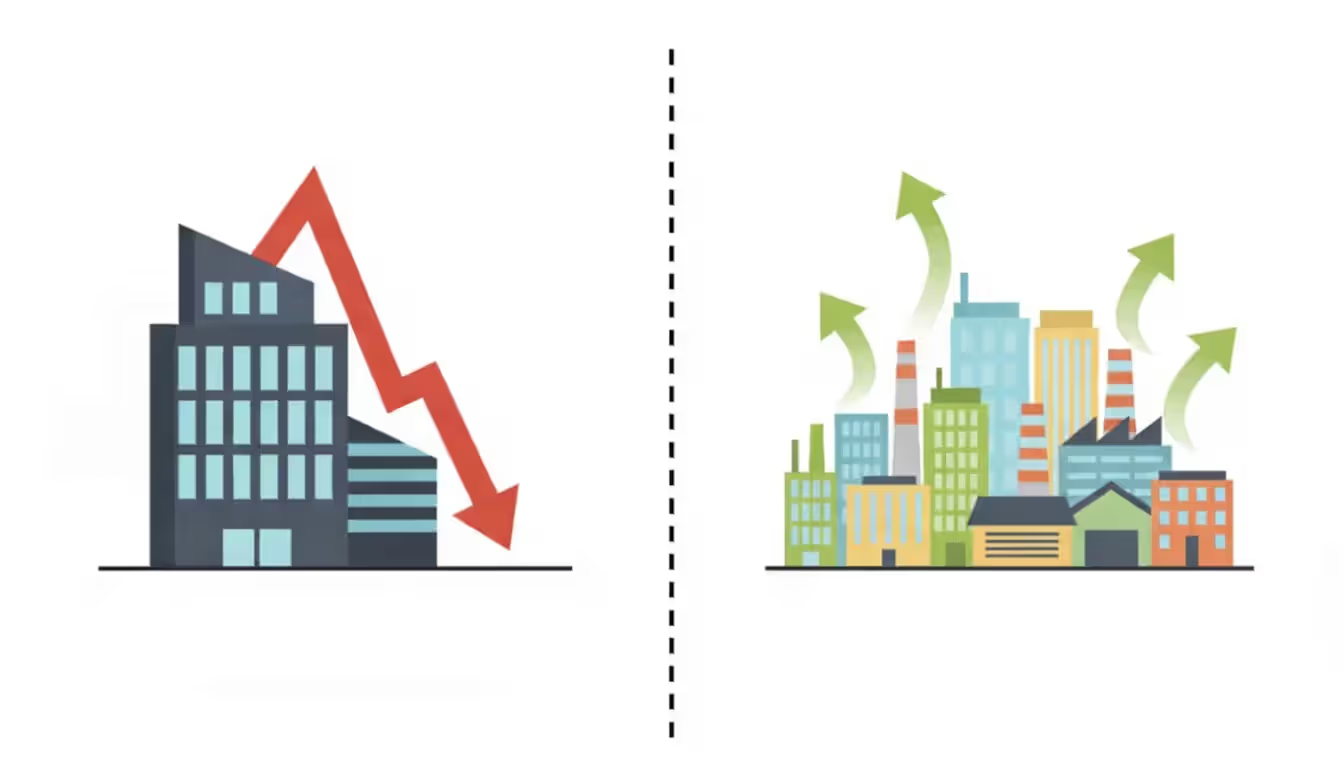
When you're putting together an investment portfolio, you'll run into two very different kinds of trouble. There's the stuff that tanks the whole market—think 2008 financial crisis—and then there's the bad news that hits just one company or sector while everything else keeps humming along.
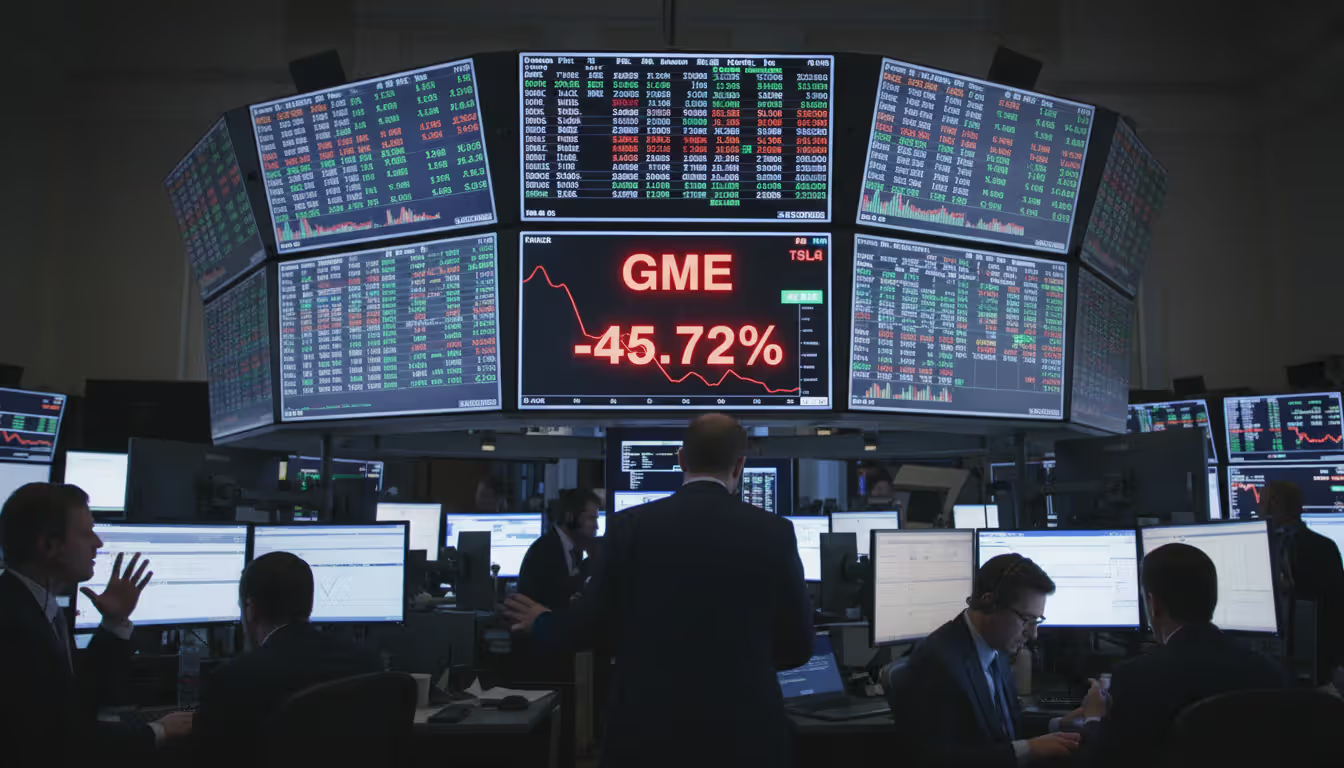
That second category? That's unsystematic risk. It's the danger lurking in individual stocks or specific assets, completely separate from what's happening across Wall Street. Picture Johnson & Johnson's 2021 talc powder litigation, or when Wells Fargo got hammered for fake accounts in 2016, or Tesla's wild swings based on Elon Musk's latest tweet. The broader market didn't care much about these dramas—they crushed specific companies while competitors sailed on unbothered.
Here's what catches most people off guard: they've loaded up on employer stock, maybe thrown some cash at three tech darlings they read about on Reddit, and bought a rental property in their hometown. Feels diversified, right? It's not. That's a portfolio one bad earnings report away from serious damage—the kind that hits whether the S&P 500 is up or down that year.
The good news? You can actually do something about this risk, which makes it fundamentally different from market-wide chaos.
Unsystematic Risk Definition and Core Characteristics
Unsystematic risk—sometimes called firm-specific risk or idiosyncratic risk—boils down to threats that target individual investments rather than your whole portfolio. When Chipotle dealt with E. coli outbreaks in 2015, their stock cratered 40%. McDonald's? Totally fine. That isolation defines the concept.
You can spot this risk by looking for three telltale signs:
It stays contained. Problems don't spread beyond the affected company or maybe its immediate competitors. When Volkswagen got caught cheating on emissions tests, Toyota owners didn't suddenly worry about their cars. The scandal remained Volkswagen's problem, even though both companies operate in the same industry.
You can diversify it away. Here's the crucial bit—add enough different investments and this risk essentially vanishes. That's not true for market-wide risks (we'll get to that distinction shortly). Research from the 1960s onward has proven you can mathematically reduce firm-specific danger to almost nothing.
Market conditions don't matter. Theranos collapsed during one of the longest bull markets in history. Conversely, plenty of well-run companies delivered solid returns during the 2022 bear market. Company-specific events follow their own timeline, disconnected from whether the Dow is setting records or testing lows.
In forex trading, idiosyncratic risk shows up differently. You might pick a broker that goes belly-up (remember when FXCM nearly imploded in 2015?), or you could concentrate everything in EUR/USD pairs, or maybe you're overleveraging individual trades. These dangers exist independent of currency market direction—your GBP/JPY position could be perfectly timed but still blow up if your broker can't execute the trade properly.
The firm-specific risk meaning becomes clearer with contrast: when inflation data comes in hot and the Fed responds by hiking rates, virtually every asset feels it. That's systematic. When a single pharmaceutical company's lead drug candidate fails Phase III trials, only that company's shareholders feel the pain. That's unsystematic.
Author: Olivia Kensington;
Source: martinskikulis.com
Systematic vs Unsystematic Risk
People mix these up constantly, but knowing the difference completely changes how you protect yourself. Systematic risk comes from big-picture forces—recessions, Federal Reserve decisions, wars, currency crises—that move most securities in the same direction simultaneously. Unsystematic risk originates inside companies: management screw-ups, operational failures, competitive losses, regulatory penalties.
Why does this matter? Because diversification works brilliantly against one but does basically nothing for the other.
Here's how they stack up across the dimensions that actually affect your money:
Feature
Systematic Risk
Unsystematic Risk
What it means
Economy-wide forces that move most investments together
BP oil spill (2010), Facebook's Cambridge Analytica scandal (2018), Silicon Valley Bank failure (2023)
How far it spreads
Touches entire markets or broad asset classes across borders
Stays confined to specific companies or narrow industry segments
Can diversification help?
No—adding more stocks won't save you from a bear market
Yes—spreading across 20-30 positions eliminates most of this risk
Your control level
You're stuck with it unless you exit markets or use complex hedges
You control it directly through smart position sizing and portfolio structure
Where it comes from
Central bank policy, GDP growth rates, geopolitical conflicts, inflation shocks
CEO departures, product recalls, earnings disappointments, fraud, patent losses
This framework should guide every portfolio decision you make. When you're adding that 25th stock to your holdings, you're not getting much additional protection against the next recession (that's systematic risk). But you're further reducing the chance that one company's accounting scandal wrecks your retirement plan (that's unsystematic risk).
The control factor matters most for practical investing. Nobody can diversify away a 30% bear market—it's hitting everyone who owns stocks. But you absolutely can make sure one corporate bankruptcy doesn't destroy your financial future. Professional investors embrace market risk as part of the game while ruthlessly eliminating pointless exposure to individual company disasters.
Common Examples of Unsystematic Risk
Let's look at actual company-specific disasters and what they teach us about firm-level risk.
Business and Industry-Specific Risks
Product catastrophes create immediate, isolated damage. Samsung's Galaxy Note 7 recall in 2016—remember phones literally catching fire?—cost them $5.3 billion and hammered their stock. Apple's iPhone sales that quarter? Just fine. The smartphone market kept growing; Samsung just stumbled while rivals capitalized.
Competitive disruption hits particular industries while leaving others untouched. Netflix's rise absolutely destroyed Blockbuster, gutted traditional cable providers like Comcast, and pressured movie theater chains. But utilities, healthcare providers, and industrials? They barely noticed. That's textbook unsystematic impact—devastating for specific businesses, invisible to unrelated sectors.
Supply chain vulnerabilities expose companies that rely too heavily on single sources. When a fire shut down a key Renesas Electronics chip plant in Japan in 2021, automakers using those specific chips halted production. Competitors with diversified suppliers maintained output. One factory fire, wildly different outcomes depending on your specific supply chain setup.
Management and Operational Risks
Leadership chaos creates company-specific turbulence. When WeWork's Adam Neumann spectacularly crashed the company's IPO plans in 2019 with erratic behavior and governance nightmares, the company's valuation plummeted from $47 billion to under $10 billion in weeks. Other co-working companies, commercial real estate, and tech stocks generally? They shrugged and moved on.
Internal scandals deliver isolated punishment. Boeing's 737 MAX crisis—two crashes killing 346 people, an 20-month grounding, $20+ billion in costs—crushed Boeing stock while Airbus gained market share and General Electric (which makes the engines) faced limited impact. The commercial aerospace market kept growing; Boeing simply lost ground to competitors.
Workplace issues affect individual employers unpredictably. When Activision Blizzard faced sexual harassment lawsuits and cultural problems in 2021, their stock suffered while EA and Take-Two remained stable. Bad corporate culture destroys value at specific companies without damaging competitors who treat employees better.
Financial and Regulatory Risks
Earnings misses trigger sharp drops that the broader market ignores. Target's May 2022 earnings report—where they warned about inventory glut and margin pressure—sent shares down 25% in a single day. The S&P 500 that day? Down less than 1%. One company's profit problem doesn't create market-wide panic.
Regulatory actions target specific firms ruthlessly. When the SEC charged Theranos with fraud in 2018, investors in that specific company lost everything. Other diagnostic labs, biotech firms, and healthcare stocks? Business as usual. Elizabeth Holmes went to prison; other CEOs kept running their companies.
Author: Olivia Kensington;
Source: martinskikulis.com
Litigation creates isolated disasters. Purdue Pharma's opioid liabilities drove the company into bankruptcy in 2019, destroying equity value. Johnson & Johnson faced billions in talc-related lawsuits. These massive legal bills hit specific defendants while competitors without similar exposure avoided the carnage.
Credit downgrades and bankruptcy represent extreme firm-specific risk. When Sears finally collapsed after years of decline, shareholders lost everything. Target, Walmart, and Amazon—competing retailers—didn't suffer meaningful damage. One company's failure to adapt to e-commerce destroyed only that company's equity value.
How Currency Positions Carry Unsystematic Risk
Forex traders often obsess over technical analysis and macroeconomic data while completely overlooking firm-specific risks embedded in their approach. Currency trading carries substantial unsystematic exposure through multiple channels.
Broker counterparty risk represents your biggest single point of failure. When the Swiss National Bank shocked markets in January 2015 by removing the EUR/CHF floor, several forex brokers instantly went insolvent. Traders using FXCM or Alpari UK faced catastrophic losses beyond their positions—their broker literally couldn't pay them. Meanwhile, traders with accounts at well-capitalized brokers like Interactive Brokers or Saxo Bank survived the chaos intact. Same market event, radically different outcomes based entirely on broker selection.
Currency pair concentration introduces risks unrelated to forex markets broadly. Let's say you trade exclusively EUR/USD—maybe 80% of your positions. You're massively exposed to European banking sector stability, ECB policy quirks, and U.S. political dysfunction in ways that someone trading AUD/JPY or USD/CAD simply isn't. When Italy's budget crisis flared in 2018, EUR traders got hammered while commodity currency pairs barely noticed.
Position sizing failures create self-inflicted firm-specific damage. A trader who dumps 50% of capital into one GBP/USD setup faces risks entirely separate from currency markets themselves—timing risk on that specific entry, overnight swap costs for that particular trade, slippage on that individual position. Proper position limits across multiple uncorrelated trades would eliminate this unnecessary concentration.
Technology and execution infrastructure affects different traders completely differently. Someone using a bargain-basement platform with spotty uptime faces disconnection risk, requote problems, and execution failures that don't touch traders paying for institutional-grade systems. When volatility spikes and you can't close a position because your platform crashed? That's pure firm-specific risk, totally unrelated to whether EUR/JPY is trending or ranging.
You reduce forex-specific unsystematic risk the same way equity investors do: spread your capital across brokers (for accounts over $50K), diversify across currency pairs with low correlation, limit individual trade size to 2-3% of capital maximum, and invest in reliable execution infrastructure. A trader with six uncorrelated currency positions split between two solid brokers faces dramatically less firm-specific risk than someone with their entire account in one broker on one EUR/USD position.
Author: Olivia Kensington;
Source: martinskikulis.com
How to Diversify Away Unsystematic Risk
The math behind diversification isn't complicated—unsystematic risk falls predictably as you add genuinely independent positions. Studies going back to the 1970s show that 20-30 stocks from different sectors knock out about 90% of firm-specific risk, though correlation patterns matter more than raw position count.
Portfolio Diversification Strategies
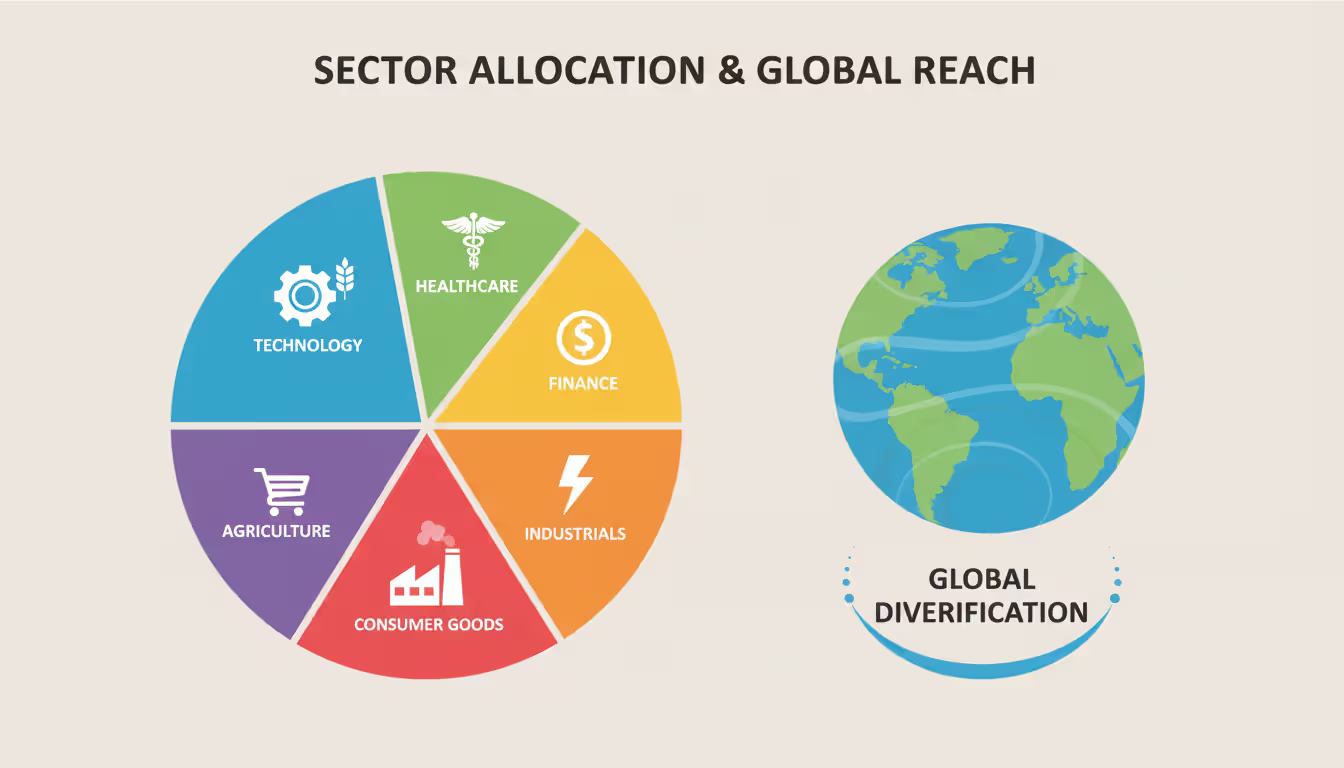
Real diversification demands actual independence between holdings, not just a long list of ticker symbols. Owning 40 stocks sounds great until you realize 35 of them are technology companies that all tank together when the NASDAQ corrects. Meanwhile, 18 carefully selected stocks across technology, healthcare, consumer staples, financials, energy, and industrials provides far better protection.
The magic word is correlation—how similarly different investments respond to events.
Position sizing discipline keeps any single holding from dominating your risk profile. Even with 30 stocks in your portfolio, allocating 35% to your absolute favorite idea reintroduces the exact firm-specific risk you're trying to eliminate. Most professional managers cap individual positions at 5% of portfolio value, maybe 7% for highest-conviction ideas. Equal-weighting works too, especially for smaller portfolios.
Rebalancing prevents drift from quietly wrecking your diversification. Let's say you bought Apple at $150 and it runs to $220 while other positions stayed flat. Suddenly Apple represents 12% of your portfolio instead of the 5% you intended. Congratulations—you've concentrated into one firm-specific risk. Trimming winners quarterly or when positions cross thresholds (like exceeding 7%) maintains your intended protection level.
Sector caps stop industry problems from becoming portfolio-wide disasters. Limiting any sector to 20% of holdings maximum ensures that sector-specific downturns—like when regional banks got crushed in March 2023—can't overwhelm your other positions. Anyone who worked in tech during the 2000-2002 crash and held mostly tech stocks learned this lesson the expensive way.
Asset Allocation Across Sectors and Geographies
Geographic spread extends firm-specific risk reduction beyond your home country. U.S. regulatory changes, domestic political dysfunction, or regional banking problems hit American companies harder than international holdings. When Silicon Valley Bank and Signature Bank failed in March 2023, European and Asian banks barely felt it.
Emerging markets bring their own firm-specific headaches—currency volatility, political risk, weaker corporate governance, less reliable financial reporting. But they provide genuine diversification from developed market problems. Most balanced portfolios benefit from 15-25% international exposure, split between developed markets (Europe, Japan, Australia) and emerging markets (China, India, Brazil).
Sector rotation strategies can accidentally reintroduce concentration risk. Investors who pile into energy during commodity booms (like 2021-2022) or load up on tech during innovation hype cycles sacrifice diversification for trend-chasing. Usually works brilliantly until sector-specific problems emerge—then the lack of diversification hurts badly.
Author: Olivia Kensington;
Source: martinskikulis.com
Reducing Specific Risk in Forex Trading
Currency traders eliminate unsystematic risk through pair diversification, timeframe variety, and strategy independence. Trading trending pairs (USD/JPY during Fed hiking cycles) alongside mean-reverting pairs (EUR/GBP with its historically stable relationship) provides strategy-level diversification that position count alone doesn't capture.
Watch correlation breakdowns. During normal markets, AUD/USD and NZD/USD might show 0.85 correlation—too similar for good diversification. But during the March 2020 COVID panic, correlations across most currency pairs briefly spiked above 0.95 as everything moved together. Traders monitoring rolling 30-day correlations can reduce position sizing when correlations surge temporarily.
Timeframe diversification protects against execution-specific risks. Mixing longer-term position trades (holding 2-4 weeks) with shorter-term tactical setups (1-3 days) ensures poor timing on one position doesn't determine your monthly P&L. Different holding periods face different firm-specific risks—overnight news events, rollover costs, execution slippage all vary by timeframe.
The relationship between diversification and risk reduction follows diminishing returns sharply. Your first five uncorrelated forex positions might reduce firm-specific risk by 65%. The next five add maybe another 20% reduction. Beyond 15-20 positions, you're splitting capital so thinly that position sizing itself creates new problems while barely reducing risk further.
Unsystematic Risk in Investment Portfolios
Theory meets reality when you actually build portfolios with real money. The goal isn't zero risk—that would mean zero returns too—but rather eliminating uncompensated firm-specific risks while maintaining exposure to systematic market risk that actually pays you for bearing it.
Measuring concentration risk quantifies your firm-specific exposure directly. Calculate what percentage your top 10 holdings represent. If it's above 50%, you're carrying substantial single-company risk regardless of total position count. Warren Buffett runs concentrated (his top 5 positions often exceed 70% of Berkshire's equity portfolio), but for mere mortals without his research team and multi-decade track record, keeping top-10 concentration under 40% makes more sense.
Risk budgeting frameworks allocate acceptable risk deliberately across categories. A sophisticated approach might be: "I'll accept all systematic equity market risk by maintaining 80% stock allocation, but I'll minimize unsystematic risk below 3% of total portfolio volatility through position limits and sector caps." This separates risks you're getting paid to take from unnecessary dangers you can eliminate.
Factor exposure reveals hidden concentration. Your portfolio might hold 35 stocks—looks diversified—until factor analysis shows 75% are high-momentum, low-profitability growth companies. You've made a massive concentrated bet on one investment style disguised as diversification. When growth stocks crashed in 2022, those "diversified" portfolios all tanked together.
Unsystematic risk matters most during company-specific disasters. When Enron collapsed in 2001, broadly diversified index investors lost maybe 0.02% of portfolio value—basically a rounding error. Enron employees with retirement savings concentrated in company stock? They lost everything—retirement savings, jobs, and pensions simultaneously. This catastrophic asymmetry between diversified and concentrated outcomes explains why eliminating firm-specific risk matters so much for regular investors.
Diversification has limits worth acknowledging upfront. You cannot diversify your way out of bear markets. During March 2020's COVID crash, correlations spiked and nearly everything fell simultaneously. Diversification reduces how often you suffer severe losses and prevents single-position blowups, but it won't save you when systematic risk takes over.
When firm-specific risk matters most: Early career, when your human capital (future earnings potential) dwarfs your investment portfolio, concentrated bets in your employer's stock or industry create dangerous correlation between your job security and investment returns. As wealth grows, you gain capacity to take on some firm-specific risk for potentially higher returns—though complete elimination still makes sense for core retirement assets.
Index funds solve the problem automatically. An S&P 500 fund holds 500 stocks across every major sector, essentially eliminating unsystematic risk through breadth alone. Total market funds extend this further, owning 3,000+ positions. This explains index investing's popularity—it solves firm-specific risk efficiently at 0.03% annual fees.
Diversification is the only free lunch in investing. By spreading investments across many different assets, investors can reduce risk without necessarily reducing expected returns—something that's impossible through any other means
— Harry Markowitz
FAQ
Can you completely eliminate unsystematic risk?
For practical purposes, yes—you can reduce firm-specific risk to negligible levels through adequate diversification. Academic research consistently demonstrates that 20-30 stocks from different sectors eliminate roughly 90-95% of company-specific danger. Index funds holding hundreds or thousands of positions essentially remove it entirely. Getting to perfect mathematical zero requires infinite diversification (impossible), but you don't need perfect. The remaining 5-10% after proper diversification represents acceptable residual risk that won't materially affect your long-term wealth accumulation.
How many stocks do you need to eliminate unsystematic risk?
Studies from the 1960s through today consistently land on 20-30 stocks for about 90% elimination of firm-specific risk. Beyond 30 holdings, additional risk reduction becomes marginal—you're splitting capital increasingly thin for minimal benefit. However, those numbers assume genuine diversity across sectors and industries. Thirty semiconductor stocks won't cut it. Thirty stocks spanning technology, healthcare, consumer goods, financials, industrials, and energy? That works. For hands-on investors, 15-25 well-selected stocks across varied sectors provides sufficient protection. Index funds shortcut the whole problem by holding hundreds of positions automatically.
Does diversification work against all risk types?
No—and this misconception causes serious portfolio damage. Diversification only reduces unsystematic (company-specific) risk effectively. Systematic risk from macroeconomic forces, recessions, interest rate shocks, or geopolitical crises affects nearly all securities simultaneously and can't be diversified away. This explains why even perfectly diversified portfolios fell 30-40% in March 2020 or during the 2008 financial crisis. You must accept systematic risk as the price of market participation, or hedge it through derivatives, alternative assets, or cash positions—all strategies with their own costs and complications.
What's idiosyncratic risk in trading contexts?
Idiosyncratic risk is just another term for unsystematic or firm-specific risk, emphasizing price movements unique to individual securities rather than market-wide forces. In trading, it includes poor execution quality, broker-specific counterparty problems, position sizing mistakes, and concentration in particular assets or strategies. A day trader focused exclusively on Tesla stock faces massive idiosyncratic risk from Elon Musk's unpredictable behavior—completely unrelated to whether the S&P 500 rises or falls that day. Reducing it requires spreading across multiple positions, varying timeframes, diversifying strategies, and avoiding overconcentration in any single trade or asset.
How does unsystematic risk affect your returns?
According to modern portfolio theory (and decades of supporting evidence), markets don't compensate investors for bearing unsystematic risk since it can be eliminated through diversification. Only systematic market risk earns a risk premium over time. Translation: holding concentrated positions doesn't boost your expected returns—it just increases volatility and the probability of catastrophic losses without additional compensation. A portfolio of 25 diverse stocks should deliver similar long-term returns to a single-stock gamble, but with dramatically lower volatility and drawdown risk. Concentration might produce higher returns in lucky scenarios (you picked Amazon in 2001), but delivers worse risk-adjusted performance across many trials.
Is company bankruptcy systematic or unsystematic risk?
Individual company bankruptcies represent pure unsystematic risk in most circumstances. Firms fail due to poor management, competitive pressure, operational mistakes, or financial mismanagement—factors specific to that company. When Bed Bath & Beyond declared bankruptcy in 2023, Target and Walmart continued thriving, demonstrating the isolated nature. However, during economic crises when bankruptcies cluster (2008-2009, or early 2020), they partially reflect underlying systematic risk factors affecting many companies simultaneously. For individual investors, proper diversification ensures any single bankruptcy causes minimal portfolio damage—typically under 1% loss if you follow prudent position sizing guidelines.
Unsystematic risk is the investment danger you actually control through smart portfolio construction. Unlike economy-wide systematic risks that every investor must accept or hedge expensively, firm-specific risks from company failures, management mistakes, or operational disasters can be reduced to almost nothing through simple diversification across 20-30 genuinely independent positions.
The practical takeaway should reshape your portfolio thinking immediately. Concentrated positions in employer stock, a handful of favorite companies you've researched obsessively, or single-sector bets expose you to uncompensated risks that diversification eliminates without sacrificing expected returns. Whether you're building an individual stock portfolio across multiple sectors, investing in broad index funds, or trading several uncorrelated currency pairs, the core principle stays constant: spreading investments across truly independent positions protects wealth from isolated failures.
Understanding the systematic versus unsystematic risk distinction clarifies which protective strategies actually work versus which are expensive placebos. Diversification powerfully reduces company-specific dangers but offers zero protection against bear markets or recessions—risks you must either embrace as part of long-term investing or hedge through sophisticated strategies with their own costs. For most investors, eliminating unsystematic risk through straightforward diversification while accepting systematic market risk as the price of equity returns represents the optimal path to portfolio construction and long-term wealth building.
Markets don't just move—they accelerate, decelerate, and shift gears. Volatility risk is the danger that unexpected changes in price swing intensity will damage your positions. Unlike directional risk, it strikes when market pace changes, hurting options traders, currency speculators, and leveraged investors alike
Volatility clustering describes how large price changes tend to follow large changes, and calm periods extend—one of the most consistent patterns in financial markets. Understanding this phenomenon transforms risk management and trading strategy across forex, equities, and other assets
Systematic risk affects entire markets simultaneously—no diversification can eliminate it. Through concrete examples from interest rate changes to geopolitical events, understand how market-wide forces impact portfolios and learn practical measurement and management strategies using beta and asset allocation
Settlement risk arises when one party in a financial transaction delivers cash or securities but the counterparty fails before reciprocating. This guide explains how settlement risk occurs in forex markets, the 1974 Herstatt collapse, and modern mitigation tools like CLS Bank and payment-versus-payment systems
The content on this website is provided for general informational and educational purposes only. It is intended to explain concepts related to Forex (FX) trading, currency markets, leverage, hedging, and risk management.
All information on this website, including articles, guides, and examples, is presented for general educational purposes. Forex trading carries significant risk, and outcomes may vary depending on market conditions, leverage, and individual decisions.
This website does not provide financial, investment, or trading advice, and the information presented should not be used as a substitute for consultation with qualified financial professionals.
The website and its authors are not responsible for any errors or omissions, or for any outcomes resulting from decisions made based on the information provided on this website.