Welcome to the Forex & FX Trading Knowledge Hub, a place where traders, investors, and finance enthusiasts can explore the principles of currency markets and Forex trading. Understanding FX markets is essential for managing risk, optimizing trading strategies, and participating in global financial markets.
This website focuses on explaining Forex trading in a clear and practical way. Many people encounter unfamiliar concepts when learning about currency pairs, pips, spreads, leverage, trading sessions, and market sentiment. The goal of this resource is to make these topics easier to understand by providing straightforward explanations of how FX markets work and how different trading strategies are commonly applied.
Throughout the site, readers can explore topics related to major and commodity currency pairs, FX options, futures, and forward contracts. The content also covers volatility, correlation, market sentiment, interest rate hedging, and risk management. In addition, the site explores practical strategies for day trading, algorithmic trading, spread betting, and managing both systematic and unsystematic risk in Forex.
The forex market processes $7.5+ trillion daily, yet a handful of pairs dominate volume. Learn which currency pairs traders prefer, why EUR/USD captures 24% of global transactions, and how liquidity, spreads, and volatility shape pair selection for different trading strategies
Slippage erodes profits faster than most traders realize. A few pips here and there might seem trivial, but over hundreds of trades, the cumulative effect can transform a winning strategy into a breakeven proposition. Discover proven methods to minimize execution costs and protect your edge
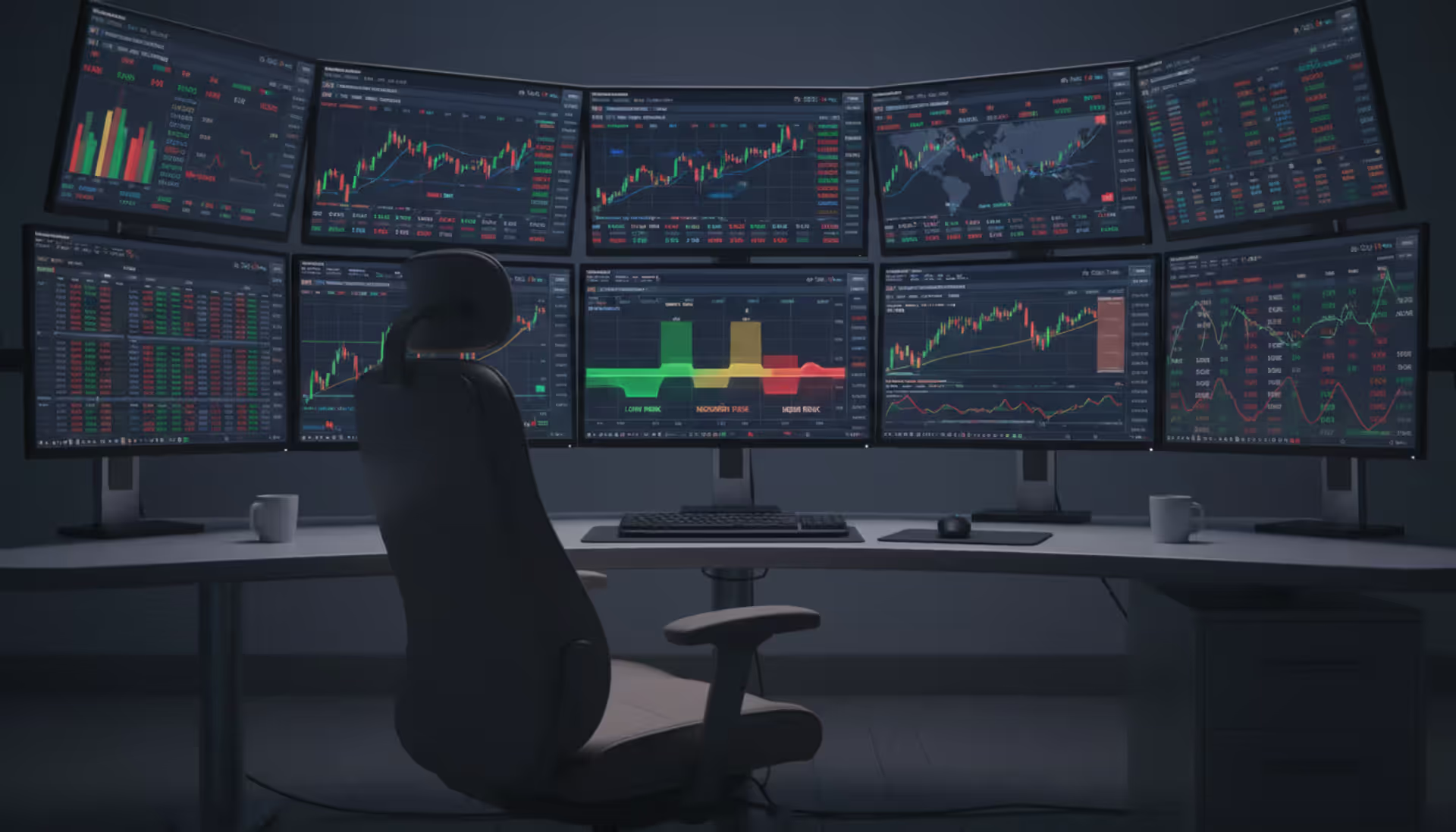
Risk meters help traders quantify market uncertainty by combining volatility measures, sentiment data, and technical indicators into actionable signals. This comprehensive guide explains how these tools work, compares popular risk indicators like the VIX, and shows you how to interpret risk-on vs risk-off conditions
Volatility determines profit potential and risk in forex trading. Some currency pairs swing hundreds of pips daily while others barely move. This guide examines which pairs exhibit the highest price fluctuations, why certain currencies are more volatile, and how to trade them effectively with proper risk management
Spread betting lets you speculate on market moves without owning the asset. This guide walks through real examples—long and short positions, forex pairs, margin calculations—showing exactly how profits and losses accumulate, how to size stakes responsibly, and what happens when trades go wrong
Learn how reward to risk ratio determines trading success. Discover calculation methods, ideal ratios for different trading styles, the mathematical relationship with win rates, and how to set profit targets that align with market structure while protecting your capital
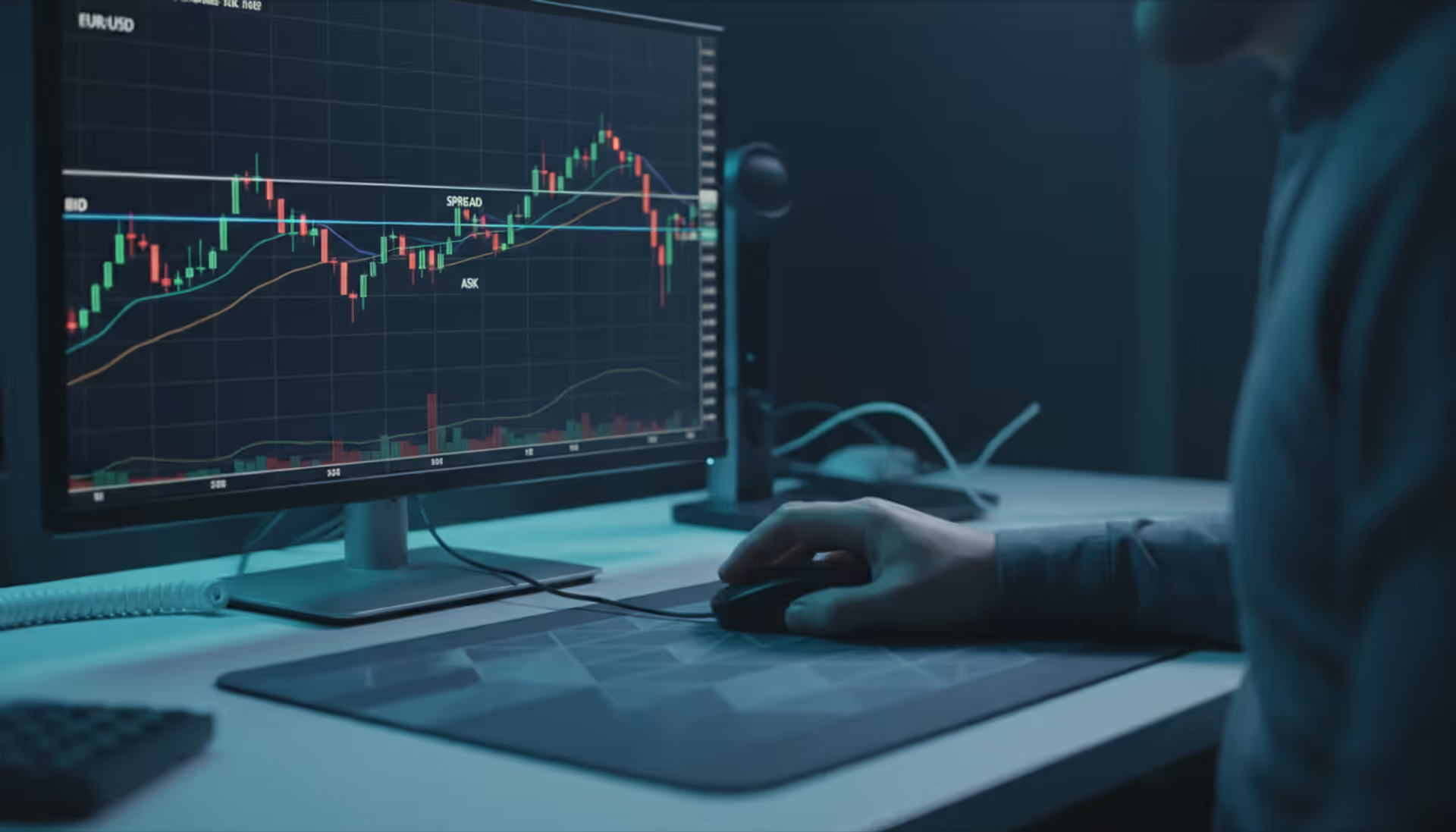
The spread is the difference between bid and ask prices in forex trading—your cost to enter every position. Understanding how spreads work, when they widen, and how to minimize these costs can dramatically improve your trading profitability over time
Currency markets shift rapidly, and a solid dollar projection can unravel when central bank rhetoric changes. This guide unpacks the mechanics behind dollar forecasting—from index construction to geopolitical factors—helping investors understand what drives USD strength and where conventional forecasts fail.
The Asian forex session operates 6:00 PM-3:00 AM EST with distinct low-volatility, range-bound characteristics. Tokyo and Sydney markets drive USD/JPY, AUD/USD, and NZD/USD activity while EUR/USD stagnates. Successful trading requires range strategies, not trend-following approaches that work during European hours
Interest rate movements can transform profitable loans into financial burdens overnight. Companies with floating-rate debt and bond investors face the same challenge: protecting against adverse rate shifts without sacrificing upside. This guide explains hedging instruments, duration strategies, and how to match protection to your specific exposure
Predicting euro-dollar movements challenges even sophisticated models. Understand forecast methodologies, the role of interest rate differentials and central bank policy, technical vs fundamental approaches, accuracy by timeframe, and how to apply predictions to real decisions
The foreign exchange market represents the largest and most liquid financial marketplace on the planet, where currencies are traded around the clock across global financial centers. This comprehensive guide explains what forex trading is, how the market functions, who participates, and essential basics for beginners
Risk meters help traders quantify market uncertainty by combining volatility measures, sentiment data, and technical indicators into actionable signals. This comprehensive guide explains how these tools work, compares popular risk indicators like the VIX, and shows you how to interpret risk-on vs risk-off conditions
Currency symbols and codes serve different purposes in global finance. Symbols like $ and € provide visual shorthand for everyday commerce, while ISO 4217 codes like USD and EUR ensure precision in banking and international trade. Understanding both systems matters for anyone handling cross-border transactions
Interest rate arbitrage exploits interest differentials between countries to generate profit. This comprehensive guide explains covered and uncovered strategies, carry trades, why covered arbitrage is considered risk-free, and the real-world constraints that limit arbitrage opportunities in modern currency markets
The foreign exchange market represents the largest and most liquid financial marketplace on the planet, where currencies are traded around the clock across global financial centers. This comprehensive guide explains what forex trading is, how the market functions, who participates, and essential basics for beginners
Unsystematic risk represents investment uncertainty tied to specific companies or assets rather than broad market forces. Unlike systematic risks affecting all securities, firm-specific risks can be substantially reduced through proper diversification across 20-30 uncorrelated positions
Forex correlation reveals how currency pairs move in relation to each other, helping traders avoid hidden risks and identify hedging opportunities. Understanding correlation coefficients, commodity relationships, and how to apply correlation analysis transforms position sizing and portfolio management for better trading outcomes
When you trade spread betting, you're making directional bets on market prices—but here's the twist: you never actually own anything. Not stocks, not commodities, not currencies. Instead, you're entering into a contract with a broker where you stake a certain dollar amount per point that a market moves.
Think of it this way: if you bet $5 per point that the S&P 500 will climb, and it jumps 50 points, you pocket $250. If it drops 50 points instead? You're down $250. Your returns scale directly with how right (or wrong) you are.
trading style took root in Britain during the 1970s as a way for everyday people to access financial markets without the hefty capital requirements of traditional investing. Since then, it's evolved into a sophisticated tool that professional traders deploy across everything from currency pairs to commodity futures. The mechanics share DNA with CFDs, but several key differences set spread betting apart—particularly around how positions are structured and what markets you can access.
Picture this: you open a trading platform and see gold quoted at two prices—$2,050 to sell, $2,052 to buy. That $2 gap? That's the spread, and it represents how your broker gets paid. When you place a financial spread bet, you're picking one of those prices based on which way you think the market will move, then choosing how much money you want to risk per point of movement.
Here's what makes spread betting in finance fundamentally dif...
The content on this website is provided for general informational and educational purposes only. It is intended to explain concepts related to Forex (FX) trading, currency markets, leverage, hedging, and risk management.
All information on this website, including articles, guides, and examples, is presented for general educational purposes. Forex trading carries significant risk, and outcomes may vary depending on market conditions, leverage, and individual decisions.
This website does not provide financial, investment, or trading advice, and the information presented should not be used as a substitute for consultation with qualified financial professionals.
The website and its authors are not responsible for any errors or omissions, or for any outcomes resulting from decisions made based on the information provided on this website.